
Doris Schattschneider
Author of M.C. Escher Kaleidocycles
About the Author
Doris Schattschneider received her Ph.D. in mathematics from Yale University and taught at Moravian College in Bethlehem, Pennsylvania for thirty-four years. Douglas R. Hofstadter trained in mathematics and physics, Hofstadter is Professor of Computer Science and Cognitive Science at Indiana show more University, and in addition does work in comparative literature, art, music, and other fields. show less
Works by Doris Schattschneider
Associated Works
Science and the Arts — Contributor — 2 copies
Tagged
Common Knowledge
- Birthdate
- 1939-10-19
- Gender
- female
- Education
- University of Rochester (AB | Mathematics)
Yale University (PhD | Mathematics | 1966) - Occupations
- professor (Mathematics and Computer Science | Moravian College | 1968- )
editor (Mathematics Magazine | 1981-1985) - Awards and honors
- Carl B. Allendoerfer Award (1979)
- Nationality
- USA
- Places of residence
- Staten Island, New York, USA (birth)
- Associated Place (for map)
- New York, USA
Members
Reviews
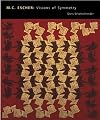
Oh wow, hundreds of drawings by the Dutchman (1898-1972) many mathematicians and computer scientists would consider the greatest artist who ever lived. There's extensive how-he-did-it discussion, but it's a treat just to leaf through the color-packed pages of this large-format tome.
M.C. Escher Kaleidocycles, 17 models of Escher's graphics and the story of how they were devised by Doris Schattschneider

Fascinating and unique book. Large format, with two column text and numerous black and white illustrations. The nets for the models in the back are all in color. The text is fairly mathematical and not directed to children.
Detailed notes:
Part I: In Three Dimensions: Extensions of M.C. Escher's Art
Chapter 1: The Geometric Solids
Platonic and Archimedean solids. Special focus on the dodecahedron and the cuboctahedron. The kaleidocycle, a ring of joined tetrahedra, in introduced. The IsoAxis is show more explained, but for some reason we don't get a net for that, perhaps because it is trademarked. I should make one for myself. The author, a mathematician, chose to study the possible objects that could be constructed by modifications to the IsoAxis net. Modifying the net so that the triangles are equilateral, rather than right-angled isosceles yields the pattern of the hexagonal kaleidocycles in the book. A slightly less extreme modification, and 8 instead of six tetrahedra yields the square kaleidocycle. At the time the author was studying the variations of the IsoAxis she was also studying the mathematics of repeating patterns. It occurred to her that these things could be combined.
Chapter 2: The Repeating Designs
Discussions of repeating designs. Translation, rotation, reflection. We call the study of all these things transformation geometry. Essentially, you can think of Escher repeating designs as unusually shaped interlocking tiles.
Chapter 3: Decorating the Solids
The platonic solids only have three types of faces: triangle, square, pentagon. It is possible to tile the plane w/ triangles and squares, but this does not entirely solve the problem of tiling the solids with those faces, as the patterns do not match up in the same way. The cubeoctahedron has both square and triangular faces, however Escher's "Circle Limit III" gives an example of a tiling on a hyperbolic surface with squares and triangles, so that gave the author a good start. It is not possible to tile the plane w/ pentagons.
Part II: Notes on the Models
Chapter 1: The tetrahedron
This one was super easy because the reptile design that was chosen had six-fold rotational symmetry. Thus no alteration had to be made in the pattern to make sure that it was not disrupted when wrapped around the tetrahedron.
Chapter 2: The octahedron
This one uses Escher's "Three Elements" and seems like it must have been remarkably straightforward to construct. show less
Detailed notes:
Part I: In Three Dimensions: Extensions of M.C. Escher's Art
Chapter 1: The Geometric Solids
Platonic and Archimedean solids. Special focus on the dodecahedron and the cuboctahedron. The kaleidocycle, a ring of joined tetrahedra, in introduced. The IsoAxis is show more explained, but for some reason we don't get a net for that, perhaps because it is trademarked. I should make one for myself. The author, a mathematician, chose to study the possible objects that could be constructed by modifications to the IsoAxis net. Modifying the net so that the triangles are equilateral, rather than right-angled isosceles yields the pattern of the hexagonal kaleidocycles in the book. A slightly less extreme modification, and 8 instead of six tetrahedra yields the square kaleidocycle. At the time the author was studying the variations of the IsoAxis she was also studying the mathematics of repeating patterns. It occurred to her that these things could be combined.
Chapter 2: The Repeating Designs
Discussions of repeating designs. Translation, rotation, reflection. We call the study of all these things transformation geometry. Essentially, you can think of Escher repeating designs as unusually shaped interlocking tiles.
Chapter 3: Decorating the Solids
The platonic solids only have three types of faces: triangle, square, pentagon. It is possible to tile the plane w/ triangles and squares, but this does not entirely solve the problem of tiling the solids with those faces, as the patterns do not match up in the same way. The cubeoctahedron has both square and triangular faces, however Escher's "Circle Limit III" gives an example of a tiling on a hyperbolic surface with squares and triangles, so that gave the author a good start. It is not possible to tile the plane w/ pentagons.
Part II: Notes on the Models
Chapter 1: The tetrahedron
This one was super easy because the reptile design that was chosen had six-fold rotational symmetry. Thus no alteration had to be made in the pattern to make sure that it was not disrupted when wrapped around the tetrahedron.
Chapter 2: The octahedron
This one uses Escher's "Three Elements" and seems like it must have been remarkably straightforward to construct. show less
This book is a do-it-yourself craft collection. A booklet about Escher's designs is accompanied by 17 sheets of printed card for making paper models. Escher designs are printed on the card stock, with instructions for folding them into 3-dimensional sculptures. The cardboard models can be folded into tetrahedrons, octahedrons, icosahedrons, cubes, dodecahedrons, and kaleidocycles which are like a long complex chain that can be connected into a circle.
Very cool for mathematicians, puzzle show more fans and students to play with. show less
Very cool for mathematicians, puzzle show more fans and students to play with. show less

Kaleidocycles (Kalos=beautiful endos = figure kyklos = circle
17 paper patterns ready to assemble into three-dimensional polyhedra adorned with the dynamically repeating patterns of M.C. Escher, and a Booklet that tells their story.
17 paper patterns ready to assemble into three-dimensional polyhedra adorned with the dynamically repeating patterns of M.C. Escher, and a Booklet that tells their story.
Lists
You May Also Like


Associated Authors
Statistics
- Works
- 6
- Also by
- 1
- Members
- 693
- Popularity
- #36,520
- Rating
- 4.1
- Reviews
- 9
- ISBNs
- 31
- Languages
- 8
- Favorited
- 1