
Bruno Ernst (1926–2021)
Author of The Magic Mirror of M. C. Escher
About the Author
Disambiguation Notice:
Hans de Rijk wrote under the pseudonyms "Bruno Ernst" (on mathematics and sciences, including impossible figures), "Ben Elshout" (on photography and film) and "Ben Engelhart" (on scripts and graphology). Please don't separate these names.
Image credit: Bruno Ernst/Hans de Rijk
Works by Bruno Ernst
Naar beter handschrift 4 copies
Snel werken met de rekenliniaal 2 copies
Inleiding tot de Calligrafie. Met Medewerking van T.Gourdie, H.Zapf, Martin Hermsdorf, E.Kuhn & C.Brand. (1966) 2 copies
Thieme's sterrenfotoboek 1 copy
Dossier 1 copy
Associated Works
M.C. Escher : his life and complete graphic work ; with a fully illustrated catalogue (1981) — Contributor — 653 copies, 6 reviews
Archimedes 25(1989)4 — Contributor, some editions — 1 copy
Tagged
Common Knowledge
- Canonical name
- Ernst, Bruno
- Legal name
- Rijk, Joannes Adrianus Friedrich de (Hans)
- Other names
- Engelhart, Ben
Ernst, Bruno
Elshout, Ben
Rijk, Hans de - Birthdate
- 1926-02-19
- Date of death
- 2021-11-23
- Gender
- male
- Education
- Instituut Saint-Louis, Oudenbosch
- Occupations
- physicist
teacher - Organizations
- Volkssterrenwacht Simon Stevin te Oudenbosch (Founder)
Mercator (Founder)
Archimedes (Founder)
Pythagoras (Founder | 1961)
Ars et Mathesis (co-founder | 1983) - Awards and honors
- Eurekaprijs (van NWO voor het beste oeuvre op het gebied van wetenschapscommunicatie 2008)
Officier in de Orde van Oranje-Nassau(2008) - Relationships
- Escher, M.C. (Vriend)
- Short biography
- His slogan is: Nescius omnium curiosum (I know nothing and am curious about everything)
- Nationality
- Netherlands
- Birthplace
- Rotterdam, Netherlands
- Places of residence
- Rotterdam, Netherlands
Utrecht, Netherlands - Place of death
- Utrecht, Netherlands
- Disambiguation notice
- Hans de Rijk wrote under the pseudonyms "Bruno Ernst" (on mathematics and sciences, including impossible figures), "Ben Elshout" (on photography and film) and "Ben Engelhart" (on scripts and graphology). Please don't separate these names.
- Associated Place (for map)
- Utrecht, Netherlands
Members
Reviews
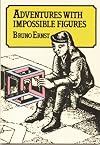
Fine book, well illustrated. Discusses different kinds of impossible figures, what visual cues conflict to induce the impossibility, how to recognize a truly impossible figure, etc. Uses M. C. Escher's painting as examples of the occurrence of particular well-categorized kinds of impossible figures. Offers plans for models that, viewed from certain angles, appear to be impossible figures. Rather short, at just under 100 pages, but that is part of its appeal.
A version put out by another show more publisher, Taschen, is a bit better than the one published by Tarquin. It is in a larger format, and contains many color illustrations and photographs which are shown only in black and white in the Tarquin version. The color photographs of models of impossible figures are somehow much more convincing than the black and white versions. show less
A version put out by another show more publisher, Taschen, is a bit better than the one published by Tarquin. It is in a larger format, and contains many color illustrations and photographs which are shown only in black and white in the Tarquin version. The color photographs of models of impossible figures are somehow much more convincing than the black and white versions. show less
M.C. Escher is one of my FAVORITE artists i love his work to death. this book isn't the best because i wanted something with a little more graphics, but that still doesn't beat the fact that its about his work.
“A woman once rang me up and said, ‘Mr. Escher, I am absolutely crazy about your work. In your print Reptiles you have given such a striking illustration of reincarnation.’ I replied, ‘Madame, if that’s the way you see it, so be it.’” An engagingly sly comment by the renowned Dutch graphic artist Maurits Cornelis Escher (1898–1972)―the complex ambiguities of whose work leave hasty or single-minded interpretations far behind. Long before the first computer-generated 3-D show more images were thrilling the public, Escher was a master of the third dimension. His lithograph Magic Mirror dates as far back as 1946. In taking that title for this book, mathematician Bruno Ernst is stressing the magic spell Escher’s work invariably casts on those who see it. Ernst visited Escher every week for a year, systematically talking through his entire œuvre with him. Their discussions resulted in a friendship that gave Ernst intimate access to the life and conceptual world of Escher. Ernst’s account was meticulously scrutinized and made accurate by the artist himself.
Escher’s work refuses to be pigeonholed. Scientific, psychological, or aesthetic criteria alone cannot do it justice. The questions remain. Why did he create the pictures? How did he construct them? What preliminary studies were necessary before achieving the final version? And how are the various images Escher created interrelated? This book, complete with biographical data, 250 illustrations, and explications of mathematical problems, offers answers to these and many other questions, and is an authentic source text of the first order. show less
Escher’s work refuses to be pigeonholed. Scientific, psychological, or aesthetic criteria alone cannot do it justice. The questions remain. Why did he create the pictures? How did he construct them? What preliminary studies were necessary before achieving the final version? And how are the various images Escher created interrelated? This book, complete with biographical data, 250 illustrations, and explications of mathematical problems, offers answers to these and many other questions, and is an authentic source text of the first order. show less
Lists
You May Also Like


Associated Authors
Statistics
- Works
- 29
- Also by
- 2
- Members
- 1,701
- Popularity
- #15,087
- Rating
- 4.1
- Reviews
- 6
- ISBNs
- 97
- Languages
- 11
