
Juhea Kim
Author of Beasts of a Little Land
Works by Juhea Kim
Associated Works
Dispatches from Anarres: Tales in Tribute to Ursula K. Le Guin (2021) — Contributor — 44 copies, 1 review
Tagged
Common Knowledge
- Gender
- female
- Nationality
- Korea (birth)
USA
Members
Reviews
Rating: 5* of five
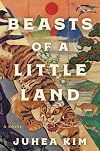
The Publisher Says: An epic story of love, war, and redemption set against the backdrop of the Korean independence movement, following the intertwined fates of a young girl sold to a courtesan school and the penniless son of a hunter
In 1917, deep in the snowy mountains of occupied Korea, an impoverished local hunter on the brink of starvation saves a young Japanese officer from an attacking tiger. In an instant, their fates are connected—and from this encounter unfolds a show more saga that spans half a century.
In the aftermath, a young girl named Jade is sold by her family to Miss Silver’s courtesan school, an act of desperation that will cement her place in the lowest social status. When she befriends an orphan boy named JungHo, who scrapes together a living begging on the streets of Seoul, they form a deep friendship. As they come of age, JungHo is swept up in the revolutionary fight for independence, and Jade becomes a sought-after performer with a new romantic prospect of noble birth. Soon Jade must decide whether she will risk everything for the one who would do the same for her.
From the perfumed chambers of a courtesan school in Pyongyang to the glamorous cafes of a modernizing Seoul and the boreal forests of Manchuria, where battles rage, Juhea Kim’s unforgettable characters forge their own destinies as they wager their nation’s. Immersive and elegant, Beasts of a Little Land unveils a world where friends become enemies, enemies become saviors, heroes are persecuted, and beasts take many shapes.
I RECEIVED A DRC FROM THE PUBLISHER VIA NETGALLEY. THANK YOU.
My Review: Starting an historical novel with a hunting scene is pretty much a statement of intent: We're heading into conflict! There's nothing about this going to be smooth and easy!
It isn't, for the characters at least. The value of self to family, to society; the value of individuation, personal or political; the value of loyalty, fidelity, honor: All strands in this novel's braid. What keeps these weighty themes from becoming burdensome to follow is the resonant writing.
This is, in my reading ear, the musing of a smart man on an immutable truth that does not ever appear the same way from person to person preceiving it; and, in his musing, retaining that awareness. I rang like a bell to this soft hammer striking me.
Current event make this read all the more trenchant. The world has never lacked people or peoples hard done by, consigned to lesser states of being than is their natural right by some standard or quality invented, "discovered," or detected without evidence of its relevance or importance. This passage in history, well, if I really need to spell it out for you I don't want to. This novel has a thriving culture that is suddenly deemed inferior, much to their mass outraged disbelief; this invented inferiority excuses a colonial oppression that has as its purpose eradicating a people's soul to be replaced with their oppressors' vision of perfect slaves.
And that, I expect you already know, is a hateful, criminal enterprise with many, many collaborators inside the edifice being created, as well as...much more terribly...many times more outside. When the day arrives that the false and ill-fitting, ramshackle and improvised, structure collapses, things break and shatter and split and buckle in random-seeming shapes without patterns. Lives and loves and entire branches of family history jumble in lethal chaos, not every death physical.
It might be the psychological ones that cause the most suffering.
What Juhea Kim has done for us is map that chaos onto one family of highly effective people who still can't save their lives, their loves, their lands without unthinkable suffering rippling out from the Korean nation's convulsive death-agonies, its multiplicity of death-agonies, and find in that chaos the undetected in the time of crisis pattern that supports random bits of the past just enough to provide the seeds for pearls to come, yet to come.
In 2024, this rread, beautiful for and in itself, means so much more than it did when it came out in 2021. It can speak its truth of betrayal and cruelty into a landscape more like itself; more like the one that needs to hear that truth said without rage or outrage or plangent pleading blame-shoving. I'd love for everyone I know, everyone I can reach, to at the least try this lovely flower's powerful fruit.
Please. show less
The Publisher Says: An epic story of love, war, and redemption set against the backdrop of the Korean independence movement, following the intertwined fates of a young girl sold to a courtesan school and the penniless son of a hunter
In 1917, deep in the snowy mountains of occupied Korea, an impoverished local hunter on the brink of starvation saves a young Japanese officer from an attacking tiger. In an instant, their fates are connected—and from this encounter unfolds a show more saga that spans half a century.
In the aftermath, a young girl named Jade is sold by her family to Miss Silver’s courtesan school, an act of desperation that will cement her place in the lowest social status. When she befriends an orphan boy named JungHo, who scrapes together a living begging on the streets of Seoul, they form a deep friendship. As they come of age, JungHo is swept up in the revolutionary fight for independence, and Jade becomes a sought-after performer with a new romantic prospect of noble birth. Soon Jade must decide whether she will risk everything for the one who would do the same for her.
From the perfumed chambers of a courtesan school in Pyongyang to the glamorous cafes of a modernizing Seoul and the boreal forests of Manchuria, where battles rage, Juhea Kim’s unforgettable characters forge their own destinies as they wager their nation’s. Immersive and elegant, Beasts of a Little Land unveils a world where friends become enemies, enemies become saviors, heroes are persecuted, and beasts take many shapes.
I RECEIVED A DRC FROM THE PUBLISHER VIA NETGALLEY. THANK YOU.
My Review: Starting an historical novel with a hunting scene is pretty much a statement of intent: We're heading into conflict! There's nothing about this going to be smooth and easy!
It isn't, for the characters at least. The value of self to family, to society; the value of individuation, personal or political; the value of loyalty, fidelity, honor: All strands in this novel's braid. What keeps these weighty themes from becoming burdensome to follow is the resonant writing.
It appeared to him that no matter how much he gave, he would always have more than enough. As he grew older, he even relished the struggles brought on by his sacrifices. There was a soaring awareness that illuminated his soul whenever he did the right thing, which also cost him something. This euphoria, however, was balanced by the utter terror he felt when he looked around and saw so many others to whom this consciousness was not only absent, but unknowable and abhorrent. Most people, MyungBo realized, were made of a different material than his, and it was not something that could shift, as from coldness to warmth, but an elemental and fundamental difference, like wood from metal.
This is, in my reading ear, the musing of a smart man on an immutable truth that does not ever appear the same way from person to person preceiving it; and, in his musing, retaining that awareness. I rang like a bell to this soft hammer striking me.
Current event make this read all the more trenchant. The world has never lacked people or peoples hard done by, consigned to lesser states of being than is their natural right by some standard or quality invented, "discovered," or detected without evidence of its relevance or importance. This passage in history, well, if I really need to spell it out for you I don't want to. This novel has a thriving culture that is suddenly deemed inferior, much to their mass outraged disbelief; this invented inferiority excuses a colonial oppression that has as its purpose eradicating a people's soul to be replaced with their oppressors' vision of perfect slaves.
And that, I expect you already know, is a hateful, criminal enterprise with many, many collaborators inside the edifice being created, as well as...much more terribly...many times more outside. When the day arrives that the false and ill-fitting, ramshackle and improvised, structure collapses, things break and shatter and split and buckle in random-seeming shapes without patterns. Lives and loves and entire branches of family history jumble in lethal chaos, not every death physical.
It might be the psychological ones that cause the most suffering.
What Juhea Kim has done for us is map that chaos onto one family of highly effective people who still can't save their lives, their loves, their lands without unthinkable suffering rippling out from the Korean nation's convulsive death-agonies, its multiplicity of death-agonies, and find in that chaos the undetected in the time of crisis pattern that supports random bits of the past just enough to provide the seeds for pearls to come, yet to come.
In 2024, this rread, beautiful for and in itself, means so much more than it did when it came out in 2021. It can speak its truth of betrayal and cruelty into a landscape more like itself; more like the one that needs to hear that truth said without rage or outrage or plangent pleading blame-shoving. I'd love for everyone I know, everyone I can reach, to at the least try this lovely flower's powerful fruit.
Please. show less
Thanks Ecco for the gifted ARC book.
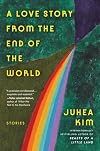
I felt immersed in climate grief while reading as each story explores the relationship between humans and the natural world – a world that is crumbling due to man-made disaster. My favorite stories were the first and last of the collection. In Biodome, Seoul is enclosed in a translucent shell to protect the city from fatal air pollution. The civil engineer responsible for the biodome’s upkeep considers an arranged marriage. In A Love Story from the End show more of the World, a research scientist on a polar expedition, who’s unsuccessful search for her birth mother resulted in estrangement from her adoptive family, rescues an abandoned polar bear cub despite a colleague’s objection to the interference. Another colleague, also an adoptee, protests oil drilling at a nearby location.
Kim does well within the length of these short stories to give developed characters and narrative while also leaving space for the reader to explore their own thoughts on the subjects at hand (and there’s quite a lot to think about). The themes of human vs. natural world and climate are found throughout while the particular type of love represented varies for each story – romantic, self, familial, inter-species, platonic. The very last line of the final story sums up everything quite perfectly and provides a satisfying conclusion to these poignant, heartfelt, and heartbreaking stories.
In her Author’s Note (don’t miss reading this!), Kim discusses what literature can do, an artist’s duty, veganism to reduce ecological impact, and other sustainable habits. She donates a portion of each of her book’s proceeds to an associated cause – this one being microgrants to grassroots organizations. This truly connects to the messages within these stories. show less
I felt immersed in climate grief while reading as each story explores the relationship between humans and the natural world – a world that is crumbling due to man-made disaster. My favorite stories were the first and last of the collection. In Biodome, Seoul is enclosed in a translucent shell to protect the city from fatal air pollution. The civil engineer responsible for the biodome’s upkeep considers an arranged marriage. In A Love Story from the End show more of the World, a research scientist on a polar expedition, who’s unsuccessful search for her birth mother resulted in estrangement from her adoptive family, rescues an abandoned polar bear cub despite a colleague’s objection to the interference. Another colleague, also an adoptee, protests oil drilling at a nearby location.
Kim does well within the length of these short stories to give developed characters and narrative while also leaving space for the reader to explore their own thoughts on the subjects at hand (and there’s quite a lot to think about). The themes of human vs. natural world and climate are found throughout while the particular type of love represented varies for each story – romantic, self, familial, inter-species, platonic. The very last line of the final story sums up everything quite perfectly and provides a satisfying conclusion to these poignant, heartfelt, and heartbreaking stories.
In her Author’s Note (don’t miss reading this!), Kim discusses what literature can do, an artist’s duty, veganism to reduce ecological impact, and other sustainable habits. She donates a portion of each of her book’s proceeds to an associated cause – this one being microgrants to grassroots organizations. This truly connects to the messages within these stories. show less
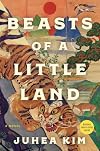
WOW, this was good. Despite all the reading/watching of Korean books and dramas I have done over the past few years, as I read this it became painfully obvious that it has all been either contemporary or deep history. Of course I am/was aware of the Japanese annexation/occupation, but almost entirely as it affects those who left, looking back at it now.
I think Kim does a masterful job here, balancing hope and despair, the epic and the personal. There were moments I was worried the book would show more stray too dark or too melodramatic for me, but Kim doesn't dwell on the darkest of topics (She doesn't shy away from them either — check the content warnings for SA, starvation, addiction, domestic abuse, and more).
In an author interview, Kim said one of the things she wanted to do with this novel was show how people attempt to live meaningful lives while the world is ending. Kim follows a number of characters here who have wildly different values. Seeing each of those lives play out, the choices they make, the things they gain and the things they lose, accomplished that very well. show less
I think Kim does a masterful job here, balancing hope and despair, the epic and the personal. There were moments I was worried the book would show more stray too dark or too melodramatic for me, but Kim doesn't dwell on the darkest of topics (She doesn't shy away from them either — check the content warnings for SA, starvation, addiction, domestic abuse, and more).
In an author interview, Kim said one of the things she wanted to do with this novel was show how people attempt to live meaningful lives while the world is ending. Kim follows a number of characters here who have wildly different values. Seeing each of those lives play out, the choices they make, the things they gain and the things they lose, accomplished that very well. show less
The stories in this collection have an overarching environmental theme. Some are speculative, postulating a near future after environmental calamities. Some are set in the world as we know it, with less privileged nations and some animal species bearing the brunt of global warming and humans’ flagrant disregard for nature. All deal with complex relationships, different forms of love against a diverse global backdrop.
The titular “A Love Story from the End of the World” is my favourite show more and explores the longing of an adopted child for her absent birth mother. Steeped in melancholy, deeply moving, this story’s ending made my eyes prickle with unexpected tears.
Another perfectly crafted story is “KwaZulu-Natal”. The protagonist has such a distinctive voice it hooked me from the get-go, and the ending’s so beautifully written it moved me to tears.
“Mountain, Island” is utterly devastating. The protagonist is a young boy living on an island that has become the rubbish dump of developed nations. Against the horrific setting, the comic glimmers (those lyrics!) brought home the insane polarities in our world, the rich-poor divide on a global scale.
“Older Sister” is deftly layered – on a familial scale, sibling dynamics and parental sacrifice are set against the larger picture of the 90s LA riots and beyond. The protagonist’s coming-of-age is a young person’s cry into the seemingly uncaring world.
Poignant, deeply moving, these four stories are what I consider to be perfect short stories, allowing a glimpse into a person’s life at one or more defining moments. It takes considerable skill to craft short stories with relatable characters whose inner worlds and outer struggles tear the reader apart. The author has the courage of her convictions, more admirable than ever in today’s socio-political climate. show less
The titular “A Love Story from the End of the World” is my favourite show more and explores the longing of an adopted child for her absent birth mother. Steeped in melancholy, deeply moving, this story’s ending made my eyes prickle with unexpected tears.
Another perfectly crafted story is “KwaZulu-Natal”. The protagonist has such a distinctive voice it hooked me from the get-go, and the ending’s so beautifully written it moved me to tears.
“Mountain, Island” is utterly devastating. The protagonist is a young boy living on an island that has become the rubbish dump of developed nations. Against the horrific setting, the comic glimmers (those lyrics!) brought home the insane polarities in our world, the rich-poor divide on a global scale.
“Older Sister” is deftly layered – on a familial scale, sibling dynamics and parental sacrifice are set against the larger picture of the 90s LA riots and beyond. The protagonist’s coming-of-age is a young person’s cry into the seemingly uncaring world.
Poignant, deeply moving, these four stories are what I consider to be perfect short stories, allowing a glimpse into a person’s life at one or more defining moments. It takes considerable skill to craft short stories with relatable characters whose inner worlds and outer struggles tear the reader apart. The author has the courage of her convictions, more admirable than ever in today’s socio-political climate. show less
Lists
Awards


You May Also Like


Associated Authors
Statistics
- Works
- 3
- Also by
- 1
- Members
- 718
- Popularity
- #35,341
- Rating
- 3.9
- Reviews
- 36
- ISBNs
- 43
- Languages
- 4