
Jenny Tinghui Zhang
Author of Four Treasures of the Sky
Works by Jenny Tinghui Zhang
Associated Works
Body Language: Writers on Identity, Physicality, and Making Space for Ourselves (2022) — Contributor — 46 copies
Tagged
Common Knowledge
- Nationality
- USA
China (birth)
Members
Reviews
4.5⭐️
“My life was written for me from the moment the name was given to me. Or it was not. That is the true beauty. That is the intent. We can practice all we want, telling and retelling the same story, but the story that comes out of your mouth, from your brush, is one that only you can tell. So let it be. Let your story be yours, and my story be mine.”
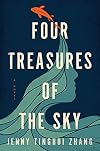
Daiyu always resented being named after a tragic heroine of Chinese literature (Lin Daiyu from Cao Xueqin's classic 18th-century show more Chinese novel Dream of the Red Chamber), fearing that it would be ominous. Born to a family of tapestry merchants, her happy childhood is interrupted when at the age of twelve her parents suddenly disappear. Fearing for her grandchild's life, her grandmother dresses Daiyu as a boy and sends her to the port city of Zhifu. Once there, she, now calling herself “Feng”, is given shelter and work at the calligraphy school run by Master Wang. She develops an interest in the art of calligraphy and learns as much as she can eavesdropping while he instructs his students. The Master acknowledges her potential and here she learns about the Four Treasures of the Study, the principles of which have a deep impact on her and as the story progresses we see how Daiyu draws strength from what she had learned even in the darkest moments of her life. At the age of thirteen, she is kidnapped and trafficked to San Francisco (smuggled across the ocean in a barrel of coal) and sold to a brothel. As “Peony” she witnesses firsthand the violence and sexual brutality young girls like her are subject to and vows to find a way to return home. She manages to escape the brothel with the help of a kind patron who also gets her identification papers as “Jacob Li” but eventually betrays her. She moves on and ultimately finds herself in the employ of kind Chinese shopkeepers in the town of Pierce,Idaho. She intends to save enough from her earnings to buy herself a passage home. But the surge in anti-Asian sentiment fueled by the Chinese Exclusion Act of 1882 triggers a series of events that changes her destiny irrevocably.
“Daiyu to Feng to Peony to Jacob Li. When will I be me again? And if I become me again, will I know who she is?"
Jenny Tinghui Zhang’s debut novel Four Treasures of the Sky is a tragic and heartbreaking story that combines historical fact, fiction, Chinese folklore and magical realism. The prose is beautiful and the characters memorable. Despite its slow start, the novel is evenly paced and at no point did I lose interest in Daiyu’s story. The episodes of brutality Daiyu witnessed and experienced in the course of her jouney are difficult to read. The author’s narrative tone in some parts might be interpreted by some as stilted or detached but I thought that the occasional factual, clipped tone of the narrative suited the story that was being told. I loved the segments on Chinese calligraphy and the description and symbolism of the different Chinese characters which are shared in the text. The author does a brilliant job in depicting Daiyu’s emotional growth through the years - from a trafficked child of thirteen in 1883 to a young girl who while admitting that she is safer dressed as a man also struggles with her feelings about Nelson, the young violin teacher she meets in Pierce. Daiyu’s interactions with the spirit of her fictional namesake Lin Daiyu that act as her inner voice and conscience throughout her journey, are depicted with much feeling and emotion as are Daiyu’s memories of Master Wang’s teachings and how she applies those principles in her life. The author also sheds a light on the xenophobia, racially-motivated violence and vigilantism that Chinese immigrants had to endure post the Chinese Exclusion Act of 1882 . The Page Act of 1875, which preceded the Chinese Exclusion Act and prohibited the entry of Chinese women into the United States is also mentioned. The author was inspired by true events, which she discusses in detail in her notes at the end of the book. Extremely well-researched and beautifully penned, this is a brilliant debut and I will be looking out for more of this author’s work in the future.
“A line can only be called strong when it has the conviction to stay on paper. Strong lines are important, but how does one make a strong line with a soft brush? Answer: resilience. A resilient brush is one that, after depositing ink on paper, can spring back up in preparation for the next stroke. But resilience is not achieved by pressing harder. No, the artist must master the art of releasing the brush, giving it the space and freedom to find itself again. Resilience is simple, really. Know when to push and when to let go.” show less
“My life was written for me from the moment the name was given to me. Or it was not. That is the true beauty. That is the intent. We can practice all we want, telling and retelling the same story, but the story that comes out of your mouth, from your brush, is one that only you can tell. So let it be. Let your story be yours, and my story be mine.”
Daiyu always resented being named after a tragic heroine of Chinese literature (Lin Daiyu from Cao Xueqin's classic 18th-century show more Chinese novel Dream of the Red Chamber), fearing that it would be ominous. Born to a family of tapestry merchants, her happy childhood is interrupted when at the age of twelve her parents suddenly disappear. Fearing for her grandchild's life, her grandmother dresses Daiyu as a boy and sends her to the port city of Zhifu. Once there, she, now calling herself “Feng”, is given shelter and work at the calligraphy school run by Master Wang. She develops an interest in the art of calligraphy and learns as much as she can eavesdropping while he instructs his students. The Master acknowledges her potential and here she learns about the Four Treasures of the Study, the principles of which have a deep impact on her and as the story progresses we see how Daiyu draws strength from what she had learned even in the darkest moments of her life. At the age of thirteen, she is kidnapped and trafficked to San Francisco (smuggled across the ocean in a barrel of coal) and sold to a brothel. As “Peony” she witnesses firsthand the violence and sexual brutality young girls like her are subject to and vows to find a way to return home. She manages to escape the brothel with the help of a kind patron who also gets her identification papers as “Jacob Li” but eventually betrays her. She moves on and ultimately finds herself in the employ of kind Chinese shopkeepers in the town of Pierce,Idaho. She intends to save enough from her earnings to buy herself a passage home. But the surge in anti-Asian sentiment fueled by the Chinese Exclusion Act of 1882 triggers a series of events that changes her destiny irrevocably.
“Daiyu to Feng to Peony to Jacob Li. When will I be me again? And if I become me again, will I know who she is?"
Jenny Tinghui Zhang’s debut novel Four Treasures of the Sky is a tragic and heartbreaking story that combines historical fact, fiction, Chinese folklore and magical realism. The prose is beautiful and the characters memorable. Despite its slow start, the novel is evenly paced and at no point did I lose interest in Daiyu’s story. The episodes of brutality Daiyu witnessed and experienced in the course of her jouney are difficult to read. The author’s narrative tone in some parts might be interpreted by some as stilted or detached but I thought that the occasional factual, clipped tone of the narrative suited the story that was being told. I loved the segments on Chinese calligraphy and the description and symbolism of the different Chinese characters which are shared in the text. The author does a brilliant job in depicting Daiyu’s emotional growth through the years - from a trafficked child of thirteen in 1883 to a young girl who while admitting that she is safer dressed as a man also struggles with her feelings about Nelson, the young violin teacher she meets in Pierce. Daiyu’s interactions with the spirit of her fictional namesake Lin Daiyu that act as her inner voice and conscience throughout her journey, are depicted with much feeling and emotion as are Daiyu’s memories of Master Wang’s teachings and how she applies those principles in her life. The author also sheds a light on the xenophobia, racially-motivated violence and vigilantism that Chinese immigrants had to endure post the Chinese Exclusion Act of 1882 . The Page Act of 1875, which preceded the Chinese Exclusion Act and prohibited the entry of Chinese women into the United States is also mentioned. The author was inspired by true events, which she discusses in detail in her notes at the end of the book. Extremely well-researched and beautifully penned, this is a brilliant debut and I will be looking out for more of this author’s work in the future.
“A line can only be called strong when it has the conviction to stay on paper. Strong lines are important, but how does one make a strong line with a soft brush? Answer: resilience. A resilient brush is one that, after depositing ink on paper, can spring back up in preparation for the next stroke. But resilience is not achieved by pressing harder. No, the artist must master the art of releasing the brush, giving it the space and freedom to find itself again. Resilience is simple, really. Know when to push and when to let go.” show less
Daiyu always resented being named after Lin Daiyu, the tragic heroine of a classic tale, feeling that it gave her own life a terrible fate that she couldn't escape. She lives happily with her parents and grandmother, until one day her parents disappear. Her grandmother sends her away, trying to save her life, and she lives on the streets as a boy named Feng. But then she's kidnapped, discovered as a girl, and secretly brought to San Francisco to work in a brothel.
This was almost show more unrelentingly bleak, with Daiyu trying to find ways to break free and getting stymied at almost every turn, by powerful people, by laws such as the Chinese Exclusion Act, and by the racism and hate of others. There's a push-me-pull-me between the ideas of fate and having agency, moments when Daiyu contemplates what she can control, and at one point she has an epiphany of how she can declare herself and her life. This historical fiction highlights a story that we should know about, but I can't say I enjoyed the reading experience. show less
This was almost show more unrelentingly bleak, with Daiyu trying to find ways to break free and getting stymied at almost every turn, by powerful people, by laws such as the Chinese Exclusion Act, and by the racism and hate of others. There's a push-me-pull-me between the ideas of fate and having agency, moments when Daiyu contemplates what she can control, and at one point she has an epiphany of how she can declare herself and her life. This historical fiction highlights a story that we should know about, but I can't say I enjoyed the reading experience. show less

There has been a lot of historical fiction about the Asian immigrant experience in the US over the past few years, but Four Treasures of the Sky by Jenny Tinghui Zhang deserves a place among the best of them. It begins in China with Daiyu struggling to find her way after her parents disappear, then turns even worse when she gets kidnapped and shipped to America to serve as whore in California. In the end, she experiences all of the difficulties and discrimination rampant in the US at the show more time in a thoughtful reflection of current AAPI issues. Zhang’s writing is beautiful, and she includes an interesting theme of Chinese characters throughout the novel. Definitely not for the faint of heart, but readers looking for an honest take on the cruelties of The Chinese Exclusion Act and the treatment of the Chinese should not miss Four Treasures. show less
The first, arresting sentence of this utterly compelling novel refers to a kidnapping, but the story’s much larger than a single person. It’s a tale of good versus evil, mostly the latter.
Despite being named for a tragic heroine of legend, Daiyu has a happy childhood in 1880s China. Growing up in a fishing village six days from the port of Zhifu, she has firm but doting parents who teach her to love nature and respect others, and to expect such respect in return. With that nurturance to show more guide Daiyu, life holds great promise:
Unbeknownst to Daiyu, these are dangerous times, and one day, her parents flee without warning, leaving her in her grandmother’s care. Soldiers come looking for the fugitives, which bewilders Daiyu; what could her parents have done wrong? And soon, it’s too dangerous for Daiyu to live in the village, whereupon she’s sent to fend for herself in Zhifu.
Perhaps that seems improbable, but what follows is all too nightmarishly real. For a while, she finds comfort and stimulation as a servant at a calligraphy school, and in learning that art, she learns about life. In that way, you might call Four Treasures of the Sky a coming-of-age novel, though it’s different in tone from any I can think of.
Her kidnapping interrupts her education and self-discovery, and much else. Kept for a year in captivity, where she’s taught English, she’s sent overseas to a brothel in San Francisco. The author may pull a punch once her protagonist arrives in America, but rest assured, Zhang doesn’t protect her characters. Daiyu also has further misadventures in Idaho, where she tries to pass as a man. Throughout, she experiences or observes the brutalities women suffer at the hands of men, or each other.
But dressing and acting as a man offers only a veneer of protection; as a Chinese person, she’s subject to constant harassment, insult, degradation, and violence. Reversals occur in full force, so that whenever a hint of kindness, generosity, or warmth reveals itself, you have to wonder how long it’ll last.
To survive, Daiyu, now called by other, invented names, retreats within her tragic alter ego, or, to be precise, literally and figuratively swallows her and holds her inside. What a remarkable metaphor, an attempted antidote to the bitterness that life forces down her throat. But the alter ego also represents the self that Daiyu may never show anyone, for fear of exposure and punishment. As a result, she won’t let herself trust or love, so that dreadful as her physical sufferings are, the emotional deprivation is that much worse.
Zhang’s prose penetrates surfaces to illuminate the shadows or currents beneath, one pleasure of Four Treasures of the Sky. Besides the passages on calligraphy, I enjoyed one describing the differences between Chinese and English; the latter, soft-pedaling unimportant words while emphasizing others with vigor, “is a matter of timing and chaos.” Another passage precisely links male power to physicality, reflected in how men move and carry themselves. Like so many parts of the novel, it’s beautifully observed without a hint of self-consciousness.
Mostly, though, Zhang wants to redeem the largely forgotten history of American bigotry and violence against Chinese. In that, she performs a great service, in general and particular. In her afterword, she says that Trump’s lies blaming China for COVID energized her, in part, to write her story.
I warn you, however, that if you read this brilliant, disturbing book, be prepared to see humans at their worst. All the white characters are racist, and few of the Chinese have much to recommend them, either. Yet Daiyu’s constant struggle over whether to live fully, and how, prevents Four Treasures of the Sky from becoming a polemic or a tract. To me, the social and political observations feel integral and crucial to the narrative.
This is an important book. show less
Despite being named for a tragic heroine of legend, Daiyu has a happy childhood in 1880s China. Growing up in a fishing village six days from the port of Zhifu, she has firm but doting parents who teach her to love nature and respect others, and to expect such respect in return. With that nurturance to show more guide Daiyu, life holds great promise:
Unbeknownst to Daiyu, these are dangerous times, and one day, her parents flee without warning, leaving her in her grandmother’s care. Soldiers come looking for the fugitives, which bewilders Daiyu; what could her parents have done wrong? And soon, it’s too dangerous for Daiyu to live in the village, whereupon she’s sent to fend for herself in Zhifu.
Perhaps that seems improbable, but what follows is all too nightmarishly real. For a while, she finds comfort and stimulation as a servant at a calligraphy school, and in learning that art, she learns about life. In that way, you might call Four Treasures of the Sky a coming-of-age novel, though it’s different in tone from any I can think of.
Her kidnapping interrupts her education and self-discovery, and much else. Kept for a year in captivity, where she’s taught English, she’s sent overseas to a brothel in San Francisco. The author may pull a punch once her protagonist arrives in America, but rest assured, Zhang doesn’t protect her characters. Daiyu also has further misadventures in Idaho, where she tries to pass as a man. Throughout, she experiences or observes the brutalities women suffer at the hands of men, or each other.
But dressing and acting as a man offers only a veneer of protection; as a Chinese person, she’s subject to constant harassment, insult, degradation, and violence. Reversals occur in full force, so that whenever a hint of kindness, generosity, or warmth reveals itself, you have to wonder how long it’ll last.
To survive, Daiyu, now called by other, invented names, retreats within her tragic alter ego, or, to be precise, literally and figuratively swallows her and holds her inside. What a remarkable metaphor, an attempted antidote to the bitterness that life forces down her throat. But the alter ego also represents the self that Daiyu may never show anyone, for fear of exposure and punishment. As a result, she won’t let herself trust or love, so that dreadful as her physical sufferings are, the emotional deprivation is that much worse.
Zhang’s prose penetrates surfaces to illuminate the shadows or currents beneath, one pleasure of Four Treasures of the Sky. Besides the passages on calligraphy, I enjoyed one describing the differences between Chinese and English; the latter, soft-pedaling unimportant words while emphasizing others with vigor, “is a matter of timing and chaos.” Another passage precisely links male power to physicality, reflected in how men move and carry themselves. Like so many parts of the novel, it’s beautifully observed without a hint of self-consciousness.
Mostly, though, Zhang wants to redeem the largely forgotten history of American bigotry and violence against Chinese. In that, she performs a great service, in general and particular. In her afterword, she says that Trump’s lies blaming China for COVID energized her, in part, to write her story.
I warn you, however, that if you read this brilliant, disturbing book, be prepared to see humans at their worst. All the white characters are racist, and few of the Chinese have much to recommend them, either. Yet Daiyu’s constant struggle over whether to live fully, and how, prevents Four Treasures of the Sky from becoming a polemic or a tract. To me, the social and political observations feel integral and crucial to the narrative.
This is an important book. show less
Lists
Awards


You May Also Like


Associated Authors
Statistics
- Works
- 6
- Also by
- 1
- Members
- 592
- Popularity
- #42,408
- Rating
- 3.9
- Reviews
- 17
- ISBNs
- 20
- Languages
- 1
