
Mike Lee (2) (1971–)
Author of Written Out of History: The Forgotten Founders Who Fought Big Government
For other authors named Mike Lee, see the disambiguation page.
About the Author
Michael Shumway "Mike" Lee was born on June 4, 1971 in Mesa, Arizona. He is an American politician and lawyer who is the junior United States Senator from Utah. A member of the Republican Party, Lee has served in the U.S. Senate since January 3, 2011. Lee is a graduate of Brigham Young University show more (BYU). He began his career as a clerk for the U.S. District Court for the District of Utah before serving as a clerk for future Supreme Court Justice Samuel Alito, who was then a judge on the Third Circuit Court. He then entered private practice, with the Sidley Austin law firm, before coming back to his home state and working as an Assistant U.S. Attorney for the District of Utah, from 2002 to 2005. Lee then joined the administration of Utah Governor Jon Huntsman, serving as the general counsel from 2005 to 2006. Lee ran for the U.S. Senate in 2010. He won the general election on November 2, 2010 with 62 percent of the vote. He made The New York Times Best Seller List in 2015 with his title Our Lost Constitution: The Willful Subversion of America's Founding Document and in 2017 with Written Out of History: The Forgotten Founders Who Fought Big Government. (Bowker Author Biography) show less
Works by Mike Lee
Written Out of History: The Forgotten Founders Who Fought Big Government (2017) 118 copies, 2 reviews
Our Lost Declaration: America's Fight Against Tyranny from King George to the Deep State (2019) 31 copies
Saving Nine: The Fight Against the Left’s Audacious Plan to Pack the Supreme Court and Destroy American Liberty (2022) 25 copies, 2 reviews
Tagged
Common Knowledge
- Legal name
- Lee, Michael Shumway
- Birthdate
- 1971-06-04
- Gender
- male
- Education
- Brigham Young University (BA|political science)
Brigham Young University (JD) - Occupations
- attorney
politician (United States senator) - Nationality
- USA
- Birthplace
- Mesa, Arizona, USA
- Associated Place (for map)
- Arizona, USA
Members
Reviews
Why John Roberts Was Wrong About Healthcare: A Conservative Critique of The Supreme Court's Obamacare Ruling by Mike Lee

Insightful look at this decision. Lee's father appeared before the Supreme Court and the author has been sitting in the gallery at the Court since he was ten years old. His analysis is straightforward and begins right away in the first chapter. He uses the introductory trope of telling you something about Chief Justice Roberts that would make you think he is a good jurist, and then Lee tells why Roberts did not live up to his reputation with this particular decision.
The problem is that the show more majority decision penned by Roberts in the National Federation of Independent Businesses versus Secretary Sibelius (known as NFIB for short) changes the ACA (Obamacare) law in order to save it. The individual mandate that is part of the law cannot stand constitutional muster as regulation, so it was changed by the Courts opinion to a tax, even though Congress expressly recoiled from making it a tax. (Yet the Court's decision assumes, on who-knows-what basis, that Congress would want the Court to change the mandate to a tax.)
The decision also says that the part of the law that requires all states to expand Medicaid or face penalties is unconstitutional. So states can now opt out of Medicaid expansion without losing Medicaid under the previous agreement with the federal government.
Lee points out that supporters of Obamacare should be upset with the Court's decision especially with the last change in the law that I mentioned. If states can opt out of Medicaid expansion, then Obamacare will likely collapse without the participation of all the states. But this change is also unfair, Lee notes, because it means that citizens of states that don't expand Medicaid will have to pay for Medicaid expansion in the states that do.
Lee's main criticism, however, is that this decision puts the Court in the position of literally making laws when the Constitution prescribes that only Congress shall make federal laws and the Supreme Court will only give those laws thumbs up or down, not rewrite the laws.
Lee suggests a remedy short of repealing Obamacare or persuading the Court to overrule its own decision: Senate Bill 506, proposed by Lee, would rewrite the law to strengthen the point that the individual mandate is not a tax. This is, he admits, a clever trick because a vote on this bill would force members of the Senate to take a stand on whether they are OK with the Supreme Court changing the mandate to a tax. If they are, they are on record as raising taxes; if they are not, their vote will force the Court to declare the mandate unconstitutional in any subsequent case involving the law, which would stab (my word, not his) Obamacare in the heart.
I am personally troubled by Obamacare and its impact on my own life and on the proper relationship of government to the citizen and the various state governments. So I read this book with a sense of disappointment that Justice Roberts would decide a case in such a strange and harmful way. Lee speculates on whether it is true, as some have claimed, that Roberts considered public opinion or, worse, media opinion (which is not representative of the people) in making his decision, and even changed his mind from voting against the ACA to voting to save it. Aside from being able to cite those who claim they are certain this happened, Lee says he personally does not know. He concludes that whatever the motivation for his error, Justice Roberts made a very bad error. If he wanted to help the Court's reputation, he may have hurt it instead; if he wanted to strengthen the constitutional roles of the Congress and the Court, he failed at that, too. What if from now on Congress feels no qualm about writing bad laws? "The Supreme Court will fix them, if we make them badly." show less
The problem is that the show more majority decision penned by Roberts in the National Federation of Independent Businesses versus Secretary Sibelius (known as NFIB for short) changes the ACA (Obamacare) law in order to save it. The individual mandate that is part of the law cannot stand constitutional muster as regulation, so it was changed by the Courts opinion to a tax, even though Congress expressly recoiled from making it a tax. (Yet the Court's decision assumes, on who-knows-what basis, that Congress would want the Court to change the mandate to a tax.)
The decision also says that the part of the law that requires all states to expand Medicaid or face penalties is unconstitutional. So states can now opt out of Medicaid expansion without losing Medicaid under the previous agreement with the federal government.
Lee points out that supporters of Obamacare should be upset with the Court's decision especially with the last change in the law that I mentioned. If states can opt out of Medicaid expansion, then Obamacare will likely collapse without the participation of all the states. But this change is also unfair, Lee notes, because it means that citizens of states that don't expand Medicaid will have to pay for Medicaid expansion in the states that do.
Lee's main criticism, however, is that this decision puts the Court in the position of literally making laws when the Constitution prescribes that only Congress shall make federal laws and the Supreme Court will only give those laws thumbs up or down, not rewrite the laws.
Lee suggests a remedy short of repealing Obamacare or persuading the Court to overrule its own decision: Senate Bill 506, proposed by Lee, would rewrite the law to strengthen the point that the individual mandate is not a tax. This is, he admits, a clever trick because a vote on this bill would force members of the Senate to take a stand on whether they are OK with the Supreme Court changing the mandate to a tax. If they are, they are on record as raising taxes; if they are not, their vote will force the Court to declare the mandate unconstitutional in any subsequent case involving the law, which would stab (my word, not his) Obamacare in the heart.
I am personally troubled by Obamacare and its impact on my own life and on the proper relationship of government to the citizen and the various state governments. So I read this book with a sense of disappointment that Justice Roberts would decide a case in such a strange and harmful way. Lee speculates on whether it is true, as some have claimed, that Roberts considered public opinion or, worse, media opinion (which is not representative of the people) in making his decision, and even changed his mind from voting against the ACA to voting to save it. Aside from being able to cite those who claim they are certain this happened, Lee says he personally does not know. He concludes that whatever the motivation for his error, Justice Roberts made a very bad error. If he wanted to help the Court's reputation, he may have hurt it instead; if he wanted to strengthen the constitutional roles of the Congress and the Court, he failed at that, too. What if from now on Congress feels no qualm about writing bad laws? "The Supreme Court will fix them, if we make them badly." show less
Saving Nine: The Fight Against the Left's Audacious Plan to Pack the Supreme Court and Destroy American Liberty by Mike Lee
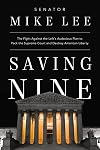
Small volume by Utah Senator Mike Lee explaining why "court packing" is bad, published in 2023 shortly before the Dobbs decision. The basic argument is that if one political party packs the court when it is in power, as soon as it is out of power the other political party will do the same, and so on and on, and that this will destabilize an already increasingly unstable system of government. Sure, this argument is fairly convincing, but if the first political party to go first has the show more advantage, then it's not the kind of argument that should stop a political party from going first.
Mike Lee argues that the justices in the Supreme Court are basically doing their job, rather than being partisan, and that is what makes packing the court such a bad decision. I would argue that the justices simply serve as sort of a damper on pure political maneuvering, regardless of their integrity, intelligence, or lack of these qualities, since they were generally appointed in previous administrations. But the conclusion is pretty much the same with either argument: court packing is likely to make our government situation more unstable.
Mike Lee writes in a pleasant, straightforward way. Some parts are about his own experiences: his father was solicitor general for the United States in the '80s, demonstrators showed up outside his family house to intimidate rather feebly when he was a boy, he worked as a law clerk and had tea at Ruth Bader Ginsburg's. The rest of his story is mostly history; previous court packing efforts, the very early history of the Supreme Court, a proposed Constitutional Amendment to prohibit court packing.
This book was clearly written to influence public opinion at a time when the tactic of court packing was being openly discussed by elements in the Biden administration. Unfortunately, it seems not to have received even the most basic of proofreading attention; it is riddled with what are clearly typos. In most cases, it's possible to figure out pretty easily what Mike Lee intended --- sometimes the typo is just a missing space between words --- but in the Conclusion, probably written last, there are some truly inscrutable sentences. show less
Mike Lee argues that the justices in the Supreme Court are basically doing their job, rather than being partisan, and that is what makes packing the court such a bad decision. I would argue that the justices simply serve as sort of a damper on pure political maneuvering, regardless of their integrity, intelligence, or lack of these qualities, since they were generally appointed in previous administrations. But the conclusion is pretty much the same with either argument: court packing is likely to make our government situation more unstable.
Mike Lee writes in a pleasant, straightforward way. Some parts are about his own experiences: his father was solicitor general for the United States in the '80s, demonstrators showed up outside his family house to intimidate rather feebly when he was a boy, he worked as a law clerk and had tea at Ruth Bader Ginsburg's. The rest of his story is mostly history; previous court packing efforts, the very early history of the Supreme Court, a proposed Constitutional Amendment to prohibit court packing.
This book was clearly written to influence public opinion at a time when the tactic of court packing was being openly discussed by elements in the Biden administration. Unfortunately, it seems not to have received even the most basic of proofreading attention; it is riddled with what are clearly typos. In most cases, it's possible to figure out pretty easily what Mike Lee intended --- sometimes the typo is just a missing space between words --- but in the Conclusion, probably written last, there are some truly inscrutable sentences. show less
Saving Nine: The Fight Against the Left’s Audacious Plan to Pack the Supreme Court and Destroy American Liberty by Mike Lee
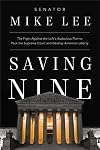
In Saving Nine, Senator Mike Lee offers a well reasoned and well written rebuttal to the concept of “court packing”. The book starts out with a comprehensive history of the Court itself, and how the number of justices eventually settled at nine (the Constitution never defined how many justices there should be). He also reviews FDR’s court packing threat, and how it probably led to one justice switching his vote on a case, which Senator Lee feels opened the floodgates for the show more administrative state. He also summarizes the current reasoning on the Left for increasing the number of justices, and most importantly, why it’s been considered a bad idea, even by liberal justices such as RBG.
An excellent book, comprehensive and well done. Kudos to Senator Lee for his cogent reasoning and well written arguments against court packing.
My thanks to Center Street and also to Netgalley for providing an ARC of this very topical book. show less
An excellent book, comprehensive and well done. Kudos to Senator Lee for his cogent reasoning and well written arguments against court packing.
My thanks to Center Street and also to Netgalley for providing an ARC of this very topical book. show less
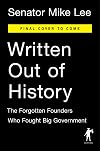
Interesting portraits of various 'forgotten founders' and how their lives or points of view demonstrated a concern for an overreaching, centralized government: Aaron Burr (!), Luther Martin, Mercy Otis Warren, Canastego, Elbridge Gerry, Mum Bett, James Otis, and George Mason. The various stories are a bit uneven in quality, but not in interest. Still, this popular history is riddled with inaccuracies (Aaron Burr, for example, never served as Governor of New York), odd repetitions, and show more slightly misplaced emphases. The final chapter is an extended -- and unnecessary -- rant by the author against former President Obama and his policies, accompanied by a swipe or two at FDR. For me, this partisanship rather marred the effect of all that had preceded. (Some of Senator Lee's comments contra Alexander Hamilton, while perhaps topical, also seem misplaced.) show less
Lists
You May Also Like


Statistics
- Works
- 6
- Members
- 294
- Popularity
- #79,673
- Rating
- 4.2
- Reviews
- 5
- ISBNs
- 132
- Languages
- 8