
John Galt (1) (1779–1839)
Author of Annals of the Parish
For other authors named John Galt, see the disambiguation page.
About the Author
Image credit: biographi.ca
Works by John Galt
Scottish Forgotten Authors: Marriage, Gillespie, Ringan Gilhaize (Scottish Lost Treasures) (2014) 7 copies, 3 reviews
The Howdie and Other Tales 3 copies
Four Galt Novels: Annals of the Parish, The Ayrshire Legatees, The Provost, The Entail (2015) 2 copies
The universal traveller, containing the popular features and contents of the best standard modern travels, in the four quarters of the world (1822) 2 copies
The Works of John Galt 2 copies
The Black Ferry 1 copy
The book of life : a story 1 copy
The Buried Alive 1 copy
The earthquake; a tale 1 copy
Life of Cardinal Wolsey 1 copy
All the Voyages Round the World, from the First by Magellan in 1520 to that of Krusenstern in 1807. 1 copy
The Dream 1 copy
A rich man and other stories 1 copy
The bachelor's wife : a selection of curious and interesting extracts, with cursory observations 1 copy
The Gudewife 1 copy
The fatal whisper. A tale 1 copy
Associated Works
Into Unknown England, 1866-1913: Selections from the Social Explorers (1976) — Photographer, some editions — 24 copies
The King's Story Book — Contributor — 1 copy
Tagged
Common Knowledge
- Birthdate
- 1779-05-02
- Date of death
- 1839-04-11
- Gender
- male
- Education
- Irvine Grammar School (1787 - 1788)
Lincoln's Inn, London, England, UK (1809) - Occupations
- lawyer
merchant
novelist
biographer - Awards and honors
- Galt, Ontario, Canada
- Relationships
- Tilloch, Elizabeth (wife)
- Nationality
- UK
- Birthplace
- Irvine, Ayrshire, Scotland, UK
- Places of residence
- Edinburgh, Scotland, UK
London, England, UK
Maldon, Essex, England, UK
Guelph, Ontario, Canada - Place of death
- Greenock, Renfrewshire, Scotland, UK
- Associated Place (for map)
- UK
Members
Reviews
Scottish Forgotten Authors: Marriage, Gillespie, Ringan Gilhaize (Scottish Lost Treasures) by Susan Ferrier
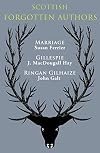
Forgotten Authors, by Susan Ferrier, J MacDougall Hay, John Galt
Forgotten no more, not by me anyway!! It was a joy to read these novels in all their Scottish diversity.
Marriage by Susan Ferrier
I loved the humour in this book along with the home truths, a poor man’s Jane Austen to be sure and too wordy overall. I think the same enjoyment could have been derived from a novel of reduced length but it remains a mystery why this book isn’t ‘up there’. Considering this is an eighteenth show more century novel the writing remains crisp and fresh. The characters jump out of the page at you and you love and hate them in equal measure, they are so clearly defined. There was much to be learnt about Scottish social life and the protocols of the time which I found revealing.
Gillespie by J MacDougall Hay
This was in complete contrast to Marriage a bleak tale of ruthless ambition. If there is any ‘feel good’ in the book I didn’t find it so if it is upliftment you are after avoid this book. And the Scottish dialect was often elusive to construe. I found it helped to read the book with a Scottish accent if that makes sense!!! But for all that it is a book that grips you and won’t release until you have read to the end. You carry on in the hope that there will be some salvation somewhere. But there isn’t. But I guess it is also a book of survival and prospering with your wits no matter whom you destroy in the process. In that sense it may even be seen as prophetic and contemporary! It’s a meaty book, well written and offers a grim picture of Calvinist Scotland that in some ways sends a shiver down your spine.
Ringan Gilhaize by John Galt
The final novel was my least favourite, maybe because I’m all ‘scottished’ out? I found it less accessible, more political, which seldom resonates positively with me. I think it is well written. I thought initially it was repetitive but as I progressed I realized it was a conscious device, kind of leitmotiv to emphasis the point. And I suppose the point is how belief and ideals can lead to fanaticism and even change a person’s behavior, which is food for thought for again it does pose a contemporary comparison with today’s fanaticisms.
As a suite of novels they are very diverse and are probably the tip of the iceberg when it comes to a wealth of Scottish classic fiction. Not to everyone’s taste I imagine. They were challenging reads with all the Scots dialect and idioms. The dictionary on my e reader couldn’t cope with many of the definitions but there were some lovely phrases ‘corpulent pandarus’ and I am still wondering what ‘clishmaclavers’ might be!!
I am grateful to Real Readers for giving me the chance to read these novels as I can honestly say that I would never have selected them to read in a million years! But my literary education has been enhanced by the experience. show less
Forgotten no more, not by me anyway!! It was a joy to read these novels in all their Scottish diversity.
Marriage by Susan Ferrier
I loved the humour in this book along with the home truths, a poor man’s Jane Austen to be sure and too wordy overall. I think the same enjoyment could have been derived from a novel of reduced length but it remains a mystery why this book isn’t ‘up there’. Considering this is an eighteenth show more century novel the writing remains crisp and fresh. The characters jump out of the page at you and you love and hate them in equal measure, they are so clearly defined. There was much to be learnt about Scottish social life and the protocols of the time which I found revealing.
Gillespie by J MacDougall Hay
This was in complete contrast to Marriage a bleak tale of ruthless ambition. If there is any ‘feel good’ in the book I didn’t find it so if it is upliftment you are after avoid this book. And the Scottish dialect was often elusive to construe. I found it helped to read the book with a Scottish accent if that makes sense!!! But for all that it is a book that grips you and won’t release until you have read to the end. You carry on in the hope that there will be some salvation somewhere. But there isn’t. But I guess it is also a book of survival and prospering with your wits no matter whom you destroy in the process. In that sense it may even be seen as prophetic and contemporary! It’s a meaty book, well written and offers a grim picture of Calvinist Scotland that in some ways sends a shiver down your spine.
Ringan Gilhaize by John Galt
The final novel was my least favourite, maybe because I’m all ‘scottished’ out? I found it less accessible, more political, which seldom resonates positively with me. I think it is well written. I thought initially it was repetitive but as I progressed I realized it was a conscious device, kind of leitmotiv to emphasis the point. And I suppose the point is how belief and ideals can lead to fanaticism and even change a person’s behavior, which is food for thought for again it does pose a contemporary comparison with today’s fanaticisms.
As a suite of novels they are very diverse and are probably the tip of the iceberg when it comes to a wealth of Scottish classic fiction. Not to everyone’s taste I imagine. They were challenging reads with all the Scots dialect and idioms. The dictionary on my e reader couldn’t cope with many of the definitions but there were some lovely phrases ‘corpulent pandarus’ and I am still wondering what ‘clishmaclavers’ might be!!
I am grateful to Real Readers for giving me the chance to read these novels as I can honestly say that I would never have selected them to read in a million years! But my literary education has been enhanced by the experience. show less
The annals of the parish, or the chronicle of Dalmailing during the ministry of the Rev. Micah Balwhidder by John Galt

"written by himself and arranged and edited by John Galt" it says on the title page. John Galt (1779 - 1839) was a Scottish writer, whose novels are best known for their depiction of Scottish rural life, tinged with ironic humour. Most of his work is published between 1812 and 1839. Galt was a very prolific writer, but mainly remembered for two work, The annals of the parish (1821) being one of them
The annals of the parish, or the chronicle of Dalmailing during the ministry of the Rev. Micah show more Balwhidder is a somewhat puzzling work. Some parts are definitely humorous, such as the beginning when the Reverend Micah Balwhidder is appointed and arrives in the village, but his congregation tries to ban him from entering the church. There are other passages which are mildly funny, but as with the work of Thomas Love Peacock it seems I miss the knowledge to understand the wit or fail to recognize the humor.
The annals of the parish consists of 51 chapters, and introduction and 50 chapters each dedicated to one year between 1760 and 1810. 1760 is the year George III ascended the throne, but I do not see why the annals end in the year 1810. The annals do not describe any significant historical moments, neither do they give a chronology of each year. Instead, each chapter focusses on a rather random, 'insignificant' incident in the life of the reverend. Thus, the annals seem to be a personal log of highlights in the career of the Reverend, and perhaps the irony is that it is so totally insignificant.
It can't be said that nothing happens. In fact, in the margins of each episode mention is made to great events in world history, such as the French Revolution and the American Revolution and War of Independence. The irony is just that very little changes in the life of the Reverend. show less
The annals of the parish, or the chronicle of Dalmailing during the ministry of the Rev. Micah show more Balwhidder is a somewhat puzzling work. Some parts are definitely humorous, such as the beginning when the Reverend Micah Balwhidder is appointed and arrives in the village, but his congregation tries to ban him from entering the church. There are other passages which are mildly funny, but as with the work of Thomas Love Peacock it seems I miss the knowledge to understand the wit or fail to recognize the humor.
The annals of the parish consists of 51 chapters, and introduction and 50 chapters each dedicated to one year between 1760 and 1810. 1760 is the year George III ascended the throne, but I do not see why the annals end in the year 1810. The annals do not describe any significant historical moments, neither do they give a chronology of each year. Instead, each chapter focusses on a rather random, 'insignificant' incident in the life of the reverend. Thus, the annals seem to be a personal log of highlights in the career of the Reverend, and perhaps the irony is that it is so totally insignificant.
It can't be said that nothing happens. In fact, in the margins of each episode mention is made to great events in world history, such as the French Revolution and the American Revolution and War of Independence. The irony is just that very little changes in the life of the Reverend. show less

A nice satire on how people in power are always able to rationalise to themselves their acts as not being driven by selfishness, but by concern for others. Yet a kind satire: Galt is compassionate to his characters despite their faults, and they come out clownish rather than evil.
Annals of the Parish, or, the Chronicle of Dalmailing During the Ministry of the Rev. Micah Balwhidder, Written by Himself by John Galt

Not really a novel, as Galt himself said, but a series of annual vignettes (sort of a "News from Lake Wobegon" from a rural Scottish parish around the turn of the nineteenth century). Filled with great Scottish words, some very amusing moments, and excellent character names.
Lists
Awards


You May Also Like


Associated Authors
Statistics
- Works
- 54
- Also by
- 13
- Members
- 469
- Popularity
- #52,470
- Rating
- 3.4
- Reviews
- 16
- ISBNs
- 193
- Languages
- 1
- Favorited
- 1