
Ball Corporation
Author of Ball Blue Book Guide to Preserving
About the Author
Series
Works by Ball Corporation
The All New Ball Book Of Canning And Preserving: Over 350 of the Best Canned, Jammed, Pickled, and Preserved Recipes (2016) 238 copies, 3 reviews
Ball Canning Back to Basics: A Foolproof Guide to Canning Jams, Jellies, Pickles, and More (2017) 65 copies, 1 review
BALL THE BLUE BOOK : THE GUIDE TO HOME CANNING AND FREEZING COOKBOOK 1985 31TH EDITION (1985) 34 copies, 1 review
Tagged
Common Knowledge
- Legal name
- Jarden Corporation
- Other names
- Wooden Jacketed Can Company (1880-1886)
Ball Brothers Glass Manufacturing Company (1886-1922)
Ball Brothers Company (1922-1969)
Ball Corporation (1969-1993)
Alltrista Corporation (1993-2001)
Jarden Home Products - Gender
- n/a
- Short biography
- From the Ball website
Five brothers founded Ball in 1880, with a loan of $200 from their Uncle George. At first they made wood-jacketed tin cans for products like paint and kerosene, but soon they expanded their offerings to glass- and tin-jacketed containers. In 1884 the brothers began making glass home-canning jars, the product that established Ball as a household name. The brothers—Edmund, Frank, George, Lucius and William—moved the company from Buffalo, New York, to Muncie, Indiana, in 1887, to take advantage of abundant natural gas reserves essential to making glass.
Ball grew rapidly in the ensuing decade, and has been in more than 45 businesses since its founding. Ball no longer manufactures the ubiquitous canning jars, but we've expanded and grown into a worldwide metal packaging company that makes billions of recyclable metal containers and a unique aerospace business that designs one-of-a-kind solutions to answer scientific and technical challenges. We manufacture on four continents
From the Jarden website
The company was renamed in June 2002. The company's previous name, Alltrista, was created by dropping the "B" from Ball and the "Minne" from Minnetrista, the street on which the Ball family had grown up in Muncie, IN. Between 1993 and 2001, as a public company, Alltrista did not perform well and after new management joined, the Board then decided we should change the name of the company to something that represented not only our heritage, but also our future. The company did not hire any consultants to assist with the naming process as management believed that the employees understood the DNA of our company better than any outsider could. In the end Martin Franklin, our Chairman, came up with the Jarden name by combining the heritage of the Ball "Jar" with the concept of our products being used in the home (den), which also had the connotation of the garden (French jardin) as we planned to expand our product range outside the home.
http://www.jarden.com/phoenix.zhtml?c... - Nationality
- n/a
- Map Location
- USA
Members
Reviews
The All New Ball® Book Of Canning And Preserving: Over 350 of the Best Canned, Jammed, Pickled, and Preserved Recipes by Ball Home Canning Test Kitchen
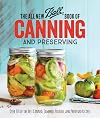
My copy of the Ball Blue Book, the one that I think of as "new", was actually published in 1995, so I decided it was past time to treat myself to a 21st century canning guide. This book both surpasses my expectations and falls somewhat short.
I was delighted to find recipes for two kinds of mustard! It has been very difficult to find a trustworthy recipe for mustard that does not require refrigerator storage. Also elusive has been a recipe for pickled brussels sprouts. I found one years ago show more in Canadian Living, but lost the recipe again (if I even ever had the chutzpah to remove the magazine from International Tires waiting room!). Here it is, or something just as good.
I was also delighted to find paired recipes for blueberry syrup and blueberry butter made from the leftover pulp. I love a twofer! (Hint: if you thaw frozen strawberries and use the dripped-off juice for making jelly, the pulp is great for making strawberry-rhubarb-sour cream pie. You're welcome.)
I was less happy with the 21st Century fancy recipe book format. One recipe per page, okay. Full page colour picture facing each recipe, increases the price of the book and doesn't really add to the usefulness because jam looks like jam, but fine, I can live with it. Recipes for using canned food interspersed with the actual recipes for canning, not so thrilled. Look at the bottom of the page to see if there are processing times given!
One of the things I liked about my 1995 Ball Blue Book was the sheer number of recipes and the crowded format that squeezed four or five recipes onto a page (I suspect that there were almost as many recipes, or more, in 120 pages as this one has in 350) so you could compare several versions of tomato sauce or salsa without a lot of page flipping. This book has a feature that does much the same thing, which I think I will come to love. Easily found by the coloured edges of the pages, green-rimmed pages contain tables of jams or pickles or fruits, giving quantities for simple and basic preserving. For example, there is a page of Fruit Butter basics with fruits, liquids, sweeteners and flavouring suggestions to mix and match, plus instructions for making the spread in a slow cooker and processing. It looks intriguing! show less
I was delighted to find recipes for two kinds of mustard! It has been very difficult to find a trustworthy recipe for mustard that does not require refrigerator storage. Also elusive has been a recipe for pickled brussels sprouts. I found one years ago show more in Canadian Living, but lost the recipe again (if I even ever had the chutzpah to remove the magazine from International Tires waiting room!). Here it is, or something just as good.
I was also delighted to find paired recipes for blueberry syrup and blueberry butter made from the leftover pulp. I love a twofer! (Hint: if you thaw frozen strawberries and use the dripped-off juice for making jelly, the pulp is great for making strawberry-rhubarb-sour cream pie. You're welcome.)
I was less happy with the 21st Century fancy recipe book format. One recipe per page, okay. Full page colour picture facing each recipe, increases the price of the book and doesn't really add to the usefulness because jam looks like jam, but fine, I can live with it. Recipes for using canned food interspersed with the actual recipes for canning, not so thrilled. Look at the bottom of the page to see if there are processing times given!
One of the things I liked about my 1995 Ball Blue Book was the sheer number of recipes and the crowded format that squeezed four or five recipes onto a page (I suspect that there were almost as many recipes, or more, in 120 pages as this one has in 350) so you could compare several versions of tomato sauce or salsa without a lot of page flipping. This book has a feature that does much the same thing, which I think I will come to love. Easily found by the coloured edges of the pages, green-rimmed pages contain tables of jams or pickles or fruits, giving quantities for simple and basic preserving. For example, there is a page of Fruit Butter basics with fruits, liquids, sweeteners and flavouring suggestions to mix and match, plus instructions for making the spread in a slow cooker and processing. It looks intriguing! show less
Ball Canning Back to Basics: A Foolproof Guide to Canning Jams, Jellies, Pickles, and More by Ball Home Canning Test Kitchen
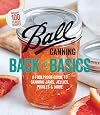
THIS book is a great choice for newbies. I know because I am one. Honestly, I have wanted to put up preserves for some time but was put off by the books I read. I think my sense of being in over my head came from the fact that I couldn't 'visualize' exactly what needed to be done. Ball's approach in this BACK TO BASICS book is much more my style. I LOVE the lists of equipment needed and the explanations .AND. photos of how things need to be done.
Need to know what a good set looks like? show more There's a photo.
Not sure exactly how to measure 'headspace'... there's a photo.
There are a variety of recipes and many of them, like the one I made --Blueberry Jam-- are simple and relatively quick. Basically, you only need your canning supplies and 4 ingredients: blueberries, pectin, sugar and lemon juice. And I really liked that there was a low sugar version and you were told ahead of time, how the low-sugar jam would be slightly different than the full sugar. (It's basically not as thick.)
Recommended to Noobs like myself. show less
Need to know what a good set looks like? show more There's a photo.
Not sure exactly how to measure 'headspace'... there's a photo.
There are a variety of recipes and many of them, like the one I made --Blueberry Jam-- are simple and relatively quick. Basically, you only need your canning supplies and 4 ingredients: blueberries, pectin, sugar and lemon juice. And I really liked that there was a low sugar version and you were told ahead of time, how the low-sugar jam would be slightly different than the full sugar. (It's basically not as thick.)
Recommended to Noobs like myself. show less

Honestly I have so many books on preserving now that this one seems redundant. I read the 1985 edition and it has out-of-date canning methods. The jam-packed format is great for putting in a lot of recipes but not so great for people who like a little bit more about each recipe. I like the lists of problems and solutions, which was probably the most useful part of this book.

This is an essential reference book for home food preservers. There are myriad recipes to try with clear and concise directions for both beginning and experienced canners.
You May Also Like


Statistics
- Works
- 25
- Members
- 1,795
- Popularity
- #14,331
- Rating
- 4.3
- Reviews
- 13
- ISBNs
- 17
- Languages
- 1