
Theodore A. Rees Cheney (1928–2008)
Author of Getting the words right : 39 ways to improve your writing
About the Author
Works by Theodore A. Rees Cheney
Tagged
Common Knowledge
- Canonical name
- Cheney, Theodore A. Rees
- Other names
- Cheney, Theodore A.
- Birthdate
- 1928-01-01
- Date of death
- 2008-03-28
- Gender
- male
- Occupations
- professor
- Nationality
- USA (birth)
- Places of residence
- Fairfield, Connecticut, USA
- Associated Place (for map)
- Connecticut, USA
Members
Reviews
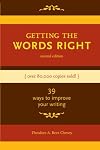
I have read many books on writing in the past. Several dealt with grammar, or structure, or plotting, or selling, or any of the other aspects of writing that everybody struggles with. However, Getting the Words Right by Theodore A. Rees Cheney is different than these other books, and it is so for a very good reason.
Cheney, in his book, presents 39 methods for improving your writing. Why not 40? Not because Cheney was lazy and couldn’t think of another one, but rather, this number show more originates from a quote by a notable author near the beginning of the book, as does the title. It is with reading this that everything started to fall into place.
Cheney takes the reader/writer on a journey through the wild, untamed lands of first drafts, extolling the importance of writing first, and revising second (and repeating this cycle ad perfectum), as revising while writing hinders the writing from being in your “style”, or may distract you too much from what you’re writing to actually say what you’re trying to say. It is later that you come by with the sickle and the hoe and tame those wild waves of grain you previously sowed.
His attitude in writing the book is honest. While many grammar educators will instruct you on the importance of sentence structure, ultimately, that sort of thing only seem to matter to English teachers and natural-language processor developers. Human brains have an ability that’s uncanny in how it parses a sentence, or a fragment of a sentence. It finds a way to fill in the blanks.
However, it is up to the writer to ensure that the blanks only provide for a more enjoyable read, and not a bumpy path down which the reader rides, jittering and complaining the entire way.
The advice provided in this book is very useful, making an excellent desk reference to consult whenever you’re revising, and especially when you’re editing. It’s definitely something to skim through before you send that manuscript to the publisher, and it belongs on any writer’s bookshelf beside style guides, prose construction guides, and other useful books on writing.
I’d recommend Getting the Words right to any writer, fiction or non-fiction, looking to hone their craft. Though there was a lot I already knew, I managed to learn quite a bit from reading this book, including ways of expressing what I already knew. show less
Cheney, in his book, presents 39 methods for improving your writing. Why not 40? Not because Cheney was lazy and couldn’t think of another one, but rather, this number show more originates from a quote by a notable author near the beginning of the book, as does the title. It is with reading this that everything started to fall into place.
Cheney takes the reader/writer on a journey through the wild, untamed lands of first drafts, extolling the importance of writing first, and revising second (and repeating this cycle ad perfectum), as revising while writing hinders the writing from being in your “style”, or may distract you too much from what you’re writing to actually say what you’re trying to say. It is later that you come by with the sickle and the hoe and tame those wild waves of grain you previously sowed.
His attitude in writing the book is honest. While many grammar educators will instruct you on the importance of sentence structure, ultimately, that sort of thing only seem to matter to English teachers and natural-language processor developers. Human brains have an ability that’s uncanny in how it parses a sentence, or a fragment of a sentence. It finds a way to fill in the blanks.
However, it is up to the writer to ensure that the blanks only provide for a more enjoyable read, and not a bumpy path down which the reader rides, jittering and complaining the entire way.
The advice provided in this book is very useful, making an excellent desk reference to consult whenever you’re revising, and especially when you’re editing. It’s definitely something to skim through before you send that manuscript to the publisher, and it belongs on any writer’s bookshelf beside style guides, prose construction guides, and other useful books on writing.
I’d recommend Getting the Words right to any writer, fiction or non-fiction, looking to hone their craft. Though there was a lot I already knew, I managed to learn quite a bit from reading this book, including ways of expressing what I already knew. show less
This book has sound recommendations and is full of examples. Nothing new here and a bit tedious to read, but it will be useful as a reference.
For anyone who is intimidated by the rewrite stage, this seems like a good starting point. I found some basic things in here that were useful, and it's an amusing read in parts. For instance, his section of the overuse of intensives gives a list of useless intensives (awfully, certainly, extremely, exciting, etc.) and then uses them all in sentences pertaining to a frog. "He was an awfully good frog. Your frog is certainly beautiful. I find frog-keeping simply exciting." and so on. The point show more being, that the intensives really (oops, there's one now!) don't add anything meaningful to the sentence. Although, I would argue that at times, when creating a voice, these highly overused words are really, truly perfect. show less
This is a real treasure of a book, one I keep going back to over and over again. It covers the three fundamentals of revision (reducing, rearranging, and rewording). I highly recommend it.
You May Also Like


Statistics
- Works
- 5
- Members
- 485
- Popularity
- #50,912
- Rating
- 3.9
- Reviews
- 7
- ISBNs
- 12