

Jonathan Fenby
Author of Modern China: The Fall and Rise of a Great Power, 1850 to the Present
About the Author
Jonathan Fenby is a former editor of the Observer and South China Morning Post and a founding partner and Managing Director of Trusted Sources research service. He is the author of several popular books on China, including Tiger Head, Snake Tails and The Penguin History of Modern China.
Image credit: Jonathan Fenby [credit: Justine Stoddart]
Works by Jonathan Fenby
Alliance: The Inside Story of How Roosevelt, Stalin and Churchill Won One War and Began Another (2006) 85 copies, 1 review
Tiger Head, Snake Tails: China Today, How It Got There, and Where It Is Heading (2012) 68 copies, 2 reviews
The Seventy Wonders of China 1 copy
Tagged
Common Knowledge
- Canonical name
- Fenby, Jonathan
- Birthdate
- 1942-11-11
- Gender
- male
- Education
- New College, Oxford
King Edward VI Grammar School, Birmingham
Westminster School, London - Occupations
- author
journalist
managing director
news editor - Organizations
- Trusted Sources
Reuters
The Economist
The Independent
The Guardian
The Observer (show all 8)
South China Morning Post
European Journalism Centre - Awards and honors
- Order of the British Empire (Commander)
French National Order of Merit (1991) - Nationality
- UK
- Places of residence
- London, England, UK
Paris, France
Bonn, Germany
Hong Kong - Map Location
- Marea Britanie
Members
Reviews

Fenby is a long-serving foreign correspondent in Paris, and this brisk run-through of French history in the 200 years from Waterloo to Charlie Hebdo really feels like high-quality journalistic writing. Clear, concise storytelling with efficient little sketches of the main actors, issues and events, enough peripheral detail to keep it lively, but no padding. Of course, even on those terms 200 years in the history of a major European power in 500 pages is a tall order, and that means the focus show more has to stay quite narrow, with little space for anything beyond political events at the centre of power. This is a very useful book for anyone who has trouble sorting out which was Louis-Philippe and which was Louis Napoleon, or can’t remember whether Giscard or Mitterrand came first, but don’t expect more on cultural history than lists of prominent writers and artists.
Fenby is clearly a big fan of Charles de Gaulle (he’s also written a biography), and his account of the period when he was in charge is one of the most interesting parts of the book. But he clearly wishes de Gaulle had stepped down in 1965. And he evidently has as little sympathy for the rebels of 68 as de Gaulle did. He sees them as just another bunch of protesters following the hallowed French tradition of taking to the streets to defend their own special interests at the expense of the rest of French society. A tradition which he feels is responsible for a lot of France’s problems. Governments come into power with reform agendas, get bogged down in conflict with interest groups who resist the proposed changes, and end up doing nothing. I’m not sure that’s a peculiarly French problem...
A good read and a useful book for filling in gaps and working out who’s who, but leaves you wanting something a bit deeper. show less
Fenby is clearly a big fan of Charles de Gaulle (he’s also written a biography), and his account of the period when he was in charge is one of the most interesting parts of the book. But he clearly wishes de Gaulle had stepped down in 1965. And he evidently has as little sympathy for the rebels of 68 as de Gaulle did. He sees them as just another bunch of protesters following the hallowed French tradition of taking to the streets to defend their own special interests at the expense of the rest of French society. A tradition which he feels is responsible for a lot of France’s problems. Governments come into power with reform agendas, get bogged down in conflict with interest groups who resist the proposed changes, and end up doing nothing. I’m not sure that’s a peculiarly French problem...
A good read and a useful book for filling in gaps and working out who’s who, but leaves you wanting something a bit deeper. show less
I was concerned a book about politics and the economy would be boring, but decided to take a chance because I love nonfiction and books about France. The first chapter almost made me give up on the book, with a disorganized overview of the contents of the book and a laundry-list of the things which make France great. I stuck it out though and if you’re someone interested in learning about modern France, I’d highly recommend you do the same. The author has collected many great stories of show more both historical events and his own experiences in France. He did a great job bringing France to life and made me very hungry reading about French cuisine.
I was initially dubious about the book’s organization by subject rather than chronology. Especially as someone not familiar with the history of France’s politics, it took me a little while to grasp the order of the events being discussed. By the middle of the book though, the references to the same events as they related to different subjects actually made it easier to learn from the book. The organization by subject also meant I could benefit more from the author’s grasp of the big picture of French politics and history. Had I simply read about the events in chronological order, I might never have gotten many of the author’s insights. Overall, I enjoyed this a lot and was surprised when the initially dry-appearing book made me laugh out loud at several of the author’s stories.
This review first published at Doing Dewey. show less
I was initially dubious about the book’s organization by subject rather than chronology. Especially as someone not familiar with the history of France’s politics, it took me a little while to grasp the order of the events being discussed. By the middle of the book though, the references to the same events as they related to different subjects actually made it easier to learn from the book. The organization by subject also meant I could benefit more from the author’s grasp of the big picture of French politics and history. Had I simply read about the events in chronological order, I might never have gotten many of the author’s insights. Overall, I enjoyed this a lot and was surprised when the initially dry-appearing book made me laugh out loud at several of the author’s stories.
This review first published at Doing Dewey. show less
The Penguin History of Modern China: The Fall and Rise of a Great Power, 1850 to the Present by Jonathan Fenby
How do you write a book like this? The subject is immense. How do you gather together all the information needed to present the coherent picture the author provides? It is an extremely interesting book which I never had any trouble returning to on a daily basis. I usually have difficulty actually finishing a book of this size, because no matter how interesting the subject, I start to tire of too much information about any one thing. This is not the case here.
The horrors the author describes show more are necessary to allow you to appreciate the emphasis the rulers of China place on "stability". From a Western POV we always have default setting against authoritarian regimes, however, we seldom count the cost of the chaos that develops without some form of structure that can hold a country like China together. I'm enough of a Western Liberal, that I find it difficult to accept the costs associated with "stability" but the book certainly forces you to look at the costs associated with a lack of "stability". show less
The horrors the author describes show more are necessary to allow you to appreciate the emphasis the rulers of China place on "stability". From a Western POV we always have default setting against authoritarian regimes, however, we seldom count the cost of the chaos that develops without some form of structure that can hold a country like China together. I'm enough of a Western Liberal, that I find it difficult to accept the costs associated with "stability" but the book certainly forces you to look at the costs associated with a lack of "stability". show less
Alliance: The Inside Story of How Roosevelt, Stalin and Churchill Won One War and Began Another by Jonathan Fenby
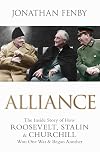
This is a straightforward narrative of the interplay between Roosevelt, Stalin and Churchill during the Second World War. Its a gripping story and well told in this book, which provides a good insight into the different motivations of the Big Three, how they changed over time and the compromises (or lack thereof) they made in order to keep the alliance going. It was particularly useful for me since much of the history of the Cold War that I had previously read tended to kick things off from show more the Yalta conference (or alternately the "percentages agreement" between Churchill and Stalin).
One can see Stalin's deep mistrust of the allies as they continually delay the allied invasion of Europe and Roosevelt's distrust of Churchill's focus on the Mediterranean and Aegean as being a ploy to use American troops to prop up the British Empire rather than defeat Nazi Germany. By 1944 Stalin's armies were steam-rolling the Germans and he felt he no longer had to offer compromise on his aim of establishing a deep cordon sanitaire fending the USSR off from western Europe. This meant that he had the upper hand in the meeting at Yalta where Roosevelt made concessions on Poland and China to the USSR because he needed Stalin's cooperation in participating in the United Nations and in declaring war on Japan.
By Potsdam, Roosevelt, who had counted on establishing a close personal relationship with Stalin as a way to counter some of his excesses, was dead and Truman had the Atomic bomb and a way to end the war with Japan sooner rather than through a land invasion which was projected to take a year and half to complete. Churchill had also been thrown out by the British electorate, bringing a labour government headed by Atlee to power. Paradoxically this meant a worsening of relations with Stalin, whom Churchill often spoke admiringly of even when he bemoaned the rise of Soviet power. One thing that had united Churchill and Stalin was their dislike of the principles of the Atlantic Charter which had promised to uphold democratic principles across the world - in Churchill's case because it would weaken Britain's hold on its Empire, particularly India. Attlee on the other hand was determined to offer India greater independence and sided with Truman who wanted to take a tougher line on ideological principles.
For those who have read widely on the period there are no earth-shaking revelations, but what Fenby does so well is bring the main characters alive, with his eye for detail and the telling quote. In that respect its an engaging and lively account that is well worth reading. show less
One can see Stalin's deep mistrust of the allies as they continually delay the allied invasion of Europe and Roosevelt's distrust of Churchill's focus on the Mediterranean and Aegean as being a ploy to use American troops to prop up the British Empire rather than defeat Nazi Germany. By 1944 Stalin's armies were steam-rolling the Germans and he felt he no longer had to offer compromise on his aim of establishing a deep cordon sanitaire fending the USSR off from western Europe. This meant that he had the upper hand in the meeting at Yalta where Roosevelt made concessions on Poland and China to the USSR because he needed Stalin's cooperation in participating in the United Nations and in declaring war on Japan.
By Potsdam, Roosevelt, who had counted on establishing a close personal relationship with Stalin as a way to counter some of his excesses, was dead and Truman had the Atomic bomb and a way to end the war with Japan sooner rather than through a land invasion which was projected to take a year and half to complete. Churchill had also been thrown out by the British electorate, bringing a labour government headed by Atlee to power. Paradoxically this meant a worsening of relations with Stalin, whom Churchill often spoke admiringly of even when he bemoaned the rise of Soviet power. One thing that had united Churchill and Stalin was their dislike of the principles of the Atlantic Charter which had promised to uphold democratic principles across the world - in Churchill's case because it would weaken Britain's hold on its Empire, particularly India. Attlee on the other hand was determined to offer India greater independence and sided with Truman who wanted to take a tougher line on ideological principles.
For those who have read widely on the period there are no earth-shaking revelations, but what Fenby does so well is bring the main characters alive, with his eye for detail and the telling quote. In that respect its an engaging and lively account that is well worth reading. show less
Lists
THE WAR ROOM (1)
Awards


You May Also Like


Associated Authors
Statistics
- Works
- 25
- Members
- 1,672
- Popularity
- #15,366
- Rating
- 3.7
- Reviews
- 36
- ISBNs
- 98
- Languages
- 10
- Favorited
- 2


