
June Cotner
Author of Graces: Prayers for Everyday Meals and Special Occasions
About the Author
Image credit: June Cotner (2009)
Works by June Cotner
Wedding Blessings: Prayers and Poems Celebrating Love, Marriage and Anniversaries (2003) 30 copies, 1 review
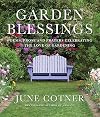
Garden Blessings: Prose, Poems and Prayers Celebrating the Love of Gardening (2014) 22 copies, 10 reviews
Looking for God in All the Right Places: Prayers and Poems to Comfort, Inspire, and Connect Humanity (2004) 10 copies
Bless the Earth: A Collection of Poetry for Children to Celebrate and Care for Our World (2024) 6 copies
Heal Your Soul, Heal the World: Prayers and Poems to Comfort, Inspire, and Connect Humanity (1998) 6 copies
Dog Blessings: Poems, Prose, and Prayers Celebrating Our Relationship with Dogs (2008) 6 copies, 1 review
Tagged
Common Knowledge
- Canonical name
- Cotner, June
- Gender
- female
- Nationality
- USA
- Associated Place (for map)
- USA
Members
Reviews
This is the type of book to take to the garden and, during little breaks away from the flowerbeds, read bits and pieces, here and there over a glass of cool lemonade. The gardener identifies with these poems and vignettes. I especially enjoyed a poem where a gardener describes her hands that no cream can soften. How true. Afterwards, as you work, you remember with joy what you have read.
 This review was written for LibraryThing Early Reviewers.
This is a handsomely produced book celebrating plants and flowers and growing things. I could have wished for the inclusion of more verse from well-known, classic writers (more substantive and interesting poetry) but still makes for a decent gift for the garden lover in your life.
This review was written for LibraryThing Early Reviewers.I had high hopes for the book “Garden Prayers: poems, prose and prayers celebrating the love of gardening”. Those hopes were quickly dashed. It has a table of contents, which implies some sort of ordering in the contents. When actually read, however, the sense of order is quick to dissipate.
I gave the book two stars because there are enough gems sprinkled through the book to justify giving the book shelf space, but that is all it has. A few great quotations, poems and proverbs are show more hidden among the shallow, self-indulgent pieces that most greeting card companies would probably reject. Prayers are mixes in with prose to which there is so little relation that one wonders that the author considered them for the same book.
Yes “Gardener’s Winter Lament” (p 54) and “A Gardener’s Springtime Prayer” (p. 55) are both about the seasons (although they are in the chapter on “Gardening”, not the chapter on “Seasons” but they clash to my ear, no matter that they face each other. One is a an iambic pentameter wannabe of all the chores that need to be done with the emphasis on keeping the idea of the person who gardens out of the picture, the gardener not showing up until the last line, which is the best in the poem, “grateful my garden always needs me.” The other, opposite that, is a prayer “Here are my hands, Spirit of Earth and Space,” which could be used as an opening or closing prayer in a small group ministry setting.
I may have actually skipped some pieces because of trite titles, but I learned early in the book that she buries the prizes deep. I read a lot of tripe to find the ineptly titled “Your Flowers Are Pretty” (p. 60) which has more to do about the gardener than the "Gardening" chapter where it is placed.
By page 132, I was tired, and almost missed Martin Luther's “Even if I knew that tomorrow the world would go to pieces, I would still plant my apple tree.” I slid by it because it headed a piece that starts with the oh so original lines “Apple round and red, / bestow upon my dear one's head / these many blessings: “ I'm sure I've heard that before. Oh yes, the child's game we used to play; “Apple apple round and red, went kurplunk on (whoever's) head!”
The best chapter, in my opinion, was the final one, “Inspiration”. Here we find Julian of Norwich and Walt Whitman; “A Community Garden Blessing” that one may actually use; other actual prayers worth reading, if not using; and the poem “Miracle” (p. 199) that in a few short words expresses what gardeners hold for all the world, promise and faith.
These wonderful pieces do not excuse the randomness with which they were put together nor the matrix of insipid trash I needed to plow through in order to find them. show less
I gave the book two stars because there are enough gems sprinkled through the book to justify giving the book shelf space, but that is all it has. A few great quotations, poems and proverbs are show more hidden among the shallow, self-indulgent pieces that most greeting card companies would probably reject. Prayers are mixes in with prose to which there is so little relation that one wonders that the author considered them for the same book.
Yes “Gardener’s Winter Lament” (p 54) and “A Gardener’s Springtime Prayer” (p. 55) are both about the seasons (although they are in the chapter on “Gardening”, not the chapter on “Seasons” but they clash to my ear, no matter that they face each other. One is a an iambic pentameter wannabe of all the chores that need to be done with the emphasis on keeping the idea of the person who gardens out of the picture, the gardener not showing up until the last line, which is the best in the poem, “grateful my garden always needs me.” The other, opposite that, is a prayer “Here are my hands, Spirit of Earth and Space,” which could be used as an opening or closing prayer in a small group ministry setting.
I may have actually skipped some pieces because of trite titles, but I learned early in the book that she buries the prizes deep. I read a lot of tripe to find the ineptly titled “Your Flowers Are Pretty” (p. 60) which has more to do about the gardener than the "Gardening" chapter where it is placed.
By page 132, I was tired, and almost missed Martin Luther's “Even if I knew that tomorrow the world would go to pieces, I would still plant my apple tree.” I slid by it because it headed a piece that starts with the oh so original lines “Apple round and red, / bestow upon my dear one's head / these many blessings: “ I'm sure I've heard that before. Oh yes, the child's game we used to play; “Apple apple round and red, went kurplunk on (whoever's) head!”
The best chapter, in my opinion, was the final one, “Inspiration”. Here we find Julian of Norwich and Walt Whitman; “A Community Garden Blessing” that one may actually use; other actual prayers worth reading, if not using; and the poem “Miracle” (p. 199) that in a few short words expresses what gardeners hold for all the world, promise and faith.
These wonderful pieces do not excuse the randomness with which they were put together nor the matrix of insipid trash I needed to plow through in order to find them. show less
This review was written for LibraryThing Early Reviewers.A book of poems and other meditations on all things related to gardening, it is of course an ideal gift for a gardener or someone who likes light poetry and inspirational quotes. But if that is the only way you look at this book, you are missing out. It is, in its own way, an interesting set of meditations on the seasons, and a collection of mostly contemporary observations on nature. The imagery and overall quality of the selections is particularly strong for a book of this type. I do wish show more the book had not been set entirely in green type on a white page because it is not the most restful to the eye, but then as this book is largely meant to be read in small dips, this is not a fatal flaw. show less
This review was written for LibraryThing Early Reviewers.Awards

You May Also Like


Associated Authors
Statistics
- Works
- 36
- Members
- 789
- Popularity
- #32,271
- Rating
- 3.8
- Reviews
- 17
- ISBNs
- 79
- Languages
- 1
