

John Wesley Powell (1834–1902)
Author of The Exploration of the Colorado River and Its Canyons
About the Author
Powell was born in western New York. His family later moved to Ohio and then to Wisconsin, where he began his adult life as a teacher. For about nine years, he taught and took time to study at colleges in Ohio and Illinois. When the Civil War began, he enlisted and quickly rose to the rank of show more major, laying out roads and designing bridges. Powell was wounded at the Battle of Shiloh and lost his right arm. Because of these events, for the remainder of his life he was referred to as Major Powell or One-arm Powell. After the war, he organized several expeditions down the Colorado River, which heretofore had not come under scientific study. It was during these trips and others that he formulated the concept of base level and antecedent streams. Although his ideas and observations are noteworthy, Powell was not a prolific writer, and his writings were not scholarly in style. Powell became the president of the U.S. Geological Survey, a position from which he lobbied congressmen and senators for funding for topographic mapping and technical reports. He was a strong proponent of developing the American West on a sound and realistic foundation. Powell died in Maine during the summer of 1902. (Bowker Author Biography) show less
Image credit: John Wesley Powell (1834-1902)
(Library of Congress Prints and Photographs Division. Reproduction Number: LC-USZ62-3862)
Works by John Wesley Powell
Introduction to 'Handbook of American Indian Languages' and 'Indian Linguistic Families of America North of Mexico' (1963) — Author; Author — 128 copies
Report on the Lands of the Arid Region of the United States, With a More Detailed Account of the Lands of Utah (1876) 32 copies
FOURTH ANNUAL REPORT Of The BUREAU Of ETHNOLOGY To The SECRETARY Of The SMITHSONIAN INSTITUTION 1882 - '83. (2017) 23 copies
First annual report of Bureau of Ethnology to Secretary of Smithsonian Institution, 1879-80 (1881) 22 copies, 2 reviews
Ninth annual report of the Bureau of Ethnology to the Secretary of the Smithsonian Institution, 1887-'88 (1889) 18 copies
Seventh annual report of the Bureau of Ethnology to the Secretary of the Smithsonian Institution, 1885-86 (1891) 16 copies
Third annual report of the Bureau of Ethnology to the Secretary of the Smithsonian Institution, 1881-82 (1884) 16 copies
Second annual report of the Bureau of Ethnology to the Secretary of the Smithsonian Institution, 1880-81 (1883) 15 copies, 1 review
Eighth annual report of the Bureau of Ethnology to the Secretary of the Smithsonian Institution, 1886-87 (1891) 15 copies
Sixth annual report of the Bureau of Ethnology to the Secretary of the Smithsonian Institution, 1884-85 (1888) 14 copies
Anthropology of the Numa; John Wesley Powell's manuscripts on the Numic peoples of Western North America, 1868-1880 (1971) 14 copies
Sixteenth annual report of the Bureau of American Ethnology to the Secretary of the Smithsonian Institution, 1894-95 (1897) 13 copies
Twenty-first annual report of the Bureau of American Ethnology : to the Secretary of the Smithsonian Institution, 1899-1900 (1903) 13 copies, 1 review
First through the Grand Canyon: Being the record of the pioneer exploration of the Colorado River in 1869-70 (2009) 12 copies, 1 review
Tenth annual report of the Bureau of Ethnology : to the Secretary of the Smithsonian Institution, 1888-89 (1889) 11 copies, 1 review
Twenty-third (23rd) Annual Report Of The Bureau Of American Ethnology To The Secretary Of The Smithsonian Institution 1901-1902 (1904) 8 copies
11th Annual Report of the Bureau of Ethnology to the Secretary of the Smithsonian Institution 1889-90 (1894) 8 copies
Fifteenth annual report of the Bureau of Ethnology : to the Secretary of the Smithsonian Institution, 1893-94 (1897) 7 copies
Twentieth annual report of the Bureau of American Ethnology to the Secretary of the Smithsonian Institution, 1898-99 (1903) 7 copies
Nineteenth annual report of the Bureau of American Ethnology : to the Secretary of the Smithsonian Institution, 1897-98 (1900) 6 copies
Seventeenth Annual Report of the Bureau of Ethnology to the Secretary of the Smithsonian Institution, 1895-96 Part 2 (1899) 4 copies
Fourteenth Annual Report of the Bureau of Ethnology to the Secretary of the Smithsonian Institution 1892-1893 in Two Parts Part I (2017) 3 copies
Beyond The Hundredth Meridian - John Wesley Powell And The Second Opening Of The West (1954) 3 copies
Selected prose of John Wesley Powell 3 copies
Bureau of Ethnology 2 copies
Exploring the Colorado River: Firsthand Accounts by Powell and His Crew (Dover Books on Travel, Adventure) (2012) 2 copies
Utah Historical Quarterly - Vol. 15, No. 1-4, January, April, July, October 1947 - The Exploration of the Colorado River in 1869 (1947) — Contributor — 2 copies
Introduction to the study of Indian languages, with words, phrases and sentences to be collected 2 copies
Fifteenth Annual Report of The Bureau of Ethnology to the Secretary of the Smithsonian Institution, 1893 - '94. (1897) 1 copy
Second Annual Report of the Bureau of Ethnology to the Secretary of the Smithsonian Institute 1 copy
Thirteenth Annual Report of the Bureau of American Ethnology to the Secretary of the Smithsonian Institution 1891-'92 (1896) 1 copy
NINTH ANNUAL REPORT Of The BUREAU Of ETHNOLOGY To The SECRETARY Of The SMITHSONIAN INSTITUTION. 1887 - 1888. (1892) 1 copy
On Primitive Institutions 1 copy
A RIVER RUNNING WEST 1 copy
Twelfth Annual Report of the United States Geological Survey to the Secretary of the Interior 1890-91 Part II Irrig (1891) 1 copy
fifth annual report of the united states geological survey to the secretary of the interior 1883-84 1 copy
The exploration of the Colorado River and its canyons (formerly titled: Canyons of the Colorado). 1 copy
Sixth Annual Report 1 copy
Associated Works
The Best of the West: An Anthology of Classic Writing from the American West (1991) — Contributor — 285 copies, 1 review
Classic Survival Stories: Thirteen Tales of Strength, Determination, and the Will to Live (2004) 19 copies
Utah Historical Quarterly - Vol. 7, No. 1-3, January, April and July 1939 - Diary of Almon Harris Thompson (1939) — Contributor — 1 copy
Adventure Classics 1 copy
Tagged
Common Knowledge
- Legal name
- Powell, John Wesley
- Other names
- Powell, J. W.
- Birthdate
- 1834-04-24
- Date of death
- 1902-09-23
- Gender
- male
- Education
- Illinois College
Oberlin College - Occupations
- geologist
university professor
civil servant
army officer - Organizations
- U.S. Geological Survey
Smithsonian Institution
Illinois Natural History Society
Illinois Wesleyan University
Illinois State Normal University
Museum of the Illinois State Natural History Society (show all 7)
U.S. Army - Awards and honors
- mineral Powellite named in his honor
Lake Powell named in his honor
Powell Peak named in his honor
Powell Plateau named in his honor
Powell, Wyoming, USA named in his honor
Criminal Justice Services Department of Mesa County in Grand Junction, Colorado residential building named in his honor (show all 8)
John Wesley Powell Middle School, Littleton, Colorado, USA named in his honor
Powell Jr High School, Mesa, Arizona, USA named in his honor - Nationality
- USA
- Birthplace
- Mount Morris, New York, USA
- Places of residence
- Jackson, Ohio, USA
Walworth County, Wisconsin, USA
Boone County, Illinois, USA - Place of death
- Brooklin, Maine, USA
- Burial location
- Arlington National Cemetery, Arlington, Virginia, USA
- Associated Place (for map)
- USA
Members
Reviews
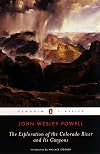
Though plain spoken in describing the portages in such canyons the immensity of the landscape and the task undertaken by Powell and his men permeated the read. Truly an awesome undertaken. And his descriptions of side canyons and Indians that inhabited these areas in the early 1870s were very interesting and unsentimental. A very enlightening though sometimes tedious read.
Classic read about the first major expedition of the Colorado river area. Great descriptions of the landscape and the adventures of the crew. Also interesting to read about the interaction of Powell and his team with local Indian tribes and description of their different cultures
Down the Colorado: Diary of the First Trip through the Grand Canyon, 1869; photographs and epilogue, 1969 by John Wesley Powell

This book serves as a nice companion to The Exploration of the Colorado River and Its Canyons, but not as a substitute, unless you are solely interested in Powell's Diary of the First Trip Through the Grand Canyon.
This large format book is broken up into three main parts: Foreword by Don D. Fowler, Diary of the First Trip Through the Grand Canyon 1869 by John Wesley Powell, and The Canyons of the Colorado - Past and Present 1969 by Eliot Porter. Interspersed throughout the book are show more illustrations from the second expedition in 1871, both engravings and photographs. Also Porter's own color photographs from around the time of this books publication, circa 1960's.
Fowler's foreword is quite useful as a brief chronicling of exploration of the Canyon lands. He also goes at some length to explain the historical inaccuracies of Powell's own diary. Powell apparently blended events of both expeditions into one account to make more of an exciting tale to reproduce for the Scribner's readers back east at the time. His hopes were to excite the public and build momentum for Congress to fund further exploration. This fortunately worked. There is also a fair bit of negativity hinted at the creation of Lake Powell, thus flooding Glen Canyon, one of the rivers in which Powell journey through.
The Diary account is the same as can be found in the Penguin or Dover edition more commonly found in bookstores. The main exception, and a helpful one at that, are a few added footnotes in which it is pointed out where Powell supplemented the first expedition diary with events that occurred in his second expedition. There are also a few quotes taken from some of the other member's diaries, and I dare say, might be more interesting writing than Powell's. Particularly that of Bradley's, which apparently at times contradicts directly what Powell writes, but not on any points that bear importance.
Lastly, there is Porter's Epilogue, which sounds more like Edward Abbey rant than anything, but I can sympathize seeing that this is written only a few years after the damming of Glen Canyon. Porter's photo's are nice and large and focus on the close and intimate side of the canyons. No large landscapes here. show less
This large format book is broken up into three main parts: Foreword by Don D. Fowler, Diary of the First Trip Through the Grand Canyon 1869 by John Wesley Powell, and The Canyons of the Colorado - Past and Present 1969 by Eliot Porter. Interspersed throughout the book are show more illustrations from the second expedition in 1871, both engravings and photographs. Also Porter's own color photographs from around the time of this books publication, circa 1960's.
Fowler's foreword is quite useful as a brief chronicling of exploration of the Canyon lands. He also goes at some length to explain the historical inaccuracies of Powell's own diary. Powell apparently blended events of both expeditions into one account to make more of an exciting tale to reproduce for the Scribner's readers back east at the time. His hopes were to excite the public and build momentum for Congress to fund further exploration. This fortunately worked. There is also a fair bit of negativity hinted at the creation of Lake Powell, thus flooding Glen Canyon, one of the rivers in which Powell journey through.
The Diary account is the same as can be found in the Penguin or Dover edition more commonly found in bookstores. The main exception, and a helpful one at that, are a few added footnotes in which it is pointed out where Powell supplemented the first expedition diary with events that occurred in his second expedition. There are also a few quotes taken from some of the other member's diaries, and I dare say, might be more interesting writing than Powell's. Particularly that of Bradley's, which apparently at times contradicts directly what Powell writes, but not on any points that bear importance.
Lastly, there is Porter's Epilogue, which sounds more like Edward Abbey rant than anything, but I can sympathize seeing that this is written only a few years after the damming of Glen Canyon. Porter's photo's are nice and large and focus on the close and intimate side of the canyons. No large landscapes here. show less
Quite an interesting book, seeing that its more of a collection of writings that were originally written for a magazine. The first 100 pages focused on geography and seems more like nature writing. This part was a little slow and seemed that it was designed to inform casual readers on the east coast, who may not be as familiar with the western territories. It was 1870 after all.
The second and more quickly paced section of the book is the diary of J.W. Powell, but there are some points where show more it can be somewhat confusing because one of the other party members is also named Powell. The diary covers the first trip down the Green River and then the Colorado River through Glen Canyon and Grand Canyon. The third section of the book is really more of an ethnography than exploration and seems to be written in 1890, a good deal after the actual journey. In hindsight, Powell's outlook on the natives he encounters would seem archaic compared to modern anthropology, but given the time and circumstances, it was quite surprising to read his relatively modern views on the matter.
Overall, a nice edition to any exploration literature collection. It covers a lot of subjects and might not be for everyone, especially if your looking to read a book about a rafting trip and not a book about native story telling. show less
The second and more quickly paced section of the book is the diary of J.W. Powell, but there are some points where show more it can be somewhat confusing because one of the other party members is also named Powell. The diary covers the first trip down the Green River and then the Colorado River through Glen Canyon and Grand Canyon. The third section of the book is really more of an ethnography than exploration and seems to be written in 1890, a good deal after the actual journey. In hindsight, Powell's outlook on the natives he encounters would seem archaic compared to modern anthropology, but given the time and circumstances, it was quite surprising to read his relatively modern views on the matter.
Overall, a nice edition to any exploration literature collection. It covers a lot of subjects and might not be for everyone, especially if your looking to read a book about a rafting trip and not a book about native story telling. show less
Lists
Awards


You May Also Like


Associated Authors
Statistics
- Works
- 127
- Also by
- 5
- Members
- 1,753
- Popularity
- #14,672
- Rating
- 3.9
- Reviews
- 15
- ISBNs
- 86
- Languages
- 3