
Bill Martin, Jr. (1916–2004)
Author of Chicka Chicka Boom Boom
About the Author
Children's writer Bill Martin, Jr. was born and raised in Hiawatha, Kansas. Ironically, the future early childhood educator had difficulty reading until he taught himself, before graduating with a teaching certificate from Emporia State University. After graduation, he taught high school drama and show more journalism in Kansas. He served in the Army Air Force as a newspaper editor during World War II. He wrote his first book, The Little Squeegy Bug, for his brother, Bernard, an artist, to illustrate while recuperating from war wounds. It was published in 1945 and the brothers would go on to collaborate on 10 more books by 1955. He earned a master's degree and doctorate in early childhood education from Northwestern University and became principal of an elementary school in Evanston, Ill., where he developed innovative reading programs. In 1962 Martin moved to New York City to become editor of the school division of Holt, Rhinehart and Winston where he developed the literature-based reading programs Sounds of Language and The Instant Readers. Martin returned to full-time writing in 1972 and ended up writing over three hundred children's books during his career. His titles include; Brown Bear, Brown Bear, What do You See?, Polar Bear, Polar Bear, What do you Hear?, The Ghost-Eye Tree, Barn Dance, and Chicka, Chicka, Boom, Boom. He died on August 11, 2004 at the age of 88. (Bowker Author Biography) show less
Series
Works by Bill Martin, Jr.
Brown Bear, Brown Bear, What Do You See? / Polar Bear, Polar Bear, What Do You Hear? / Panda Bear, Panda Bear, What Do You See? (2003) 44 copies, 2 reviews
Brown Bear, Brown Bear, What Do You See? / Polar Bear, Polar Bear, What Do You Hear? / Panda Bear, Panda Bear, What Do You See? / Baby Bear, Baby Bear, What Do You See? (2008) 40 copies, 1 review
Chicka, Chicka, Boom, Boom...and Lots More Learning Fun [1999 film] (2002) — Writer — 37 copies, 2 reviews
Morning Bells (New Dimensions in the World of Reading, Silver Burdett Ginn) (1993) 27 copies, 1 review
Chicka Chicka Box Box!: Chicka Chicka Boom Boom; Chicka Chicka 1, 2, 3 (Chicka Chicka Book, A) (2013) 11 copies
Sounds of Home Teacher's Edition 0030861926 by Bill Martin Jr / Holt Sounds of Language Reading Program (1972) 7 copies
Chicka Chicka ABCs and 123s Collection (Boxed Set): Chicka Chicka ABC; Chicka Chicka 1, 2, 3; Words (Chicka Chicka Book, A) (2018) 5 copies
The Wild Turkey and Her Poults (Bill Martin's Little woodland books read-along series) (1979) 5 copies
Chicka Chicka 123... and More Counting Fun (Scholastic Storybook Treasures) (2009) 4 copies, 1 review
Bears 4 copies
Chicka Chicka Box Box!: Chicka Chicka Boom Boom; Chicka Chicka 1, 2, 3 (Chicka Chicka Book, A) 3 copies
Optical Illusions 3 copies
The Gray Squirrel and the Red Intruder(Bill Martin's Little Woodland books (A Read-Along Series)) (1979) 3 copies
CHEERIOS Promotions -3 Book Set - MARSUPIAL SUE / CHICKA CHICKA BOOM BOOM /THE RELATIVES CAME (2001) 2 copies
Freedom's apple tree 2 copies
Panda Bear, Panda Bear, What Do You See? and Polar Bear, Polar Bear, What Do You Hear? 2 books wit 2 Cd's (2000) 2 copies, 1 review
Five little rabbits, 2 copies
My Crayons Talk 2 copies
Frogs in a pond 2 copies
Golden Arrow 2 copies
Susie Moriar 1 copy
June Bugs 1 copy
The Three Billy-Goats Gruff 1 copy
The Bird and the Snake 1 copy
Chicka Chicka Boom Boom Pack: Chicka Chicka Boom Boom / Chicka Chicka 123 / Boom Chicka Rock (2013) 1 copy
Polar Bear book and CD storytime set (MacMillan Young Listeners) by Bill Martin (2012-12-24) (1856) 1 copy
The Bears and the Bees 1 copy
Sounds Around the Campfire 1 copy
Butterflies Becoming 1 copy
Panda Bear, Panda Bear, 1 copy
The Christmas Puppy 1 copy
From Head to toe 1 copy
Brown Bear, Brown Bear, What Do You See? Slide and Find by Bill Martin Jr.(2005-10-20) (2010) 1 copy
Old Old Witch 1 copy
Diez pequeñas orugas 1 copy
Teaching suggestions for Sounds jubilee and Sounds freedomring (Sounds of language / Bill Martin) (1975) 1 copy
The Perfect Gift for Babies: Essential Board Books for Every Child: Chicka Chicka Boom Boom; Click, Clack, Moo; Dear Zoo (2016) 1 copy
Is Won's Victory 1 copy
Let's Eat 1 copy
Associated Works
The 20th-Century Children's Book Treasury: Picture Books and Stories to Read Aloud (1998) — Contributor — 1,824 copies, 14 reviews
Tagged
Common Knowledge
- Canonical name
- Martin, Bill, Jr.
- Legal name
- Martin, William Ivan, Jr.
- Birthdate
- 1916-03-20
- Date of death
- 2004-08-11
- Gender
- male
- Education
- Emporia State University
Northwestern University (Ph.D|1961)
Kansas State Teachers College (BA) - Occupations
- teacher
principal
editor
children's book author
publishing executive - Organizations
- Holt, Rinehart and Winston
US Army Air Force (WWII) - Nationality
- USA
- Birthplace
- Hiawatha, Kansas, USA
- Places of residence
- Hiawatha, Kansas, USA
New York, New York, USA - Place of death
- Commerce, Texas, USA
- Associated Place (for map)
- USA
Members
Reviews
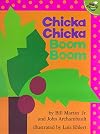
Chicka Chicka Boom Boom by Bill Martin Jr. and John Archambault is a playful children’s picture book that introduces the alphabet in a fun and engaging way. The letters are presented through rhythm and rhyme, which helps young children stay interested and makes it easier for them to memorize the alphabet.
The story follows lowercase letters as they climb a coconut tree in alphabetical order. As more letters climb, the tree begins to bend and eventually the letters fall. After this happens, show more the uppercase letters are introduced, helping children learn the difference between lowercase and uppercase letters in a simple and memorable way.
One of the main themes of the book is inclusion, shown when the uppercase letters come together to help the lowercase letters after they fall. The authors use literary elements such as rhyme, repetition, bright colors, and movement to keep children engaged throughout the story. This book creates a fun learning environment, and on a personal level, it was one of my favorite books as a child because it made learning the alphabet exciting and enjoyable. show less
The story follows lowercase letters as they climb a coconut tree in alphabetical order. As more letters climb, the tree begins to bend and eventually the letters fall. After this happens, show more the uppercase letters are introduced, helping children learn the difference between lowercase and uppercase letters in a simple and memorable way.
One of the main themes of the book is inclusion, shown when the uppercase letters come together to help the lowercase letters after they fall. The authors use literary elements such as rhyme, repetition, bright colors, and movement to keep children engaged throughout the story. This book creates a fun learning environment, and on a personal level, it was one of my favorite books as a child because it made learning the alphabet exciting and enjoyable. show less

A young boy and his sister are dispatched to the other side of town one blustery autumn night to fetch some milk in this spooky picture book from co-authors Bill Martin, Jr. and John Archambault, and illustrator Ted Rand. Hurrying through the dark night, the pair squabble about the boy's hat, which his sister insists makes him look stupid, but they are in complete accord when it comes to the Ghost-Eye tree standing at the midway point of their walk. Making their way past it going out, they show more find themselves terrified by a wailing sound they hear, when passing it on the way back, and scramble madly for safety. Once home, the boy decides he will make himself scarce, when his mother again wants milk at night...
Given the subject matter, and the striking cover image, I expected to enjoy The Ghost-Eye Tree, which I initially sought out as a Halloween read, despite the fact that it is not explicitly a Halloween story. I was not disappointed, finding the story satisfactorily spooky, as well as unexpectedly heartwarming. I appreciated the fact that while the sister begins by ridiculing her brother (not unrealistically, in a tale about siblings), she also is very determined to help him, when push comes to shove and he loses his hat. The accompanying artwork from Ted Rand was by turns deliciously creepy and beautifully expressive, and I particularly appreciated the use of light, and the range of expressions the artist captured in his human faces. The text itself had a poetic cadence, making this a good read-aloud selection, which is hardly surprising when one considers that the story was developed by the co-authors as a readers' theater piece for young people. All in all, this is one I would recommend to picture book readers and audiences in the mood for spooky read-alouds. show less
Given the subject matter, and the striking cover image, I expected to enjoy The Ghost-Eye Tree, which I initially sought out as a Halloween read, despite the fact that it is not explicitly a Halloween story. I was not disappointed, finding the story satisfactorily spooky, as well as unexpectedly heartwarming. I appreciated the fact that while the sister begins by ridiculing her brother (not unrealistically, in a tale about siblings), she also is very determined to help him, when push comes to shove and he loses his hat. The accompanying artwork from Ted Rand was by turns deliciously creepy and beautifully expressive, and I particularly appreciated the use of light, and the range of expressions the artist captured in his human faces. The text itself had a poetic cadence, making this a good read-aloud selection, which is hardly surprising when one considers that the story was developed by the co-authors as a readers' theater piece for young people. All in all, this is one I would recommend to picture book readers and audiences in the mood for spooky read-alouds. show less
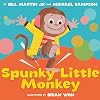
Little Monkey doesn't want to get out of bed, but then suddenly has the energy to greet the day when asked to chant a silly rhyme and wiggle his body.
I wanted to like this book but it had so many strikes against it almost immediately. I know monkey characters can sometimes be problematic but I was willing to see where this goes. Without any context, this monkey for some reason has a sombrero and maracas. Sure ... that makes sense (in sarcasm). Speaking of sense, the rhyme/chant is show more nonsensical almost immediately: "Apple Juice, Orange Juice, Gooseberry Pies -- Monkey needs some exercise!" Rutabaga, Rutabaga Sis! Boom! Bah! And yes, that is the exact capitalization and punctuation used. I could see all the movement bits that come later being fun with toddlers and preschoolers, especially claps and stomps, but I'm not sure exactly how one gets "the rhythm of the head" with a "Ding-Dong!"
The illustrations are bright and cheery, with almost a paper-cut quality to them even though they were made digitally in Adobe Illustrator and Photoshop per the note at the end of the book. Despite first billing, I'm not entirely sure what Bill Martin Jr. had to do with this book, especially given that he passed away 13 years before this book's copyright date. The actual author says that this book's text uses "Bill Martin Jr's philosophy" to engage children to "begin chiming in with you" and try to "match the song in their heads with what is printed on the page." I think titles like Bill Martin Jr's classic Brown Bear, Brown Bear, What Do You See? certainly do that, but I'm less sure that this rutabaga nonsense does -- and furthermore, do we even want that? I'm having a hard time picturing a parent or teacher who wants to hear "Rutabaga, Rutabaga Sis! Boom! Bah!" shouted throughout the day. show less
I wanted to like this book but it had so many strikes against it almost immediately. I know monkey characters can sometimes be problematic but I was willing to see where this goes. Without any context, this monkey for some reason has a sombrero and maracas. Sure ... that makes sense (in sarcasm). Speaking of sense, the rhyme/chant is show more nonsensical almost immediately: "Apple Juice, Orange Juice, Gooseberry Pies -- Monkey needs some exercise!" Rutabaga, Rutabaga Sis! Boom! Bah! And yes, that is the exact capitalization and punctuation used. I could see all the movement bits that come later being fun with toddlers and preschoolers, especially claps and stomps, but I'm not sure exactly how one gets "the rhythm of the head" with a "Ding-Dong!"
The illustrations are bright and cheery, with almost a paper-cut quality to them even though they were made digitally in Adobe Illustrator and Photoshop per the note at the end of the book. Despite first billing, I'm not entirely sure what Bill Martin Jr. had to do with this book, especially given that he passed away 13 years before this book's copyright date. The actual author says that this book's text uses "Bill Martin Jr's philosophy" to engage children to "begin chiming in with you" and try to "match the song in their heads with what is printed on the page." I think titles like Bill Martin Jr's classic Brown Bear, Brown Bear, What Do You See? certainly do that, but I'm less sure that this rutabaga nonsense does -- and furthermore, do we even want that? I'm having a hard time picturing a parent or teacher who wants to hear "Rutabaga, Rutabaga Sis! Boom! Bah!" shouted throughout the day. show less
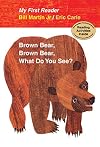
Brown Bear, Brown Bear, What Do You See? is a great early childhood picture book that uses repetition and pattern to help young readers build confidence and predict what comes next. The story moves through a sequence of animals and colors, with each page repeating the same sentence structure. This makes it really effective for beginning readers and also works well as a read-aloud.
The illustrations are bright and bold, which keeps kids interested and helps connect the words to the images. The show more predictable text pattern supports early literacy skills because children can quickly join in and “read” along even if they don’t know every word yet. It also helps reinforce color recognition and animal identification.
In a classroom setting, this book is especially useful for participation and engagement. Kids can chant the lines together, practice memory skills, and connect language with visuals. Even though it’s simple, it’s very purposeful and well-designed for early learners. Overall, it’s a classic that’s both fun and educational. show less
The illustrations are bright and bold, which keeps kids interested and helps connect the words to the images. The show more predictable text pattern supports early literacy skills because children can quickly join in and “read” along even if they don’t know every word yet. It also helps reinforce color recognition and animal identification.
In a classroom setting, this book is especially useful for participation and engagement. Kids can chant the lines together, practice memory skills, and connect language with visuals. Even though it’s simple, it’s very purposeful and well-designed for early learners. Overall, it’s a classic that’s both fun and educational. show less
Lists
Youth: Zoology (4)
Youth: DEI (1)
BitLife (1)
Autumn books (1)
1960s (1)
Ghosts (1)
Awards


You May Also Like


Associated Authors
Statistics
- Works
- 203
- Also by
- 2
- Members
- 72,154
- Popularity
- #176
- Rating
- 4.2
- Reviews
- 2,313
- ISBNs
- 787
- Languages
- 22
- Favorited
- 6

