
Erich Fried (1921–1988)
Author of Liebesgedichte
About the Author
Image credit: Photo © ÖNB/Wien
Series
Works by Erich Fried
Als ich mich nach dir verzehrte. Zweiundsiebzig Gedichte von der Liebe. (Wagenbach SALTO) (1990) 36 copies
Die Beine der größeren Lügen / Unter Nebenfeinden / Gegengift. Drei Gedichtsammlungen. (1999) 7 copies
Georg Eisler — Author — 2 copies
Einblicke - Durchblicke. Fundstücke und Werkstattberichte aus dem Nachlass von Erich Fried (1993) 2 copies
Überlegungen 1 copy
Gedichte; 3. 1 copy
Gedichte; 1. 1 copy
Gedichte; 2. 1 copy
Varovná znamení 1 copy
Prosa 1 copy
Die Gewalt 1 copy
Lírica amorosa alemã moderna — Author — 1 copy
Kopfschwere Erinnerungen — Poetry — 1 copy
Und nicht taub und stumpf werden : Unrecht, Widerstand und Protest ; Reden, Polemiken, Gedichte (1984) 1 copy
Die da reden gegen Vernichtung : Psychologie, bildende Kunst und Dichtung gegen den Krieg (1986) 1 copy
Wezwanie do niepokoju 1 copy
Associated Works
World Poetry: An Anthology of Verse from Antiquity to Our Time (1998) — Contributor — 496 copies, 2 reviews
Against Forgetting: Twentieth-Century Poetry of Witness (1993) — Contributor — 375 copies, 2 reviews
Bertolt Brecht poems part one 1913-1928 Edited by John Willett and Ralph Manheim with the co-operation of Erich Fried (1976) — Composer — 13 copies
Alfred Hrdlicka Texte u. Bilder zur 60. Geburtstag d. Bildhauers A. H (1988) — Contributor — 2 copies
Poesie : Hebräisch, Deutsch — Translator — 1 copy
Erich Fried - Shakespeare-Übersetzungen: Richard II / Heinrich V (1969) — Translator, some editions — 1 copy
Tagged
Common Knowledge
- Canonical name
- Fried, Erich
- Birthdate
- 1921-05-06
- Date of death
- 1988-11-22
- Gender
- male
- Occupations
- poet
translator
essayist - Organizations
- Gruppe 47
- Awards and honors
- Würdigungspreis für Literatur (1972)
Internationaler Verlegerpreis der Sieben (Prix International des Editeurs) (1977)
Literaturpreis der Stadt Wien (1980)
Literaturpreis der Stadt Bremen (1983)
Goldenes Ehrenzeichen für Verdienste um das Land Wien (1985)
Österreichischer Staatspreis für Verdienste um die österreichische Kultur im Ausland (1986) (show all 10)
Carl-von-Ossietzky-Medaille (1987)
Goldener Schlüssel der Stadt Smederevo (1987)
Georg-Büchner-Preis (1987)
Ehrendoktorwürde der Universität Osnabrück (Fachbereich Sprach- und Literaturwissenschaft, 1988) - Nationality
- Austria
- Birthplace
- Vienna, Austria
- Place of death
- Baden-Baden, Baden-Württemberg, Germany
- Burial location
- Kensall Green, London, UK
- Associated Place (for map)
- Austria
Members
Reviews

Without You.
Not nothing
without you
but not the same
Not nothing
without you
but perhaps less
Not nothing
but less
and less
Perhaps not nothing
without you
but not much more
When I wrote an answer to the question “Discuss your thoughts on sentimentality in literature. When is emotion in literature effective and when is it superfluous?”, I used a poem by Pablo Neruda as my main example, I could quite easily have used an example by Erich Fried. The crux of my argument was that although show more anything written was reliant on artifice to convince the reader of it’s veracity, it then becomes how you use it, that to make it work it must be like sleight of hand, so all you see is the magic and not some fool playing with their hands. This brings me to the poetry in this book, there is a deep yearning and desperation to his words, there’s a pain that’s more than bone-deep and yet he displays a stoicism and an optimism that comes across in the humour, this is a poetry that doesn’t scream it’s loss, it displays a subtlety and calm that makes it even more powerful.
What It Is
It is madness
says reason
It is what it is
says love
It is unhappiness
says caution
It is nothing but pain
says fear
It has no future
says insight
It is what it is
says love
It is ridiculous
says pride
It is foolish
says caution
It is impossible
says experience
It is what it is
says love.
This poetry comes across as deeply personal, proudly wearing it’s lovers badge, and yet it doesn’t become corny, it is touching yet doesn’t become saccharine, bighearted but doesn’t simper or whine, this is a poetry that reveals it’s heart as an elemental force, natural. Whose appeal lies in it’s simplicity, humanity and in the direct honesty of it’s gaze. In this fantastic bilingual edition from Oneworld Classics, one of the twentieth centuries great poets, has been translated with an understated sagacity that allows the poetry to shine. The Translator Stuart Hood, was a long-time friend, fellow writer and colleague of whom, The Times Literary Supplement said that 'Hood’s sensitive translation accurately captures Fried’s style, his incisive, constant questioning and his refusal to shy away from any issue… an apposite introduction to the English-speaking reader of an important contemporary German poet.' The Guardian described it as 'A poetry bared to the ironic quick, to the quintessential bone, and it is alive and alarming in Stuart Hood's excellent translations from the German.'. For those whose German language skills are of a high enough standard this is also a Bilingual Edition.
The Heart in Reality
The heart
that said:
“Don’t be afraid for me”
freezes
and is afraid for her
to whom
it said it
Erich Fried (May 1921 – November 1988), although born in Austria, lived in England. Born to Jewish Parents in Vienna, he was a child actor and from a young age wrote strongly political essays and poetry. When his Father was murdered by the Gestapo after the Anschluss with Nazi Germany , he and his mother fled to London, where he found casual work as a librarian and in the factories, he also joined a left-wing emigrant movement (Young Austria) but left in protest of it’s growing Stalinist tendencies. In 1944 he married Maria Marburg, just before the birth of his son & also published his first book of poetry, the marriage didn’t last long as they had separated by 1946, at which time he was working for the BBC’s German Service, where he met his soon to be life-long friend and the translator of this book (Love Poems) Stuart Hood. in 1952 he divorced his first wife and married Nan Spence Eichner, with whom he had two children; David (1958) and Katherine (1961). Erich and Nan divorced in 1965. In 1965 he got married for a third time to Catherine Boswell with whom he had three children; Petra (1965), Klaus and Tom (1969).
In the Post-war Years, although he lived in England, his reputation as a poet, writer and translator grew in German and his native Austria. His oeuvre also included radio plays, a novel, short prose pieces and works of criticism, add to these a libretto and his translations of T.S. Elliot, Shakespeare, E.E. Cummings and Dylan Thomas. In 1982 he regained his Austrian nationality, retaining the British one he has adopted in 1949. He died in 1988 of cancer whilst in Baden-Baden, Germany, and is buried in London. He was also known for his politically inspired work and was published on both sides of the iron curtain, achieving great popularity. An Austrian literary prize is named after him - the Erich Fried Prize. show less
Not nothing
without you
but not the same
Not nothing
without you
but perhaps less
Not nothing
but less
and less
Perhaps not nothing
without you
but not much more
When I wrote an answer to the question “Discuss your thoughts on sentimentality in literature. When is emotion in literature effective and when is it superfluous?”, I used a poem by Pablo Neruda as my main example, I could quite easily have used an example by Erich Fried. The crux of my argument was that although show more anything written was reliant on artifice to convince the reader of it’s veracity, it then becomes how you use it, that to make it work it must be like sleight of hand, so all you see is the magic and not some fool playing with their hands. This brings me to the poetry in this book, there is a deep yearning and desperation to his words, there’s a pain that’s more than bone-deep and yet he displays a stoicism and an optimism that comes across in the humour, this is a poetry that doesn’t scream it’s loss, it displays a subtlety and calm that makes it even more powerful.
What It Is
It is madness
says reason
It is what it is
says love
It is unhappiness
says caution
It is nothing but pain
says fear
It has no future
says insight
It is what it is
says love
It is ridiculous
says pride
It is foolish
says caution
It is impossible
says experience
It is what it is
says love.
This poetry comes across as deeply personal, proudly wearing it’s lovers badge, and yet it doesn’t become corny, it is touching yet doesn’t become saccharine, bighearted but doesn’t simper or whine, this is a poetry that reveals it’s heart as an elemental force, natural. Whose appeal lies in it’s simplicity, humanity and in the direct honesty of it’s gaze. In this fantastic bilingual edition from Oneworld Classics, one of the twentieth centuries great poets, has been translated with an understated sagacity that allows the poetry to shine. The Translator Stuart Hood, was a long-time friend, fellow writer and colleague of whom, The Times Literary Supplement said that 'Hood’s sensitive translation accurately captures Fried’s style, his incisive, constant questioning and his refusal to shy away from any issue… an apposite introduction to the English-speaking reader of an important contemporary German poet.' The Guardian described it as 'A poetry bared to the ironic quick, to the quintessential bone, and it is alive and alarming in Stuart Hood's excellent translations from the German.'. For those whose German language skills are of a high enough standard this is also a Bilingual Edition.
The Heart in Reality
The heart
that said:
“Don’t be afraid for me”
freezes
and is afraid for her
to whom
it said it
Erich Fried (May 1921 – November 1988), although born in Austria, lived in England. Born to Jewish Parents in Vienna, he was a child actor and from a young age wrote strongly political essays and poetry. When his Father was murdered by the Gestapo after the Anschluss with Nazi Germany , he and his mother fled to London, where he found casual work as a librarian and in the factories, he also joined a left-wing emigrant movement (Young Austria) but left in protest of it’s growing Stalinist tendencies. In 1944 he married Maria Marburg, just before the birth of his son & also published his first book of poetry, the marriage didn’t last long as they had separated by 1946, at which time he was working for the BBC’s German Service, where he met his soon to be life-long friend and the translator of this book (Love Poems) Stuart Hood. in 1952 he divorced his first wife and married Nan Spence Eichner, with whom he had two children; David (1958) and Katherine (1961). Erich and Nan divorced in 1965. In 1965 he got married for a third time to Catherine Boswell with whom he had three children; Petra (1965), Klaus and Tom (1969).
In the Post-war Years, although he lived in England, his reputation as a poet, writer and translator grew in German and his native Austria. His oeuvre also included radio plays, a novel, short prose pieces and works of criticism, add to these a libretto and his translations of T.S. Elliot, Shakespeare, E.E. Cummings and Dylan Thomas. In 1982 he regained his Austrian nationality, retaining the British one he has adopted in 1949. He died in 1988 of cancer whilst in Baden-Baden, Germany, and is buried in London. He was also known for his politically inspired work and was published on both sides of the iron curtain, achieving great popularity. An Austrian literary prize is named after him - the Erich Fried Prize. show less
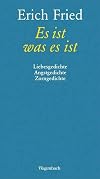
Repräsentative Gedichtsammlung von Erich Fried, einschließlich seines berühmtesten Gedichts: Was es ist.
Ein Band, der den ganzen Erich Fried vorstellt: seinen ästhetischen Anspruch und seinen kritischen Zweifel, seinen erotischen Freimut und seine politische Würde.
Erich Fried, 1921 in Wien geboren. 1938 Flucht vor den Nazis nach London, wo er auch bis zu seinem Tod 1988 lebte. Nach dem Krieg unternahm er zahlreiche Lesereisen nach Österreich und Deutschland, ergriff in vielen show more politischen Fragen Partei und wurde in der Folge mit Verleumdungen, Zensur und gerichtlichen Klagen überzogen. Erst als Sechzigjährigen erreichten ihn der Ruhm und die großen Literaturpreise. show less
Ein Band, der den ganzen Erich Fried vorstellt: seinen ästhetischen Anspruch und seinen kritischen Zweifel, seinen erotischen Freimut und seine politische Würde.
Erich Fried, 1921 in Wien geboren. 1938 Flucht vor den Nazis nach London, wo er auch bis zu seinem Tod 1988 lebte. Nach dem Krieg unternahm er zahlreiche Lesereisen nach Österreich und Deutschland, ergriff in vielen show more politischen Fragen Partei und wurde in der Folge mit Verleumdungen, Zensur und gerichtlichen Klagen überzogen. Erst als Sechzigjährigen erreichten ihn der Ruhm und die großen Literaturpreise. show less

Der Autor integriert beim Thema Liebe auch die Ängste, Nöte, Zweifel und so weiter,
die Liebesbeziehungen mitsichbringen. Die Gestaltung dieses Gegenpols zum romantischen Schwelgen
verleiht den Texten eine sensible Differenzierung. (Uli auf Amazon)
die Liebesbeziehungen mitsichbringen. Die Gestaltung dieses Gegenpols zum romantischen Schwelgen
verleiht den Texten eine sensible Differenzierung. (Uli auf Amazon)
Gedichte lesen
Wer
von einem Gedicht
seine Rettung erwartet
der sollte lieber
lernen
Gedichte zu lesen
Wer
von einem Gedicht
keine Rettung erwartet
der sollte lieber
lernen
Gedichte zu lesen
[Erich Fried]
Erich Fried - ein Wortkünstler sondersgleichen. Oft versteht man seine Worte nach mehrmaligem Lesen, meistens versteht man intuitiv genau, was er sagen möchte. Worte sind sein Handwerk, doch er schreibt mit Leichtigkeit und aus seiner Seele heraus. Absolut empfehlenswert.
Wer
von einem Gedicht
seine Rettung erwartet
der sollte lieber
lernen
Gedichte zu lesen
Wer
von einem Gedicht
keine Rettung erwartet
der sollte lieber
lernen
Gedichte zu lesen
[Erich Fried]
Erich Fried - ein Wortkünstler sondersgleichen. Oft versteht man seine Worte nach mehrmaligem Lesen, meistens versteht man intuitiv genau, was er sagen möchte. Worte sind sein Handwerk, doch er schreibt mit Leichtigkeit und aus seiner Seele heraus. Absolut empfehlenswert.
Awards


You May Also Like


Associated Authors
Statistics
- Works
- 101
- Also by
- 22
- Members
- 707
- Popularity
- #35,839
- Rating
- 3.9
- Reviews
- 5
- ISBNs
- 150
- Languages
- 8
- Favorited
- 5