
Max Frisch (1911–1991)
Author of Homo Faber
About the Author
Max Frisch was born in Switzerland in 1911. He attended the University of Zurich and spent six years in the Swiss Army. He also worked as a freelance writer and an architect. Frisch is most famous for writing the novel I'm Not Stiller and the play The Firebugs. Both works explore one of Frisch's show more major themes: the problematic nature of living life without a true understanding of one's identity. Many of his works feature explore this theme, including the plays The Chinese Wall, Andorra: A Play in Twelve Scenes, and Don Juan; or the Love of Geometry. He has also written several other novels, including Homo Faber: A Report, and Man in the Holocene. Frisch was awarded the International Neustadt Prize for Literature in 1987. He died in 1991 in Zurich. (Bowker Author Biography) show less
Image credit: Max Frisch around 1950
Series
Works by Max Frisch
Biedermann und die Brandstifter: Ein Lehrstück ohne Lehre mit einem Nachspiel (German Edition) (1963) — Editor; Author — 42 copies
Andorra + The Fire Raisers 5 copies
Gesammelte Werke in zeitlicher Folge von Max Frisch - Band III 1949 bis 1956 - Werksausgabe edition Suhrkamp (1986) 4 copies
Frisch, Max : Frisch, Max: Gesammelte Werke in zeitlicher Folge. - Jub.-Ausg.. - Frankfurt am Main : Suhrkamp (1986) 3 copies
Three Plays 2 copies
Suhrkamp-Taschenbuch ; 700 Montauk : e. Erzählung Homo Faber Ausgewählte Prosa (3 BÜCHER) (1976) 2 copies
Dramen, eine Auswahl 2 copies
Gesammelte St cke 2 copies
Im übrigen bin ich immer völlig allein Briefwechsel mit der Mutter 1933 - Eishockeyweltmeisterschaft in Prag - Reise (2000) 2 copies
Grundlagen und Gedanken, Drama, Biedermann und die Brandstifter: Biedermann Und Die Brandstifter - Von G Jordan (1980) 2 copies
Analysen und Reflexionen, Bd.9, Max Frisch 'Andorra', 'Biedermann und die Brandstifter': Vorschläge und unterrichtspraktische Interpretation (2004) 2 copies
Homo Фабер = homo Faber; Назову себя Гантенбайн = Mein name sei Gantenbein; Солдатская книжка = Dienstbüchlein : Избр.… (1998) 1 copy
The Chinese Wall / A Farce 1 copy
Cándido y los incendiarios 1 copy
Correspondence 1 copy
Santa Cruz 1 copy
Il teatro 1 copy
Max Frisch drámák 1 copy
Powiedzmy, Gantenbeim 1 copy
Anklagelsen : roman 1 copy
Homo Faber ÇArpık Sevda 1 copy
Homo Faber. Skýrsla 1 copy
Max Frisch: Stücke - Nun singen sie wieder / Graf Öderland / Biedermann und die Brandstifter / Andorra (1977) 1 copy
Stiller (t.2) 1 copy
Kont Öderland / Santa Cruz 1 copy
Stücke (Nun singen sie wieder, Graf Öderland, Biedermann und die Brandstifter, Andorra) / RUB 430 [Taschenbuch] (1973) 1 copy
Lektürehilfen Homo faber: Ausführliche Inhaltsangabe mit Interpretation - plus 8 Abitur-Fragen mit Lösungen (2008) 1 copy
Nun singen sie wieder: Versuch eines Requiems: Uraufgeführt am Schauspielhaus Zürich 23. März 1945 1 copy
Three Plays 1 copy
1975 1 copy
Stu cke 1 copy
Philipp Hotz'un Büyük Öfkesi 1 copy
2002 1 copy
Associated Works
Fiction, Volume 6, Number 1 — Contributor — 1 copy
Fiction, Volume 1, Number 1 — Contributor — 1 copy
Urlaubsträume. Geschichten für die schönste Zeit des Jahres — Author — 1 copy
Tagged
Common Knowledge
- Canonical name
- Frisch, Max
- Legal name
- Frisch, Max Rudolf
- Birthdate
- 1911-05-15
- Date of death
- 1991-04-04
- Gender
- male
- Education
- Federal Polytechnic School of Zürich (BA|1940)
University of Zurich - Occupations
- novelist
playwright
diarist
essayist
architect
journalist - Organizations
- Neue Zürcher Zeitung
Swiss Army (WWII) - Awards and honors
- Georg Büchner Preis (1958)
Friedenspreis (1976)
Jerusalem Prize (1965)
Neustadt International Prize for Literature (1986)
Heinrich Heine Preis (1989)
Conrad Ferdinand Meyer Prize (1938) (show all 7)
Foreign Honorary Member, American Academy of Arts and Letters (1974) - Relationships
- Bachmann, Ingeborg
Oellers, Marianne (wife) - Cause of death
- colorectal cancer
- Nationality
- Switzerland
- Birthplace
- Zürich, Switzerland
- Places of residence
- Zürich, Switzerland (birth)
Rome, Italy
New York, New York, USA - Place of death
- Zürich, Switzerland
- Map Location
- Switzerland
Members
Discussions
Group Read, May 2020: Homo Faber in 1001 Books to read before you die (May 2020)
Group Read, January 2016: I'm Not Stiller. in 1001 Books to read before you die (January 2016)
Reviews
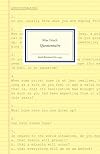
In regard to the world situation, do you hope:
a. that reason will prevail?
b. that a miracle will occur?
c. that everything will go on as before?
This wonderful and very unusual little book takes the form of a series of ten questionnaires that the great Swiss writer Max Frisch devised as a way of interrogating his own opinions and biases. Originally published in 1972 as part of his extensive journals (Tagebuch 1966-1971), it works especially well as a standalone piece, prompting wild hypotheses show more and speculative trains of thought from the reader, who might use any page in here as a basis for self-reflection, meditation, casual analysis or creative writing.
Some lines of questioning are open and philosophical:
VII.25.
Are you friends with yourself?
…while others are quite specific:
VI.4.
If you meet a man in swimming trunks about whom you know nothing, how is it that after a few words (not about money) you know he is a rich man?
Some address political concerns:
IX.15.
Can you name a free country in which the rich are not in the minority, and can you explain why in such countries the majority always imagines itself to possess the power?
…and many reflect Frisch's specifically male preoccupations:
III.1.
Are you sorry for women?
2.
Why? (Why not?)
3.
When a woman's hands and eyes and lips betray excitement, desire, etc., because you touch them, do you take this personally?
4.
What do you feel about other men:
a. when you are the successor?
b. when you are the predecessor?
c. when you are both in love with the same woman at the same time?
Although the format should by rights be very limiting, I found that many of the questions in here struck me as extraordinarily insightful. I was astonished to read the following, on a very specific issue that I've spent a lot of time thinking about:
V.23.
If you live in a foreign country and find your own particular brand of humour never works, can you adjust to the need of keeping all your relationships on a serious level, or does this make you seem a stranger to yourself?
My god, I could write a thousand words on that one right now! For people who like mind-mapping exercises, Proustian questionnaires or similar imaginative prompts, this book offers a rather unusual example of the genre – but it also demands to be seen as a fascinating creative work in its own right. You can, if you wish, read the whole thing through in an hour or so; but most people will, I think, find at least a couple of pages in here that can be productively dwelt on for days on end. Without question, a stimulating little oddity. show less
a. that reason will prevail?
b. that a miracle will occur?
c. that everything will go on as before?
This wonderful and very unusual little book takes the form of a series of ten questionnaires that the great Swiss writer Max Frisch devised as a way of interrogating his own opinions and biases. Originally published in 1972 as part of his extensive journals (Tagebuch 1966-1971), it works especially well as a standalone piece, prompting wild hypotheses show more and speculative trains of thought from the reader, who might use any page in here as a basis for self-reflection, meditation, casual analysis or creative writing.
Some lines of questioning are open and philosophical:
VII.25.
Are you friends with yourself?
…while others are quite specific:
VI.4.
If you meet a man in swimming trunks about whom you know nothing, how is it that after a few words (not about money) you know he is a rich man?
Some address political concerns:
IX.15.
Can you name a free country in which the rich are not in the minority, and can you explain why in such countries the majority always imagines itself to possess the power?
…and many reflect Frisch's specifically male preoccupations:
III.1.
Are you sorry for women?
2.
Why? (Why not?)
3.
When a woman's hands and eyes and lips betray excitement, desire, etc., because you touch them, do you take this personally?
4.
What do you feel about other men:
a. when you are the successor?
b. when you are the predecessor?
c. when you are both in love with the same woman at the same time?
Although the format should by rights be very limiting, I found that many of the questions in here struck me as extraordinarily insightful. I was astonished to read the following, on a very specific issue that I've spent a lot of time thinking about:
V.23.
If you live in a foreign country and find your own particular brand of humour never works, can you adjust to the need of keeping all your relationships on a serious level, or does this make you seem a stranger to yourself?
My god, I could write a thousand words on that one right now! For people who like mind-mapping exercises, Proustian questionnaires or similar imaginative prompts, this book offers a rather unusual example of the genre – but it also demands to be seen as a fascinating creative work in its own right. You can, if you wish, read the whole thing through in an hour or so; but most people will, I think, find at least a couple of pages in here that can be productively dwelt on for days on end. Without question, a stimulating little oddity. show less

This was Frisch's third mature novel, written after his break-up with Ingeborg Bachmann, a complicated exploration of fiction and role-playing as they enter into both real life and the occupation of storytelling.
The "I" figure of the book works through a baffling and contradictory series of possible scenarios involving himself and a character called Enderlin, who sometimes seems to be himself and sometimes a separate person. Enderlin in turn imagines himself as Gantenbein, a man who is show more pretending to be blind, and in that capacity marries the actress Lila, who seems to be (but isn't necessarily) identical with a woman Enderlin (or possibly "I") has met on a business trip to another city. Gantenbein also makes friends with a woman called Camilla Huber: his assumed blindness allows him not to notice that her pretended occupation of manicurist is just a front for prostitution, so he gives her pleasure by going to have his nails done whilst telling her stories. These stories are the only parts of the book in the past tense — everything else is narrated in the present or future/conditional/subjunctive ("But what if...?").
The idea seems to be that social identity is always a kind of pretence, or at least that we can never be sure that we experience an interaction or a relationship in the same way as others do. Frisch talked about truth as the absence that is left when we have explored all the fictions. I'm not sure! What stuck with me from this book was not so much all the sophisticated stuff about men in suits and women in smart costumes who spend most of their time in airports and business hotels and are obsessed with getting their smoking behaviour and whisky-drinking right, but the weird, untethered stories that open and close the book: an unidentified man who has left a hospital in panic, wearing only spectacles and a wrist-watch, runs through the centre of Zürich; the body of an unknown man floats serenely down the Limmat pursued by the police who have inexpertly been trying to fish it out, and does not come to rest until it has left the city centre altogether. show less
The "I" figure of the book works through a baffling and contradictory series of possible scenarios involving himself and a character called Enderlin, who sometimes seems to be himself and sometimes a separate person. Enderlin in turn imagines himself as Gantenbein, a man who is show more pretending to be blind, and in that capacity marries the actress Lila, who seems to be (but isn't necessarily) identical with a woman Enderlin (or possibly "I") has met on a business trip to another city. Gantenbein also makes friends with a woman called Camilla Huber: his assumed blindness allows him not to notice that her pretended occupation of manicurist is just a front for prostitution, so he gives her pleasure by going to have his nails done whilst telling her stories. These stories are the only parts of the book in the past tense — everything else is narrated in the present or future/conditional/subjunctive ("But what if...?").
The idea seems to be that social identity is always a kind of pretence, or at least that we can never be sure that we experience an interaction or a relationship in the same way as others do. Frisch talked about truth as the absence that is left when we have explored all the fictions. I'm not sure! What stuck with me from this book was not so much all the sophisticated stuff about men in suits and women in smart costumes who spend most of their time in airports and business hotels and are obsessed with getting their smoking behaviour and whisky-drinking right, but the weird, untethered stories that open and close the book: an unidentified man who has left a hospital in panic, wearing only spectacles and a wrist-watch, runs through the centre of Zürich; the body of an unknown man floats serenely down the Limmat pursued by the police who have inexpertly been trying to fish it out, and does not come to rest until it has left the city centre altogether. show less
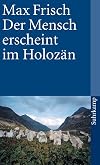
This was a very strange reading experience: a loose sequence of descriptive and narrative sections, encyclopaedic articles, bible excerpts and memories. It takes a while before you realize that the book revolves around the older man, Herr Geiser, a confused loner who lives in a valley in southern Switzerland, not far from the Italian border. Geyser is clearly intrigued by the signs of decline in his environment (landslides due to constant rain, ants in his house, bus connections that have show more been interrupted), but also in himself: he has difficulty remembering things and doing the most basic actions. He tries to hold on tightly to what he once knew and focuses on geographical and historical articles and bible fragments (from Genesis) about the earliest geological and biological history; Frisch also inserts these articles and fragments into the text, with the original layout (up to and including texts in gothic lettering).
Geyser also ventures into a rather perilous trip through the mountains, trying to resume a journey that he used to undertake. We also get a flashback to a rather difficult climb of the Matterhorn, 50 years before. Certainly towards the end there seems to be something seriously wrong with the man, he sometimes seems unconscious for hours, and eventually people (including his daughter) appear who speak to him like a child.
As a writer, Frisch keeps himself in the background, but his seemingly purely descriptive report harshly portrays the dementing process of an old man who is more or less aware of what is happening. And also the broader metaphor, the reference to the ruthless power of erosion, to the nullity of man, (which only ‘appeared in the Holocene’, so very late in the history of the earth) finally becomes clear. What is a human life? What is man himself and can he withstand the enormous power of nature and time? Frisch makes his reader sweat in this philosophical parable. show less
Geyser also ventures into a rather perilous trip through the mountains, trying to resume a journey that he used to undertake. We also get a flashback to a rather difficult climb of the Matterhorn, 50 years before. Certainly towards the end there seems to be something seriously wrong with the man, he sometimes seems unconscious for hours, and eventually people (including his daughter) appear who speak to him like a child.
As a writer, Frisch keeps himself in the background, but his seemingly purely descriptive report harshly portrays the dementing process of an old man who is more or less aware of what is happening. And also the broader metaphor, the reference to the ruthless power of erosion, to the nullity of man, (which only ‘appeared in the Holocene’, so very late in the history of the earth) finally becomes clear. What is a human life? What is man himself and can he withstand the enormous power of nature and time? Frisch makes his reader sweat in this philosophical parable. show less

This one was a relatively quick read, and one that I very much enjoyed. Many other reviews exist of this book (even on LT) so I’ll just focus on the things I particularly liked.
Much of the book reads like an account of care-free, leisurely tourism through Mexico and Europe. The main character has trouble engaging with art, emotions and non-calculatable motivations that drive other people. Usually, these characters get stereotyped into unrelatability, but here I thought the main show more character’s confrontation with other humans, art and sunrises through mid-life crisis romance felt fairly genuine and sometimes even endearing (YMMV though).
Another thing I liked very much is the way that the layering of focalizers added to the characterization. Normally, the accumulation of occasional meta-comments and the choice of what the narrator focuses on or introduces would read like a clumsy omniscient narrator failing to conceal their set-up of the big twist, a joke with the punch-line set up telegraphed way too obviously. But since the book is framed as the main character retelling their experiences after the fact, the clumsiness comes across as self-delusion, a blindness to certain areas of life that are entirely in line with the kind of person the main character is.
I’m glad I read this. It’s a pity I didn’t get to it sooner. show less
Much of the book reads like an account of care-free, leisurely tourism through Mexico and Europe. The main character has trouble engaging with art, emotions and non-calculatable motivations that drive other people. Usually, these characters get stereotyped into unrelatability, but here I thought the main show more character’s confrontation with other humans, art and sunrises through mid-life crisis romance felt fairly genuine and sometimes even endearing (YMMV though).
Another thing I liked very much is the way that the layering of focalizers added to the characterization. Normally, the accumulation of occasional meta-comments and the choice of what the narrator focuses on or introduces would read like a clumsy omniscient narrator failing to conceal their set-up of the big twist, a joke with the punch-line set up telegraphed way too obviously. But since the book is framed as the main character retelling their experiences after the fact, the clumsiness comes across as self-delusion, a blindness to certain areas of life that are entirely in line with the kind of person the main character is.
I’m glad I read this. It’s a pity I didn’t get to it sooner. show less
Lists
Books I've read (1)
Read in school (1)
A Novel Cure (1)
Existentialism (1)
Reading Globally (1)
Plays I Like (1)
Cooper (1)
Awards


You May Also Like


Associated Authors
Statistics
- Works
- 197
- Also by
- 8
- Members
- 10,373
- Popularity
- #2,291
- Rating
- 3.8
- Reviews
- 116
- ISBNs
- 590
- Languages
- 30
- Favorited
- 47


