
Charles Boardman Hawes (1889–1923)
Author of The Dark Frigate
About the Author
Image credit: Pinterest
Works by Charles Boardman Hawes
A Boy Who Went Whaling 1 copy
Associated Works
A Newbery Zoo: A dozen animal stories by Newbery Award-winning authors (1995) — Contributor — 39 copies, 2 reviews
Tagged
Common Knowledge
- Birthdate
- 1889-01-24
- Date of death
- 1923-07-16
- Gender
- male
- Education
- Bowdoin College (grad 1911)
Harvard University - Occupations
- author
editor - Awards and honors
- Newbery (1924)
- Relationships
- Hawes, Charles Taylor (father)
Boardman, Martha Tibbetts (mother)
Cable, Dorothea (wife) - Short biography
- Hawes was the elder son of Charles Taylor Hawes and Martha Tibbetts Boardman. Born in Clifton Springs, New York, he was raised in Bangor, Maine, and graduated from Bowdoin College in 1911 where he was "editor of The Quill and a devoted student of the classics". He was a graduate student at Harvard for one year, on the staff of The Youth's Companion to 1920, and associate editor of The Open Road to his death in 1923. On June 1, 1916, Hawes married Dorothea Cable of Northampton, Massachusetts, the youngest daughter of the novelist George Washington Cable and Louise Stewart Bartlett. At that time he lived in Cambridge and worked for The Youth's Companion.
- Nationality
- USA
- Birthplace
- Clifton Springs, New York, USA
- Places of residence
- Bangor, Maine, USA
Cambridge, Massachusetts, USA - Place of death
- Springfield, Massachusetts, USA
- Associated Place (for map)
- USA
Members
Reviews

One of five titles chosen - along with Cedric the Forester, The Windy Hill, The Golden Fleece and the Heroes Who Lived Before Achilles, and The Old Tobacco Shop - as a Newbery Honor Book in 1922, the first year the award was given out, The Great Quest is the first of two award-winning seafaring yarns from Charles Boardman Hawes, the second being the 1924 Newbery Medal winner, The Dark Frigate.
Opening in 1826, in the small New England village of Topham, it details the adventures of Josiah show more Woods, a young man who lives with, and works for, his Uncle Seth Upham, the local shopkeeper. When the strangely charismatic Cornelius Gleazen - Topham's disgraced prodigal son - returns to the home of his fathers, it soon becomes apparent that he has some sort of hold over Joe's brusque uncle, whose behavior becomes decidedly erratic. But although Joe observes his uncle with some concern, nothing prepares him for the revelation that Seth Upham had invested all his funds, everything that is to be Joe's inheritance, in a sea voyage to Africa. Setting out with his uncle, two of his uncle's assistants, Arnold Lamont and Simeon Muzzy, local farmer Abe Guptil, and Cornelius Gleazen himself, Joe is soon embarked on a dangerous journey that will take him from Boston to Havana, and thence to the coast of Guinea.
I began The Great Quest this past November (2009), reading online through books.google, as I was unable to obtain a copy through my library system, but although Hawes' story is not entirely without merit - some of his descriptive passages are quite atmospheric - I found it difficult to get through the book. In fact, I had all but abandoned it, until a snow day yesterday gave me the opportunity of finally finishing it. I'm happy to be done with it, to be frank, and don't really recommend it, unless you are (like me) determined to read the entire corpus of Newbery titles, both medal-winners and honor books.
Although Hawes is clearly not painting a positive portrait of the slave trade, or those who engaged in it - Cornelius Gleazen, Molly Matterson, Bud O'Hara, and all the others involved in this most detestable business, are clearly the villains of the piece - there is still a great deal of racism in the story, making it a rather ugly document of previous generations' idea of the world. As Joe and his companions - both friendly and hostile - flee across the African landscape, the language used to discuss their pursuers made me cringe. Joe considers the natives "superstitious" and ignorant, because they fear guns, but somehow also "cowardly," for attacking a smaller group. Reading along, I found myself thinking, "So they're cowardly for attacking a group possessing weapons they fear? Hmm..."
The "bad" guys make constant use of the term "n*gger," while the "good" guys may opt for the more polite "negro," but despite their differences, as Joe observes at one point, they all "at least" had white skin! I was conscious of an acute sense of disgust, while reading the second half of The Great Quest, a sensation that reached its zenith with Joe's analysis of black warfare, and the possible correlation this might have to the enslavement of Africans:
"I wonder if the whole performance to which we owed our lives was not characteristic of the natives of the African coast? If therein did not lie just the difference between a people so easily led into slavery and a people that never, whatever their weaknesses have been, have yielded to their oppressors? It all happened long ago, and it was my only acquaintance with black warfare; but surely we could never thus have thrown American Indians off the scent."
At this point in the narrative, having put up with "innocent" Americans being "accidentally" led into slaving voyages; having encountered "savage" blacks with a strange resentment of the European pillagers of their land, the murderers and enslavers of countless scores of their people; and having read this astonishing "blame the victim" explanation of slavery - lack of centralized organization is surely a sign that a people is more fit for slavery - I would have been very happy if the entire party HAD been caught by the natives. Sadly, it was not to be...
Spare yourself the grief, and skip The Great Quest. Unless you're a children's literature scholar, investigating the history of this particular kind of adventure-story for boys, or someone who is bound and determined to read all the Newbery books, you can definitely do without it! show less
Opening in 1826, in the small New England village of Topham, it details the adventures of Josiah show more Woods, a young man who lives with, and works for, his Uncle Seth Upham, the local shopkeeper. When the strangely charismatic Cornelius Gleazen - Topham's disgraced prodigal son - returns to the home of his fathers, it soon becomes apparent that he has some sort of hold over Joe's brusque uncle, whose behavior becomes decidedly erratic. But although Joe observes his uncle with some concern, nothing prepares him for the revelation that Seth Upham had invested all his funds, everything that is to be Joe's inheritance, in a sea voyage to Africa. Setting out with his uncle, two of his uncle's assistants, Arnold Lamont and Simeon Muzzy, local farmer Abe Guptil, and Cornelius Gleazen himself, Joe is soon embarked on a dangerous journey that will take him from Boston to Havana, and thence to the coast of Guinea.
I began The Great Quest this past November (2009), reading online through books.google, as I was unable to obtain a copy through my library system, but although Hawes' story is not entirely without merit - some of his descriptive passages are quite atmospheric - I found it difficult to get through the book. In fact, I had all but abandoned it, until a snow day yesterday gave me the opportunity of finally finishing it. I'm happy to be done with it, to be frank, and don't really recommend it, unless you are (like me) determined to read the entire corpus of Newbery titles, both medal-winners and honor books.
Although Hawes is clearly not painting a positive portrait of the slave trade, or those who engaged in it - Cornelius Gleazen, Molly Matterson, Bud O'Hara, and all the others involved in this most detestable business, are clearly the villains of the piece - there is still a great deal of racism in the story, making it a rather ugly document of previous generations' idea of the world. As Joe and his companions - both friendly and hostile - flee across the African landscape, the language used to discuss their pursuers made me cringe. Joe considers the natives "superstitious" and ignorant, because they fear guns, but somehow also "cowardly," for attacking a smaller group. Reading along, I found myself thinking, "So they're cowardly for attacking a group possessing weapons they fear? Hmm..."
The "bad" guys make constant use of the term "n*gger," while the "good" guys may opt for the more polite "negro," but despite their differences, as Joe observes at one point, they all "at least" had white skin! I was conscious of an acute sense of disgust, while reading the second half of The Great Quest, a sensation that reached its zenith with Joe's analysis of black warfare, and the possible correlation this might have to the enslavement of Africans:
"I wonder if the whole performance to which we owed our lives was not characteristic of the natives of the African coast? If therein did not lie just the difference between a people so easily led into slavery and a people that never, whatever their weaknesses have been, have yielded to their oppressors? It all happened long ago, and it was my only acquaintance with black warfare; but surely we could never thus have thrown American Indians off the scent."
At this point in the narrative, having put up with "innocent" Americans being "accidentally" led into slaving voyages; having encountered "savage" blacks with a strange resentment of the European pillagers of their land, the murderers and enslavers of countless scores of their people; and having read this astonishing "blame the victim" explanation of slavery - lack of centralized organization is surely a sign that a people is more fit for slavery - I would have been very happy if the entire party HAD been caught by the natives. Sadly, it was not to be...
Spare yourself the grief, and skip The Great Quest. Unless you're a children's literature scholar, investigating the history of this particular kind of adventure-story for boys, or someone who is bound and determined to read all the Newbery books, you can definitely do without it! show less

This book has a lot of intrigue and a sense of adventure. Charles Hawes really has “adventure” going for his writing. I feel like I can’t use that word enough.
However… this issue here is the hovering sense of racism. Although our heroes are unwittingly tricked into partaking in the slave trade, and disapprove, their main foe is “the blacks”. And considering what the main characters are doing in Africa, it’s hard to view the Africans as much of a villain. Africans attack and show more kill and provide a sense of danger, but there’s no real moral security in who you want to triumph. The attacks were written well (adventure!) but I wasn’t really on the side of our “heroes”. It is played out so there’s blackmail and the narrator is young and just trying to protect his uncle, etc… but that doesn’t make one believe the Africans are in the wrong. There were indeed internal villains in the group, and that was much more satisfying.
Overall, I enjoyed it. It toes the line, but it’s a decent, yeah, adventure. show less
However… this issue here is the hovering sense of racism. Although our heroes are unwittingly tricked into partaking in the slave trade, and disapprove, their main foe is “the blacks”. And considering what the main characters are doing in Africa, it’s hard to view the Africans as much of a villain. Africans attack and show more kill and provide a sense of danger, but there’s no real moral security in who you want to triumph. The attacks were written well (adventure!) but I wasn’t really on the side of our “heroes”. It is played out so there’s blackmail and the narrator is young and just trying to protect his uncle, etc… but that doesn’t make one believe the Africans are in the wrong. There were indeed internal villains in the group, and that was much more satisfying.
Overall, I enjoyed it. It toes the line, but it’s a decent, yeah, adventure. show less
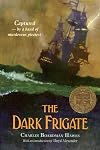
From my earliest days, I have had a taste for science fiction. To me, adventure equaled hopping in one's spaceship and blasting off for distant worlds. As I grew older and became aware of other genres of fiction, I gained a vague awareness that the plot of a typical space opera could easily be rewritten--to fit another genre, to be set in the Wild West or on the open seas. I never had an interest in experiencing those other genres, however. The few snatches of westerns or pirate show more swashbucklers I saw on television never made me hungry for a different taste. I have now learned that maybe I just needed to experience a good story in one of those other genres. The Dark Frigate is a pirate story. It's the tale of Philip Marsham, a young man born and bred to the sea. Left on his own when his father is lost at sea, Philip sets out to seek his fortune. After wandering a bit inland he is drawn to the sailor's life and ships out on The Rose of Devon. Unfortunately, the ship encounters a band of pirates and circumstances force Philip to sail with them. It's a great book. Mr. Hawes made the entire world come alive, so much so that I had to adapt my thinking to the archaic language used by the characters. Conversely, I had no problem picturing scene after scene in my mind as I read it. It's sold as a book for young adults, but I found the story and characters to be quite grown up. We bought the book for my daughter's schooling and, given her tastes, she may not like this one. If that's so, I'll be glad to take this tome off her hands and put it on my own shelf.
--J. show less
--J. show less
For a children's book, this started off pretty slow. I kept wondering why it was considered a children's book as the level of the language was pretty complex. But then I remembered this got the Newbery in 1924. What worked as children's books then rarely do now. The definition seems to be based on what children would enjoy as adults read the book to the children, not children reading themselves. At that time, it was rare for children to own books or have access to libraries.
The pace did show more pick up and the action did get going and it was an enjoyable story. In my mind's ear I could hear the gasp of children as unexpected things happen and the delighted laughs when good things happen. show less
The pace did show more pick up and the action did get going and it was an enjoyable story. In my mind's ear I could hear the gasp of children as unexpected things happen and the delighted laughs when good things happen. show less
Lists
Awards


You May Also Like


Associated Authors
Statistics
- Works
- 8
- Also by
- 2
- Members
- 967
- Popularity
- #26,625
- Rating
- 3.3
- Reviews
- 20
- ISBNs
- 73
- Languages
- 3