
William Peter Blatty (1928–2017)
Author of The Exorcist
About the Author
William Peter Blatty was born in Manhattan, New York on January 7, 1928. He graduated from Georgetown University in 1950. After serving in the Air Force, he worked for the United States Information Agency in Beirut. He returned to the United States for a public relations job in Los Angeles, where show more he hoped to begin his career as a writer. In 1961, he appeared as a contestant on You Bet Your Life. He and a fellow contestant won $10,000. He quit his day job and become a full-time writer. He collaborated with the director Blake Edwards on the screenplays for several films including A Shot in the Dark, What Did You Do in the War, Daddy?, Darling Lili, and Gunn. He wrote several horror fiction books including The Exorcist, The Ninth Configuration, and Legion. All of the books were adapted into movies with the screenplays written by Blatty. He won an Academy Award for The Exorcist screenplay. He also adapted his novel John Goldfarb, Please Come Home! for the screen. He wrote several memoirs including Which Way to Mecca, Jack?, I'll Tell Them I Remember You, and Finding Peter. He died from multiple myeloma on January 12, 2017 at the age of 89. (Bowker Author Biography) show less
Image credit: By Terry Ballard from Merrick, New York, USA - William Peter BlattyUploaded by Nianne, CC BY 2.0, https://commons.wikimedia.org/w/index.php?curid=20520828
Series
Works by William Peter Blatty
Finding Peter: A True Story of the Hand of Providence and Evidence of Life after Death (2015) 18 copies, 2 reviews
If There Were Demons, Then Perhaps There Were Angels: William Peter Blatty's Own Story of the Exorcist (2001) 14 copies, 1 review
EXORCIST confidential 2 copies
Exorcist II 1 copy
The Exorcist (Original) 1 copy
Associated Works
Smoke and Mirrors: Screenplays, Teleplays, Stage Plays, Comic Scripts & Treatments (2014) — Contributor — 23 copies
Tagged
Common Knowledge
- Legal name
- Blatty, William Peter
- Birthdate
- 1928-01-07
- Date of death
- 2017-01-12
- Gender
- male
- Education
- Georgetown University (B.A.|1950)
George Washington University (M.A. ∙ English Literature|1954) - Occupations
- screenwriter
novelist
movie producer - Organizations
- United States Information Agency
United States Air Force - Awards and honors
- Bram Stoker Award (Lifetime Achievement ∙ 1997)
Academy Award (1973)
Golden Globe - Short biography
- Blatty was born in New York City, the son of Lebanese parents Mary (née Mouakad) and Peter Blatty, a carpenter.[1] His father left home when William was six years old. Raised in relative poverty by his deeply religious Catholic mother, he apparently lived at twenty-eight different addresses during his childhood. He attended several Catholic and Jesuit schools before finding his raison d'etre and attending Georgetown University and George Washington University to study English. In the mid-1950s, Blatty was a contestant on the quiz show You Bet Your Life, winning $10,000: enough money to enable him to devote more time to writing professionally.
- Cause of death
- multiple myeloma
- Nationality
- USA (birth)
- Birthplace
- New York, New York, USA
- Places of residence
- New York, New York, USA
Malibu, California, USA - Place of death
- Bethesda, Maryland, USA
- Map Location
- USA
Members
Reviews
Still an outstanding story after all these years. I first read this book in the 1970s as a tween and watched the movie on VHS some years later. My reread in this stage of life gave me a new respect for the book. It made me ponder how I must have felt in my early adolescence while reading it. I know I had questions at the end but dared not to ask them. Questioning faith at that time and place was highly frowned upon.
Now that I've spent decades asking those same questions and finding my show more answers, The Exorcist is an excellent bit of horror writing, and I enjoyed it immensely. I was surprised at the amount of text that bubbled to the surface as I read. The things we remember from our first decades of life seem to stay with us in our last decades. Clearly it was important to me.
I'm putting this in a spoiler wrap because part of it is how the plot plays out and because some may find it offensive.
One of the best passages is near the end of the book, when the two priests are taking a break from performing the ritual exorcism. Karras questions the value of faith when the Christian's God seems to value his most vulnerable servants so little (Regan, the homeless, his mother), and part of Merrin's answer includes this:
“Yet I think the demon's target is not the possessed; it is us . . . the observers . . . every person in this house. And I think—I think the point is to make us despair; to reject our humanity, Damien; to see ourselves as ultimately bestial; as ultimately vile and putrescent; without dignity; ugly; unworthy.”
The description of the demon's target is a long one, but this quote sums it up nicely. This and the lengthier text are a description of sin according to God. Specifically, the sins in humanity. The book never asks the follow-up that a child could ask: Who created humanity, and in whose debased image is humanity created?
Merrin's answer is to ignore it. Let it go. I have to say, I'm with Karras on this one. Merrin ignored it all and lost his life. Karras didn't ignore it. He sacrificed himself, and won the battle. I now recognize this book as one of my steps in my long steps into disbelief.
I'm not proofing this, so I expect there will be many mistakes. I'll come back and edit them later. show less
Now that I've spent decades asking those same questions and finding my show more answers, The Exorcist is an excellent bit of horror writing, and I enjoyed it immensely. I was surprised at the amount of text that bubbled to the surface as I read. The things we remember from our first decades of life seem to stay with us in our last decades. Clearly it was important to me.
I'm putting this in a spoiler wrap because part of it is how the plot plays out and because some may find it offensive.
“Yet I think the demon's target is not the possessed; it is us . . . the observers . . . every person in this house. And I think—I think the point is to make us despair; to reject our humanity, Damien; to see ourselves as ultimately bestial; as ultimately vile and putrescent; without dignity; ugly; unworthy.”
The description of the demon's target is a long one, but this quote sums it up nicely. This and the lengthier text are a description of sin according to God. Specifically, the sins in humanity. The book never asks the follow-up that a child could ask: Who created humanity, and in whose debased image is humanity created?
Merrin's answer is to ignore it. Let it go. I have to say, I'm with Karras on this one. Merrin ignored it all and lost his life. Karras didn't ignore it. He sacrificed himself, and won the battle. I now recognize this book as one of my steps in my long steps into disbelief.
I'm not proofing this, so I expect there will be many mistakes. I'll come back and edit them later. show less
I hadn’t read this since I dared checking it out of the public library in seventh grade, when I took it to the desk fearing that the librarian would look at me in horror at wanting to read such a thing. I don’t remember if I finished it; all I remember is the feeling of bringing it into my house like I was bringing a suitcase filled stolen diamonds onto a plane. This was spiritual contraband.
Sine then I had, like everyone else, seen the movie. I picked up the novel a few weeks ago show more because of my reading William Friedkin’s memoir earlier this year and because of an academic project I hope to begin. The good news is that the novel is readable and not embarrassing. Blatty clearly knew how to tell this story, and I am confident that he worked with an editor who shaped the manuscript into a narrative by cutting longer conversations between the characters. I say this because each character is a type: the priest wavering in his vocation, the Jewish Colombo-like detective, the movie-star mother, the dutiful German servants, the older, wise, and strong title character, the innocent girl, and, of course, the demon possessing her. On can imagine the temptation Blatty must have had to have them engage in longer conversations about the challenges of faith or the nature of evil. Hence my suspicion that an editor advised Blatty to keep everything moving, which he does. For all the talk in academic circles about the merits of Dracula, The Exorcist reads like The Ambassadors by comparison.
Also interesting is that all of the scenes we remember from the film—indeed, all of the business with Regan tied to the bed—doesn’t really begin until well over 200 pages into the novel. Regan throwing up is like Huck and Jim on the river: a moment that has survived in the collective imagination that serves as shorthand for the whole experience of the book.
(A note regarding the title: it’s interesting in its inexactitude. The novel should properly be titled The Exorcism, especially since Father Merrin doesn’t really enter the plot until the last eighty pages or so, but Blatty or his editors knew that The Exorcist just sounds better.)
The novel raises many questions about the logistics of demonic possession. (Minor spoilers follow.) For example, we learn that the blasphemous Latin description of the Virgin Mary that was inserted into a local church’s missal was typed on Regan’s mother’s typewriter with a “strong hand.” But why would a demon want to do this? To humiliate the three or four Jesuits in Georgetown who could translate the thing? The same goes for the desecration of that same church. Yes, this brings Kinderman into the plot, since he assumes that the person who desecrated the church also murdered one of the characters, but the demon doesn’t want to bring people together for the sake of a plotline. Here’s another: did Father Merrin’s excavation in Iraq unearth the demon Pazuzu? If so, do demons come from the earth like the genie from the lamp? If that’s the case, there should be a Papal ban on Mesopotamian archeology. And, in the novel’s climactic moment, the demonic algebra might not stand up to proof: if the demon can move quickly from one body to another, why not move back the instant before its host flies out of a window?
For that matter, why would the demon take all of his time in possessing Regan—beginning with the Captain Howdy business, then the noises in the attic, the shaking bed, the cold room, the contortions, and then all of the terrible business everyone remembers from the film: the whites of the eyes, the blasphemes, the vomiting, the levitating? Why not zap! enter “the piglet’s” body and throw her out the window onto those famous steps?
The answer to all of these questions is that Blatty knew to make the demon obey the rules of good storytelling, just as Friedkin had the imagination to turn long passages of dialogue between Karras and the demon into terrifying moviemaking. And all the snotty objections I can make about the plotting proved to be moot when, at 4:00 the other morning, I heard one of my kids talking in his sleep or when—a few minutes ago—one of them silently walked in the room in which I was writing this and scared the hell out of me. show less
Sine then I had, like everyone else, seen the movie. I picked up the novel a few weeks ago show more because of my reading William Friedkin’s memoir earlier this year and because of an academic project I hope to begin. The good news is that the novel is readable and not embarrassing. Blatty clearly knew how to tell this story, and I am confident that he worked with an editor who shaped the manuscript into a narrative by cutting longer conversations between the characters. I say this because each character is a type: the priest wavering in his vocation, the Jewish Colombo-like detective, the movie-star mother, the dutiful German servants, the older, wise, and strong title character, the innocent girl, and, of course, the demon possessing her. On can imagine the temptation Blatty must have had to have them engage in longer conversations about the challenges of faith or the nature of evil. Hence my suspicion that an editor advised Blatty to keep everything moving, which he does. For all the talk in academic circles about the merits of Dracula, The Exorcist reads like The Ambassadors by comparison.
Also interesting is that all of the scenes we remember from the film—indeed, all of the business with Regan tied to the bed—doesn’t really begin until well over 200 pages into the novel. Regan throwing up is like Huck and Jim on the river: a moment that has survived in the collective imagination that serves as shorthand for the whole experience of the book.
(A note regarding the title: it’s interesting in its inexactitude. The novel should properly be titled The Exorcism, especially since Father Merrin doesn’t really enter the plot until the last eighty pages or so, but Blatty or his editors knew that The Exorcist just sounds better.)
The novel raises many questions about the logistics of demonic possession. (Minor spoilers follow.) For example, we learn that the blasphemous Latin description of the Virgin Mary that was inserted into a local church’s missal was typed on Regan’s mother’s typewriter with a “strong hand.” But why would a demon want to do this? To humiliate the three or four Jesuits in Georgetown who could translate the thing? The same goes for the desecration of that same church. Yes, this brings Kinderman into the plot, since he assumes that the person who desecrated the church also murdered one of the characters, but the demon doesn’t want to bring people together for the sake of a plotline. Here’s another: did Father Merrin’s excavation in Iraq unearth the demon Pazuzu? If so, do demons come from the earth like the genie from the lamp? If that’s the case, there should be a Papal ban on Mesopotamian archeology. And, in the novel’s climactic moment, the demonic algebra might not stand up to proof: if the demon can move quickly from one body to another, why not move back the instant before its host flies out of a window?
For that matter, why would the demon take all of his time in possessing Regan—beginning with the Captain Howdy business, then the noises in the attic, the shaking bed, the cold room, the contortions, and then all of the terrible business everyone remembers from the film: the whites of the eyes, the blasphemes, the vomiting, the levitating? Why not zap! enter “the piglet’s” body and throw her out the window onto those famous steps?
The answer to all of these questions is that Blatty knew to make the demon obey the rules of good storytelling, just as Friedkin had the imagination to turn long passages of dialogue between Karras and the demon into terrifying moviemaking. And all the snotty objections I can make about the plotting proved to be moot when, at 4:00 the other morning, I heard one of my kids talking in his sleep or when—a few minutes ago—one of them silently walked in the room in which I was writing this and scared the hell out of me. show less

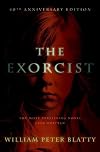
I picked up this Harper Perennial edition of Blatty's classic horror novel with the perfectly creepy cover at the Barnes and Noble in Sioux Falls, South Dakota early last month, thinking it would make for some good Halloween reading. Little did I realize, it would also become a chilling meditation on the state of America in late 2024.
Frankly, I might not have picked up the book if it weren’t for the grab-you-by-the-(eye)balls cover design by Milan Bozic. The pea-soup green, the show more high-contrast eyes and mouth, the font configuration into a cross: it’s the visual equivalent of icy fingers down a spine. “Buy me, Pathetic Mortal!”
I have an interesting history with The Exorcist (the novel), dating back to 1979 when I picked up the original classic purple cover with a blurry photo of what looked like a tormented woman. I think I plucked it from the free paperback books rack at my local library. I was 16 and on the edge of teenage rebellion; in fact, this may have been my shining Rebel with a Cause moment. As a shy preacher's kid in my small Wyoming town, reading The Exorcist was my middle finger to conformity. I didn’t drink or swear, but I could read subversive adult books. In fact, I very purposefully read The Exorcist in public, holding it in front of my face like a billboard advertisement for depravity.
And that's when things went south for me.
Read the rest of the story at The Quivering Pen: https://davidabrams.substack.com/p/what-im-reading-the-exorcist show less
Frankly, I might not have picked up the book if it weren’t for the grab-you-by-the-(eye)balls cover design by Milan Bozic. The pea-soup green, the show more high-contrast eyes and mouth, the font configuration into a cross: it’s the visual equivalent of icy fingers down a spine. “Buy me, Pathetic Mortal!”
I have an interesting history with The Exorcist (the novel), dating back to 1979 when I picked up the original classic purple cover with a blurry photo of what looked like a tormented woman. I think I plucked it from the free paperback books rack at my local library. I was 16 and on the edge of teenage rebellion; in fact, this may have been my shining Rebel with a Cause moment. As a shy preacher's kid in my small Wyoming town, reading The Exorcist was my middle finger to conformity. I didn’t drink or swear, but I could read subversive adult books. In fact, I very purposefully read The Exorcist in public, holding it in front of my face like a billboard advertisement for depravity.
And that's when things went south for me.
Read the rest of the story at The Quivering Pen: https://davidabrams.substack.com/p/what-im-reading-the-exorcist show less
This book, in my opinion, is a "slow descent into hell," with a steady tempo that creates fear through scientific and clinical research before the supernatural aspects take over. One of the main strengths is the characters. Chris MacNeil is a compelling, desperate mother, and Father Karras shows a relatable struggle between faith and science. The philosophical queries raised in the book concerning the existence of God and the nature of evil are terrifying. Many readers may find the novel's show more graphic depictions upsetting and offensive, and it is intentionally raw and profane. Detective Kinderman offers a much-needed respite from the stress. Overall, I liked the novel's theological and philosophical elements as well as the tension that underpins the plot's development. show less
Lists
Kayla (1)
Eerie eTales (1)
A Novel Cure (1)
top 100 (1)
Gen X Library (1)
1970s (1)
Page Turners (1)
Overdue Podcast (1)
Devilish Books (1)
Movies/Shows (2)
Urban Horror (1)
Horror: Top 10 (1)
1970s Horror (1)
Favourite Books (1)
Awards


You May Also Like


Associated Authors
Statistics
- Works
- 46
- Also by
- 6
- Members
- 9,877
- Popularity
- #2,410
- Rating
- 3.9
- Reviews
- 247
- ISBNs
- 283
- Languages
- 20
- Favorited
- 18
