
Bruce Schechter
Author of My Brain Is Open; The Mathematical Journeys of Paul Erdős
Works by Bruce Schechter
The Path of No Resistance: The Story of the Revolution in Superconductivity (1989) 18 copies, 3 reviews
Tagged
Common Knowledge
- Canonical name
- Schechter, Bruce
- Gender
- male
- Education
- Massachusetts Institute of Technology (PhD|Physics)
Members
Reviews
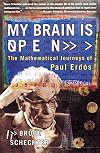
Back when I was just an epsilon, I wanted to be a mathematician so there was a lot for me to appreciate in the story of Paul Erdős. He and I were attracted to the same kinds of mathematical problems--the so-called elementary ones which didn't require a lot of study just to understand what was being asked. Bruce Schechter, who I coincidentally once knew from the internet, does a great job of telling the story being careful to present the subject matter without presupposing much mathematical show more knowledge on the part of the reader, though I wonder if those who are not like me would follow along with all the details. I suppose if they chose to read the book in the first place, they probably would.
I am not so quick as Mr. Schechter to interpret Ramsey Theory as he does as being about the mathematical necessity of there being order in the universe. Nor do I think it significant in any way that I was acquainted with, not only Bruce Schechter, but another person mentioned in the book who it turns out was in my high school home room class even though Ramsey's theorem entails that out of a group of six people, there must be either three mutually acquainted or three complete strangers. Furthermore, I think that there are constellations in the sky, not because of Ramsey theory, as Mr. Schechter suggests but because of a different researcher, Wolfgang Köhler, (German, not Hungarian) who developed Gestalt Psychology which attempts to predict how we classify random data into configurations based on specific attributes. Perhaps this is because I have left mathematics behind for psychology, but I wonder now whether if I had met Erdős when I was an epsilon, I'd have remained with math instead. show less
I am not so quick as Mr. Schechter to interpret Ramsey Theory as he does as being about the mathematical necessity of there being order in the universe. Nor do I think it significant in any way that I was acquainted with, not only Bruce Schechter, but another person mentioned in the book who it turns out was in my high school home room class even though Ramsey's theorem entails that out of a group of six people, there must be either three mutually acquainted or three complete strangers. Furthermore, I think that there are constellations in the sky, not because of Ramsey theory, as Mr. Schechter suggests but because of a different researcher, Wolfgang Köhler, (German, not Hungarian) who developed Gestalt Psychology which attempts to predict how we classify random data into configurations based on specific attributes. Perhaps this is because I have left mathematics behind for psychology, but I wonder now whether if I had met Erdős when I was an epsilon, I'd have remained with math instead. show less
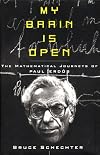
Fascinating book about one of the 20th century's most unusual charcaters and greatest mathematicians. For 40 years, Paul Erdos (pronounced air-dish), lived out of suitcases as he roamed the world seeking someone, anyone, to do math problems with. He announced himself by turning up on someone's doorstep claiming "My brain is open!", and expecting them to feed and accomodate him for a week or so while he mined their brains for maths problems and proofs. He called childen "epsilons", men, show more "slaves", women, "bosses", God,"Supreme Fascist", and said anyone who quit maths was "dead'. For all his eccentricity he was one of the most phenomenonal minds of the 20th century, his output in terms of papers and collaborations was extraordinary. In fact he had so many collaborators that a the "Erdos number" was created, to describe the degree of separation between him, his collaoborators and anyone who collaborated with his collaborators. This is a warm and often funny book, liberally spiced with mathematics, but (thankfully) not enough to deter maths dunces like myself. Highly recommended for anyone who loves math or just loves stories about quirky geniuses. show less

Alright, first a primer on superconductivity: When electricity flows down a wire, some of the flow is lost due to the resistance of the material. The opposite of resistance is conductance. Superconductivity occurs when a material is cooled to such a ridiculously low temperature that the near-absence of heat allows electricity to flow without loss. The temperature at which this happens is called the critical temperature. High-temperature superconductivity physics seeks to find materials that show more allows for superconductivity at a critical temperature above 77 kelvins. Everybody with me so far? Good. Here we go.
Bruce Schechter, in The Path of No Resistance, documents the early pioneers in the field of high-temperature superconductivity. Regular superconductivity was discovered as a property of matter in 1911. For 75 years, no one had come up with a material that superconducted above 23K. Then, in 1986, Bednorz and Mueller induced superconductivity in lanthanum barium copper oxide at 35K (trust me, the 12K difference was earth-shattering news). They were immediately awarded the Nobel Prize in Physics the next year. (By the way, for those that care, the current record (as of 2014) is mercury barium calcium copper oxide at 133 kelvins.)
Then, things really got fun. Research teams from across the world theorized a new frontier of superconductive ceramics where electricity could flow and maglev trains could travel across countries without energy loss. The problem was that all this was very pie in the sky talk. The only samples that could produce such effects were small and fragile at best. Schechter’s interviews with scientists a few years after the fact show just how scientific thought changes from year to year and what happens when the media gets a hold of scientific discoveries before the techniques are properly vetted. It’s an interesting book, albeit slightly dated, but fun nonetheless. show less
Bruce Schechter, in The Path of No Resistance, documents the early pioneers in the field of high-temperature superconductivity. Regular superconductivity was discovered as a property of matter in 1911. For 75 years, no one had come up with a material that superconducted above 23K. Then, in 1986, Bednorz and Mueller induced superconductivity in lanthanum barium copper oxide at 35K (trust me, the 12K difference was earth-shattering news). They were immediately awarded the Nobel Prize in Physics the next year. (By the way, for those that care, the current record (as of 2014) is mercury barium calcium copper oxide at 133 kelvins.)
Then, things really got fun. Research teams from across the world theorized a new frontier of superconductive ceramics where electricity could flow and maglev trains could travel across countries without energy loss. The problem was that all this was very pie in the sky talk. The only samples that could produce such effects were small and fragile at best. Schechter’s interviews with scientists a few years after the fact show just how scientific thought changes from year to year and what happens when the media gets a hold of scientific discoveries before the techniques are properly vetted. It’s an interesting book, albeit slightly dated, but fun nonetheless. show less
Although not a comprehensive biography, My Brain Is Open does offer a detailed portrait of Paul Erdős that conveys a sense of his personality and his love for math. Schechter explains enough of the math to provide the necessary context without interrupting the flow of the story.
Lists
Awards

You May Also Like


Associated Authors
Statistics
- Works
- 3
- Members
- 320
- Popularity
- #73,922
- Rating
- 3.9
- Reviews
- 9
- ISBNs
- 10
- Languages
- 4
- Favorited
- 1