
Charles Coleman Finlay
Author of The Patriot Witch
About the Author
Series
Works by Charles Coleman Finlay
The Magazine of Fantasy and Science Fiction September/October 2020, Vol. 139, Nos. 3 & 4 (1960) — Editor — 24 copies
The Magazine of Fantasy and Science Fiction July/August 2018, Vol. 135, Nos. 1 & 2 (2018) 22 copies, 1 review
The Magazine of Fantasy and Science Fiction March/April 2017, Vol. 132, Nos. 3 & 4 (2017) 20 copies, 1 review
The Magazine of Fantasy and Science Fiction September/October 2017, Vol. 133, Nos. 3 & 4 (2017) 19 copies, 1 review
The Magazine of Fantasy and Science Fiction September/October 2019, Vol. 137, Nos. 3 & 4 (1991) — Editor — 18 copies
The Magazine of Fantasy and Science Fiction July/August 2015, Vol. 129, Nos. 1 & 2 (2015) 17 copies, 1 review
The Magazine of Fantasy and Science Fiction March/April 2015, Vol. 128, Nos. 3 & 4 (2015) — Editor — 17 copies, 2 reviews
The Magazine of Fantasy and Science Fiction March/April 2018, Vol. 134, Nos. 3 & 4 (1958) — Editor — 16 copies, 1 review
The Magazine of Fantasy and Science Fiction September/October 2016, Vol. 131, Nos. 3 & 4 (2016) — Editor — 16 copies, 1 review
The Magazine of Fantasy and Science Fiction September/October 2015, Vol. 129, Nos. 3 & 4 (2015) 16 copies, 1 review
The Magazine of Fantasy and Science Fiction January/February 2018, Vol. 134, Nos. 1 & 2 (2018) 15 copies, 1 review
The Magazine of Fantasy and Science Fiction January/February 2016, Vol. 130, Nos. 1 & 2 (2016) 14 copies, 2 reviews
The Magazine of Fantasy and Science Fiction May/June 2018, Vol. 134, Nos. 5 & 6 (2018) — Editor — 14 copies, 1 review
The Magazine of Fantasy and Science Fiction May/June 2017, Vol. 132, Nos. 5 & 6 (2017) 13 copies, 1 review
The Magazine of Fantasy and Science Fiction March/April 2019, Vol. 136, Nos. 3 & 4 (2006) 13 copies, 1 review
The Magazine of Fantasy and Science Fiction March/April 2016, Vol. 130, Nos. 3 & 4 (2016) — Editor — 13 copies
The Magazine of Fantasy and Science Fiction November/December 2018, Vol. 135, Nos. 5 & 6 (2018) — Editor — 13 copies, 1 review
The Magazine of Fantasy and Science Fiction September/October 2018, Vol. 135, Nos. 3 & 4 (2018) — Editor — 13 copies, 1 review
The Magazine of Fantasy and Science Fiction November/December 2016, Vol. 131, Nos. 5 & 6 (2016) — Editor — 13 copies, 1 review
The Magazine of Fantasy and Science Fiction July/August 2019, Vol. 137, Nos. 1 & 2 (1951) — Editor — 13 copies, 1 review
The Magazine of Fantasy and Science Fiction November/December 2017, Vol. 133, Nos. 5 & 6 (1958) 13 copies
The Magazine of Fantasy and Science Fiction July/August 2016, Vol. 131, Nos. 1 & 2 (2016) 13 copies, 1 review
The Magazine of Fantasy and Science Fiction May/June 2019, Vol. 136, Nos. 5 & 6 (1944) — Editor — 12 copies
The Magazine of Fantasy and Science Fiction March/April 2020, Vol. 138, Nos. 3 & 4 (2020) 12 copies, 1 review
The Magazine of Fantasy and Science Fiction January/February 2017, Vol. 132, Nos. 1 & 2 (2017) 11 copies, 1 review
The Magazine of Fantasy and Science Fiction January/February 2020, Vol. 138, Nos. 1 & 2 (2020) — Editor; Columnist — 11 copies
The Magazine of Fantasy and Science Fiction May/June 2016, Vol. 130, Nos. 5 & 6 (2016) 11 copies, 1 review
The Magazine of Fantasy and Science Fiction July/August 2017, Vol. 133, Nos. 1 & 2 (1953) — Editor — 11 copies, 1 review
The Magazine of Fantasy and Science Fiction January/February 2021, Vol. 140, Nos. 1 & 2 (2021) 11 copies
The Magazine of Fantasy and Science Fiction January/February 2019, Vol. 136, Nos. 1 & 2 (1978) — Editor — 11 copies, 1 review
The Magazine of Fantasy and Science Fiction November/December 2019, Vol. 137, Nos. 5 & 6 (2019) — Editor — 10 copies
The Magazine of Fantasy and Science Fiction November/December 2015, Vol. 129, Nos. 5 & 6 (2015) — Editor — 10 copies
The Magazine of Fantasy and Science Fiction November/December 2020, Vol. 139, Nos. 5 & 6 (2020) — Editor — 8 copies, 1 review
Her Life Sentence 3 copies
The Minutemen's Witch 3 copies
The Infill Trait 3 copies
Of Silence and the Man at Arms 3 copies
Abandon the Ruins 3 copies
The Rapeworm 2 copies
For Want Of A Nail 2 copies
AN EYE FOR AN EYE 2 copies
Wild Thing [short story] 2 copies
The Texas Bake Sale 2 copies
The Crystal Stair 2 copies
Passing Through 2 copies
After the Gaud Chrysalis 2 copies
The Moon Is Always Full 1 copy
Footnotes 1 copy
Time bomb time (short story) 1 copy
Love and the Wayward Troll 1 copy
The Crystal Stair 2 1 copy
The Crystal Stair 1 1 copy
Powerboy's Last Adventure 1 copy
A Game Of Chicken 1 copy
Fading Quayle Dancing Quayle 1 copy
The Nursemaid's Suitor 1 copy
A Democracy of Trolls 1 copy
Associated Works
The Year's Best Science Fiction: Twentieth Annual Collection (2003) — Contributor — 525 copies, 1 review
The Year's Best Science Fiction: Twenty-Sixth Annual Collection (2009) — Contributor — 424 copies, 2 reviews
Oz Reimagined: New Tales from the Emerald City and Beyond (2013) — Contributor — 166 copies, 12 reviews
One Lamp: Alternate History Stories from The Magazine of Fantasy & Science Fiction (2003) — Contributor — 49 copies
In Lands That Never Were: Tales of Swords and Sorcery from The Magazine of Fantasy & Science Fiction (2004) — Contributor — 36 copies
The Magazine of Fantasy and Science Fiction August 2008, Vol. 115, No. 2 (2008) — Contributor — 20 copies, 1 review
The Magazine of Fantasy and Science Fiction July/August 2014, Vol. 127, Nos. 1 & 2 (2014) — Editor — 15 copies, 1 review
The Best of Strange Horizons: Year One : September 2000-August 2001 (2003) — Contributor — 12 copies, 1 review
Brave New Worlds {Second Edition ebook} — Contributor, some editions — 11 copies
The Magazine of Fantasy and Science Fiction April 2002, Vol. 102, No. 4 (2002) — Contributor — 10 copies
Beneath Ceaseless Skies Issue #4 — Contributor — 4 copies
Noctum Aeternus 1 — Contributor — 3 copies
Beneath Ceaseless Skies Issue #3 — Contributor — 2 copies
Lady Churchill's Rosebud Wristlet No. 10 — Contributor — 1 copy
Tagged
Common Knowledge
- Other names
- Finlay, C. C.
- Birthdate
- 1964
- Gender
- male
- Education
- University of Oxford, New College
Capital University
Ohio State University - Organizations
- Science Fiction and Fantasy Writers of America
- Awards and honors
- Locus Award Finalist (Editor, 2017)
- Relationships
- Carson, Rae (spouse)
- Nationality
- USA
- Birthplace
- New York, New York, USA
- Places of residence
- New York, New York, USA (birthplace)
Columbus, Ohio, USA
Oxford, England, UK - Associated Place (for map)
- USA
Members
Reviews

The July/August issue of Fantasy & Science Fiction is a strong issue with several quite good stories that range from detective stories with a magical twist to tales of frightening dystopias where humans are kept as beasts of burden by bird-like creatures. There is no real unifying theme to the stories in this issue, they are simply a collection of good to excellent pieces of short fiction all traveling together under a single cover.
The longest story in the issue is the cover story Johnny Rev show more by Rachel Pollack, a kind of cross between a noir detective novel, a folk tale, and a nightmare. In the story, the title character is a private detective who had duplicated himself rather than tell his mother-in-law that his wife had died and his child had become so dangerous that she had to be exiled to a magical forest. oddly, he had created the duplicate imperfectly, and, as needed to balance the scales, he had destroyed the duplicate as well. Or at least Johnny Rev thought he had until the duplicate began showing up in his dreams bearing Johnny's card, a development that poses something of a problem for the protagonist as he is under a magical compulsion that requires him to take any case from a person who brings him his card. The story wanders through a magical version of New York as Johnny tries to figure out how his duplicate came back, and how to get rid of it for good. Along the way, Johnny has to revisit some painful events of his past and reconnect with a number of people he had mostly cut off contact with. The mystery itself is pretty well laid out, and Johnny's path to solving it is interesting and well-written, including the reversal that takes place once he figures out the somewhat unexpected identity of who is behind his troubles. As a stew pot melange of a detective novel, an urban fantasy, a personal tragedy, and some comedy, this story could have collapsed in on itself quite easily, but Pollack's deft handling of the diverse elements keeps it moving, and carries the reader to its conclusion in quite an enjoyable manner.
A creepy Lovecraftian love story, The Deepwater Bride by Tamsyn Muir is centered on Hester Blake, a teenager from a long line of women blessed (or perhaps cursed) with the gift of prophecy who is living in a small town with her Aunt Mar. From the outset of the story Hester begins seeing omens that presage the arrival of one of the deep old ones to claim their bride. As a Blake, she realizes that her role is to document the coming catastrophe in which the old one will rise from the dark places of the oceans, kill everyone in the vicinity, and then take its chosen mate back to the vasty depths. Hester becomes obsessed with finding out who the bride is going to be, and locates Rainbow Kipley, a another young teenage girl that all the signs point towards being future bride. Hester and Rainbow form an odd friendship, over which Hester feels considerable guilt as she knows what is in store for her companion. The story rolls along until the almost inevitable twist, which really isn't all that surprising but is still well-executed, and then the old one takes its lover home. The story is horrific and terrifying, made even more so by the almost casual attitude of the two adolescents at its heart, but is also a touching, albeit wildly off-kilter, love tale.
The most experimental, and I think best, story in the issue is The Body Pirate by Van Aaron Hughes, which imagines a world in which "souls" move about between a handful of "bodies" that ostensibly belong to them. As the story progresses, it becomes clear that the "bodies" are essentially humans while the "souls" are bird-like creatures that fit themselves into slots on the bodies and take control of them. The practice of a "soul" possessing multiple bodies that it rotates through is relatively new at the time the story takes place, and "souls" flit between them to be able to accomplish more, leaving the "bodies" to handle smaller tasks on their own while they head off to direct the actions of a different "body". The story uses an interesting presentation whenever a soul and its body are separated but still acting in the story, dividing the text into two parallel columns showing what each is doing while they are apart. The story is, at its core, a mystery that unfolds somewhat horrifically over the course of the pages, revealing that the neither the "souls" or the "bodies" are exactly what they were originally presented as. The title of the story refers to the criminal act of one "soul" taking over a "body" belonging to another, but as the various secrets are revealed, it turns out to refer to something that is much larger, and more unsettling than that.
The second pure detective story in the volume is The Curse of the Myrmelon by Matthew Hughes, although it is set in a much more traditional fantasy milieu than Johnny Rev. Cascor is a "Discriminator", making him more or less a private detective in a world in which the use of unauthorized magic by those who are not a member of an appropriate guild is a serious matter. This poses something of a problem for Cascor, as the case he is presented with involves the use of magic and requires him to dance just along the edge of what is acceptable, and what will run afoul of the strong arm of the wizard's guild. The mystery, involving some miscounted merchandise, turns out to be quite convoluted, and Casco's efforts are made more complicated by repeated visits from Jihr, a wizard guild's agent who says he suspects Cascor to be treading on wizardly prerogatives. The story winds and twists, coming to a few dead ends and a few reversals before Cascor untangles the knot and unravels the mystery, bringing the story to a satisfying conclusion. There are a few coincidences in the story that seem to be just a little too serendipitous, but overall it holds up well despite these minor flaws.
A story of nostalgia, history, and wistful regret, Dixon's Road by Richard Chwedyk features an engineer specialized in terraforming who returns to the home of his former lover, long since dead, after traveling through the stars to transform other worlds. Told from the perspective of a tour guide working at the preserved home of the famous poet Laura Michel, the story starts up with the arrival of Dixon, the man who terraformed the world on which all of the action takes place, and Laura's former lover. He spends the better part of the day exploring the house, revealing the connection between his work and the poetry of his long departed love. But he also reveals the distance that existed between them - in its most stark form when he describes catching up with forty-five years worth of her work after emerging from a long voyage in cold sleep. The story is beautifully bittersweet, and almost tragic, as it shows a figure walking out of history into the present to remember what was lost along the way.
Oneness: A Triptych by James Patrick Kelly isn't really a story, but as the title suggests three separate vignettes, each focused on one person sharing themselves with someone or something else. In the first, two people apparently in virtual reality have an encounter, with one desperately wanting to do whatever they can to make the other happy, while the object of their affections has become bored with their trysts. Things proceed in a desultory manner until a somewhat significant curve ball is thrown into the mix. In the second, an elderly couple meet and have an extremely unusual encounter, the description of which probably is not for the squeamish, although they do end up quite together as one. In the third, a Christian missionary seeks to convert the members of an inhuman faith by accepting the challenge of their altar, and finds herself one with everything. Each mini-story is, in its own way, both touching and slightly disturbing.
Oliver Buckram poses the question of what one does when one is deprived of purpose in This Quintessence of Dust. Officer Judy 42 is a robot designed to serve as a peace officer in a future where much of the mundane tasks of the world have been handed over to mechanical servitors. Unfortunately, humanity has unexpectedly died off as the result of a virulent plague leaving all of the nannybots, butlerbots, and various other bots without anyone to actually serve. Unable to come to grips with the fact that their beloved charges are not alive any more, the various robots continue to try to service the needs of their inert masters, becoming increasingly agitated as they receive no response to their ministrations. Judy 42 finds purpose in bringing order even in the absence of humans, while others such as Bernard 93 seem to be satisfied serving other robots, but the deeper question posed by the story centers on the question of the validity of externally imposed purpose. If one cannot determine purpose for oneself, how does one cope with the removal of a purpose you didn't choose? This story, although quite short and straightforward, poses an extremely interesting philosophical question, and as a result is much larger than the sum of its pages.
Paradise and Trout by Betsy James is unusual in that the starts after the protagonist, a ten year old boy named Harry, is dead. The story doesn't flash back to when Harry was alive, but rather takes place entirely during Harry's journey through the afterlife as he sets out to navigate his way to the fortress where his uncles and other ancestors man the walls. After his father hands him a bridge and an admonishment not to speak to anyone on his journey as part of the funeral ceremony, Harry sets out only to be approached by a fox, a vulture, a lioness, and finally a fly. He finally makes it to the crossing, but finds the independence to make his own choice at the end. The story is an odd coming of age story, made so by the fact that the central character is already a corpse when it begins, and it carries the interesting suggestion that it is almost never too late to decide one's own fate.
The latest in a series of stories about a collection of man-made islands in the Pacific Ocean, The Silicon Curtain: A Seastead Story by Naomi Kritzer shows the somewhat subtle sinister side of a "libertarian paradise" like Seastead. Told from the perspective of Rebecca Garrison, the story recounts her and her friend Thor's expedition to Sal, an island given over to biomedical research. Once they arrive, they find the entire island in lock-down, with all of the partners - the actual citizens of the island - having left, while all of the associates - the hired workers - all abandoned to fend for themselves inside of locked laboratory facilities. Rebecca and Thor shift from what is essentially industrial espionage to a rescue operation, doing the right thing even in the face of intransigence from Sal's security chief. Kritzer jumps from a subterfuge-laden adventure, to a jail break, to commentary on the deficiencies of a lawless society, all the while weaving in moral choices, family issues, and political maneuvering, capably working all of these elements together with a remarkable economy of pages. This story manages to explore big ideas and pack lots of action into its brief length with the end result being a beautiful, intriguing, and exciting read.
The last story in the volume is Into the Fiery Planet by Gregor Hartmann, an odd tale about terraformers on the very geologically active planet Zephyr who find themselves at risk of losing the support of their interplanetary nation due to an impending conflict. Franden, like many of Zephyr's other inhabitants, enjoys immersing himself in the freshly spewed volcanic sands on the surface of the planet. Most of the story is taken up with a conversation between Franden and a visiting filmmaker who suggests that the best way for Zephyr to ensure that it is not among those planets discarded as too expensive to maintain would be for Franden to make a film showcasing the benefits the planet has to offer. The story is quirky and enjoyable to read, but never really rises much above being an entertaining diversion.
The science fact article in the issue is Traveling Through Time by Pat Murphy and Paul Doherty, which is something of a deceptive title for the article, as it is not actually about time travel. Instead, the article is about how scientists look at clues in the present to determine what the past looked like, and how our view of the past has evolved and changed as our store of information has grown. Using examples from paleontology, paleobiology, and geology, Murphy and Doherty outline how scientists came to our current understanding of how dinosaurs walked, what the climate of the past was like, and how an ancient and slow-moving reactor formed. The article is fairly good, although the science it contains is somewhat basic.
The best stories in the volume are The Body Pirate, The Quintessence of Dust, and The Silicon Curtain: A Seastead Story, and Johnny Rev is quite good as well. While those stories are the cream of the crop here, there are really no bad stories in this bunch. Even the weakest story - Into the Fiery Planet - is still pretty good even if it is not quite as good as the other stories found in the volume. Fantasy & Science Fiction consistently puts out high quality issues full of genre fiction stories that range from good to excellent, and this issue is no exception.
This review has also been posted to my blog Dreaming About Other Worlds. show less
The longest story in the issue is the cover story Johnny Rev show more by Rachel Pollack, a kind of cross between a noir detective novel, a folk tale, and a nightmare. In the story, the title character is a private detective who had duplicated himself rather than tell his mother-in-law that his wife had died and his child had become so dangerous that she had to be exiled to a magical forest. oddly, he had created the duplicate imperfectly, and, as needed to balance the scales, he had destroyed the duplicate as well. Or at least Johnny Rev thought he had until the duplicate began showing up in his dreams bearing Johnny's card, a development that poses something of a problem for the protagonist as he is under a magical compulsion that requires him to take any case from a person who brings him his card. The story wanders through a magical version of New York as Johnny tries to figure out how his duplicate came back, and how to get rid of it for good. Along the way, Johnny has to revisit some painful events of his past and reconnect with a number of people he had mostly cut off contact with. The mystery itself is pretty well laid out, and Johnny's path to solving it is interesting and well-written, including the reversal that takes place once he figures out the somewhat unexpected identity of who is behind his troubles. As a stew pot melange of a detective novel, an urban fantasy, a personal tragedy, and some comedy, this story could have collapsed in on itself quite easily, but Pollack's deft handling of the diverse elements keeps it moving, and carries the reader to its conclusion in quite an enjoyable manner.
A creepy Lovecraftian love story, The Deepwater Bride by Tamsyn Muir is centered on Hester Blake, a teenager from a long line of women blessed (or perhaps cursed) with the gift of prophecy who is living in a small town with her Aunt Mar. From the outset of the story Hester begins seeing omens that presage the arrival of one of the deep old ones to claim their bride. As a Blake, she realizes that her role is to document the coming catastrophe in which the old one will rise from the dark places of the oceans, kill everyone in the vicinity, and then take its chosen mate back to the vasty depths. Hester becomes obsessed with finding out who the bride is going to be, and locates Rainbow Kipley, a another young teenage girl that all the signs point towards being future bride. Hester and Rainbow form an odd friendship, over which Hester feels considerable guilt as she knows what is in store for her companion. The story rolls along until the almost inevitable twist, which really isn't all that surprising but is still well-executed, and then the old one takes its lover home. The story is horrific and terrifying, made even more so by the almost casual attitude of the two adolescents at its heart, but is also a touching, albeit wildly off-kilter, love tale.
The most experimental, and I think best, story in the issue is The Body Pirate by Van Aaron Hughes, which imagines a world in which "souls" move about between a handful of "bodies" that ostensibly belong to them. As the story progresses, it becomes clear that the "bodies" are essentially humans while the "souls" are bird-like creatures that fit themselves into slots on the bodies and take control of them. The practice of a "soul" possessing multiple bodies that it rotates through is relatively new at the time the story takes place, and "souls" flit between them to be able to accomplish more, leaving the "bodies" to handle smaller tasks on their own while they head off to direct the actions of a different "body". The story uses an interesting presentation whenever a soul and its body are separated but still acting in the story, dividing the text into two parallel columns showing what each is doing while they are apart. The story is, at its core, a mystery that unfolds somewhat horrifically over the course of the pages, revealing that the neither the "souls" or the "bodies" are exactly what they were originally presented as. The title of the story refers to the criminal act of one "soul" taking over a "body" belonging to another, but as the various secrets are revealed, it turns out to refer to something that is much larger, and more unsettling than that.
The second pure detective story in the volume is The Curse of the Myrmelon by Matthew Hughes, although it is set in a much more traditional fantasy milieu than Johnny Rev. Cascor is a "Discriminator", making him more or less a private detective in a world in which the use of unauthorized magic by those who are not a member of an appropriate guild is a serious matter. This poses something of a problem for Cascor, as the case he is presented with involves the use of magic and requires him to dance just along the edge of what is acceptable, and what will run afoul of the strong arm of the wizard's guild. The mystery, involving some miscounted merchandise, turns out to be quite convoluted, and Casco's efforts are made more complicated by repeated visits from Jihr, a wizard guild's agent who says he suspects Cascor to be treading on wizardly prerogatives. The story winds and twists, coming to a few dead ends and a few reversals before Cascor untangles the knot and unravels the mystery, bringing the story to a satisfying conclusion. There are a few coincidences in the story that seem to be just a little too serendipitous, but overall it holds up well despite these minor flaws.
A story of nostalgia, history, and wistful regret, Dixon's Road by Richard Chwedyk features an engineer specialized in terraforming who returns to the home of his former lover, long since dead, after traveling through the stars to transform other worlds. Told from the perspective of a tour guide working at the preserved home of the famous poet Laura Michel, the story starts up with the arrival of Dixon, the man who terraformed the world on which all of the action takes place, and Laura's former lover. He spends the better part of the day exploring the house, revealing the connection between his work and the poetry of his long departed love. But he also reveals the distance that existed between them - in its most stark form when he describes catching up with forty-five years worth of her work after emerging from a long voyage in cold sleep. The story is beautifully bittersweet, and almost tragic, as it shows a figure walking out of history into the present to remember what was lost along the way.
Oneness: A Triptych by James Patrick Kelly isn't really a story, but as the title suggests three separate vignettes, each focused on one person sharing themselves with someone or something else. In the first, two people apparently in virtual reality have an encounter, with one desperately wanting to do whatever they can to make the other happy, while the object of their affections has become bored with their trysts. Things proceed in a desultory manner until a somewhat significant curve ball is thrown into the mix. In the second, an elderly couple meet and have an extremely unusual encounter, the description of which probably is not for the squeamish, although they do end up quite together as one. In the third, a Christian missionary seeks to convert the members of an inhuman faith by accepting the challenge of their altar, and finds herself one with everything. Each mini-story is, in its own way, both touching and slightly disturbing.
Oliver Buckram poses the question of what one does when one is deprived of purpose in This Quintessence of Dust. Officer Judy 42 is a robot designed to serve as a peace officer in a future where much of the mundane tasks of the world have been handed over to mechanical servitors. Unfortunately, humanity has unexpectedly died off as the result of a virulent plague leaving all of the nannybots, butlerbots, and various other bots without anyone to actually serve. Unable to come to grips with the fact that their beloved charges are not alive any more, the various robots continue to try to service the needs of their inert masters, becoming increasingly agitated as they receive no response to their ministrations. Judy 42 finds purpose in bringing order even in the absence of humans, while others such as Bernard 93 seem to be satisfied serving other robots, but the deeper question posed by the story centers on the question of the validity of externally imposed purpose. If one cannot determine purpose for oneself, how does one cope with the removal of a purpose you didn't choose? This story, although quite short and straightforward, poses an extremely interesting philosophical question, and as a result is much larger than the sum of its pages.
Paradise and Trout by Betsy James is unusual in that the starts after the protagonist, a ten year old boy named Harry, is dead. The story doesn't flash back to when Harry was alive, but rather takes place entirely during Harry's journey through the afterlife as he sets out to navigate his way to the fortress where his uncles and other ancestors man the walls. After his father hands him a bridge and an admonishment not to speak to anyone on his journey as part of the funeral ceremony, Harry sets out only to be approached by a fox, a vulture, a lioness, and finally a fly. He finally makes it to the crossing, but finds the independence to make his own choice at the end. The story is an odd coming of age story, made so by the fact that the central character is already a corpse when it begins, and it carries the interesting suggestion that it is almost never too late to decide one's own fate.
The latest in a series of stories about a collection of man-made islands in the Pacific Ocean, The Silicon Curtain: A Seastead Story by Naomi Kritzer shows the somewhat subtle sinister side of a "libertarian paradise" like Seastead. Told from the perspective of Rebecca Garrison, the story recounts her and her friend Thor's expedition to Sal, an island given over to biomedical research. Once they arrive, they find the entire island in lock-down, with all of the partners - the actual citizens of the island - having left, while all of the associates - the hired workers - all abandoned to fend for themselves inside of locked laboratory facilities. Rebecca and Thor shift from what is essentially industrial espionage to a rescue operation, doing the right thing even in the face of intransigence from Sal's security chief. Kritzer jumps from a subterfuge-laden adventure, to a jail break, to commentary on the deficiencies of a lawless society, all the while weaving in moral choices, family issues, and political maneuvering, capably working all of these elements together with a remarkable economy of pages. This story manages to explore big ideas and pack lots of action into its brief length with the end result being a beautiful, intriguing, and exciting read.
The last story in the volume is Into the Fiery Planet by Gregor Hartmann, an odd tale about terraformers on the very geologically active planet Zephyr who find themselves at risk of losing the support of their interplanetary nation due to an impending conflict. Franden, like many of Zephyr's other inhabitants, enjoys immersing himself in the freshly spewed volcanic sands on the surface of the planet. Most of the story is taken up with a conversation between Franden and a visiting filmmaker who suggests that the best way for Zephyr to ensure that it is not among those planets discarded as too expensive to maintain would be for Franden to make a film showcasing the benefits the planet has to offer. The story is quirky and enjoyable to read, but never really rises much above being an entertaining diversion.
The science fact article in the issue is Traveling Through Time by Pat Murphy and Paul Doherty, which is something of a deceptive title for the article, as it is not actually about time travel. Instead, the article is about how scientists look at clues in the present to determine what the past looked like, and how our view of the past has evolved and changed as our store of information has grown. Using examples from paleontology, paleobiology, and geology, Murphy and Doherty outline how scientists came to our current understanding of how dinosaurs walked, what the climate of the past was like, and how an ancient and slow-moving reactor formed. The article is fairly good, although the science it contains is somewhat basic.
The best stories in the volume are The Body Pirate, The Quintessence of Dust, and The Silicon Curtain: A Seastead Story, and Johnny Rev is quite good as well. While those stories are the cream of the crop here, there are really no bad stories in this bunch. Even the weakest story - Into the Fiery Planet - is still pretty good even if it is not quite as good as the other stories found in the volume. Fantasy & Science Fiction consistently puts out high quality issues full of genre fiction stories that range from good to excellent, and this issue is no exception.
This review has also been posted to my blog Dreaming About Other Worlds. show less

The March/April 2015 issue of Fantasy & Science Fiction is not the first issue edited by C.C. Finlay, but it is the first issue edited by C.C. Finlay after he took over that position full-time. If one can take the collection of stories found in this installment of the magazine as evidence for "how will the shift from van Gelder to Finlay affect the magazine", then the answer is more or less "not at all". This issue contains the usual mix of strong selections of science fiction and fantasy show more stories that cover a broad range of styles, themes, and subgenres.
Originally written in Chinese and translated by Ken Liu, What Has Passed Shall in Kinder Light Appear by Bao Shu imagines a world in which history moves backwards with the story beginning with a strange celestial event a handful of years "before" China hosts the Olympics and then regressing through much of the twentieth century to the depths of World War II. Despite history moving backwards, people live their lives forwards, existing in a world that becomes less technologically advanced and overall less prosperous as they advance in age. Told from the perspective of Xie Baosheng as he lives through this reverse history and experiences the economic stagnation of China, takes part in the protest at Tiananmen Square, sees the rise of Communism and eventually the terrors of the Cultural Revolution, and finally, endures the civil war that rages between the Communists and the Nationalists as the Japanese take advantage of the chaos to claim large portions of the country. Woven through these large-scale historical events is Xie's ill-fated romance with Zhao Qi, in which the pair are doomed to be separated by political realities, and alongside this romance is Xie's life with his wife Shen Qian, a marriage that through no fault of any person is just one more piece of the tragedy. As the story progresses, the reader is aware of the big events that lie in Xie's "future", and can feel the rising dread that comes with that foreknowledge as one can almost see what will happen to him and those he cares about before it happens. The story is sad and melancholy, and very aware of this fact, climaxing in a conversation between Xie and Sartre about the nature of reality. Despite some stiffness that seems to be characteristic of Chinese science fiction, the story is brilliant on many levels, and quite emotionally moving.
Both disturbing and uplifting, A Residence for Friendless Ladies by Alice Sola Kim is an emotionally powerful tale about the preservation of self-identity in the face of oppression. The unnamed narrator of the story turns to his grandmother as a last resort to avoid being shipped away to Jamaica, but finds that life in the restrictive halls of the titular residence requires giving up his hard-fought masculine identity and returning to living as a demure, feminine, and obedient woman. He knuckles under for a bit, making a few friends, and obeying the rules, terrified of the alternative. From the start, the narrator is told never to answer the late night knocking on her door. At first he scoffs, but when he actually hears it, it fills him with an existential dread. As the story progresses, the reader gets hints of what kind of woman is able to leave the residence - how they are shaped and molded into something more "acceptable", losing themselves in the process. Eventually, the narrator rebels and pushes so far past the boundaries that he is considered irredeemable, but he realizes that this also frees him, and in the final lines he steps out to embrace his true self, regardless of the cost. The story is a powerful treatment of gender identity mixed with just a little bit of classic horror elements to show the very real struggle faced by people trying to assert their identity in the face of a society that just wants them to disappear into the box it has chosen for them regardless of their wishes.
Set in a dystopian future in which the U.S. has degenerated to a collection of slums interspersed among a collection of multinational corporations, Things Worth Knowing by Jay O'Connell tells the story of Stanley, the last teacher working at a public high school. As the story opens, it seems that calling Stanley's job "teacher" is a bit of a stretch, as all public education in this fictional world is automated and the only real role Stanley has is to keep a lid on things if the students get out of hand. Then Joel walks into Stanley's boring, stable school and displays talents that get multiple mega-corporations interested in his services. From there the story becomes one of heavy-handed corporate arm-twisting while Stanley, wishing he could still have the kind of impact on a kid's life that he used to have, sticks his neck out so Joel can make his own choices. The story is a brief glimpse into a somewhat bleak world, but shows that even in a depersonalized educational system, a teacher can still make a difference to a student.
Resting at the border of fantasy and fable, La Héreon by Charlotte Ashley follows an enigmatic rapier-wielding female duelist who goes by the name "La Héreon" as she enters an illegal tournament. After recruiting a young nun (who has some reservations about being a nun) to be her second, she engages in a series of fights with odd opponents from the land of faerie. Each foe presents a unique challenge, and each victory results in a unique reward in return. The duels are staged well, and fun to read, and the characters are interesting, but the story feels more like the prologue to a bigger story than it feels like a complete story in itself. Another story told ins a folk tale style, The Mantis Tattoo by Paul M. Berger follows Nudur, a young stone age hunter and member of the "Human Beings", who is chosen by Mantis, one of the powerful spirits that guide his tribe. He is sent northward on an errand to find the Fathers of Man and lead them to their new home. Finding the Fathers proves to be easy, but when Nudur arrives in their camp, things don't go the way he expected. The Fathers want Nudur's tribe's greatest secret, which will give them power enough to drive Nudur's people out of their home and claim it for their own. Forced to try to outwit the stronger and more numerous Fathers, Nudur engages in a series of increasingly desperate schemes, each of which is almost casually countered by the Fathers. The story seems to be framed as an encounter between Neanderthals and modern men, and is just mystical enough to be satisfying as a piece of fantasy fiction.
This Is the Way the Universe Ends: With a Bang by Brian Dolton imagines a distant future in which the entire universe is populated only by a handful of virtually immortal sentient beings. Titus happens upon something new, which is quite unusual in the waning years of reality, but when she investigates, she is attacked by the Galasphere, another immortal entity. After fending off its attacks she discovers that the novel object is an engine, and is confronted with a mystery. Woven through and integral to the story are the various alliances who all have different ideas about how to confront the impending death of the universe: The Faction are simply content to expire along with the rest of their reality, the Conclave hope to pass through to the next iteration of time and space, while the Cabal seeks to return to the beginning of the current universe and relive through it from the beginning. Titus discovers that there is a conspiracy to speed up the end of everything, and Titus follows the increasingly disturbing clues to an even more disturbing finale. This story accomplishes the neat trick of making the inevitable end of the universe into something that is tense and uncertain.
Told with a series of commands and computer responses Last Transaction by Nik Constantine gives an extremely limited view of a financial crime in progress. Through the back and forth, citizen 79867 discovers that their account has been overdrawn by many thousands of credits. What follows is a series of interactions showing various efforts to work around the computer system and engage in a little larceny. The story is decent, but not particularly interesting, with the only notable element being the somewhat unusual way in which it is told. Just barely science fiction, Bilingual by Henry Lien is told as a series of tweets from Akari Yamaguchi, a young girl horrified at the Taiji dolphin hunt, all of them sandwiched between a pair of corporate memos, one from Seatopia's CEO, the other from Seatopia's counsel. In the opening memo, Seatopia's CEO wants to prosecute Yamaguchi for the actions subsequently detailed in her attached tweets, which describe her plan to create a warning for dolphins to keep them away from Taiji. Of course, Yamaguchi has to make a warning that the dolphins can understand, and that is where the science fiction (and Seatopia's unhappiness) comes into the story. Yamaguchi works at interacting with some of Seatopia's dolphins to try to figure out how to communicate with them, all the while dogged by the security guards at the park. Eventually she decides she has figured out dolphin language and, presumably, executes her plan. This is, essentially, an alien contact story in which the protagonist has to try to figure out how to communicate, and it is both reasonably interesting and told in an unusual enough manner that it is pretty good.
Laced through with macabre ideas about beauty, Little Girls in Bone Museums by Sadie Bruce explores the lengths women will go to be seen as attractive and the disposable nature of those women. Part of the story explores the life of Piedra, who becomes a "bone knot", a young woman who has gone through a procedure in which the muscles in her contorted body atrophy away until she is frozen in one position, to be displayed as a piece of art. The other part of the story follows a young girl, fascinated by the skeletal remains of such "bone knots" after viewing them in a museum, and the child's grandmother, who hopes to dissuade her from volunteering for such a fate. The reader follows as Piedra endures the painful process to turn her into living sculpture, becomes part of a wealthy man's collection and is put on display to be admired at parties and social events, and is relatively quickly forgotten to be set aside in a back room, and eventually donated to a museum, where her short life comes to an anticlimactic close. Interspersed throughout Piedra's story is the conversation between the admiring child and cautious grandmother, with the child having thoughts only of the glory and prestige of becoming a "bone knot" and entirely discounting the cost. This counterpoint makes Piedra's story seem all the more tragic, as one can see the motivations that caused her to choose the brief and limited life she has, and highlights that she was once potentially so much more than a wealthy man's toy. Tragic and frightening, this story is a brutal and bitter taste of the pressures placed on young girls, and the cost they pay in the name of beauty.
Time travel is inherently odd. In A Small Diversion on the Road to Hell by Jonathan L. Howard, time travel is also a source of wry and self-aware humor. Set in a bar named Helix, in the city of Helix, next to the tourist attraction called the Helix, the story is told from the perspective of a bartender as he interacts with a succession of time traveling customers, each of whom has a story that folds back upon the story told be one of the others, making what can only be described as a metaphorical helix. This sort of self-referential humor is woven throughout the story as the bartender uses his inner monologue to make pithy observations about what he is observing. Eventually the whole story turns on the existence of acronyms, and the whole adds up to a somewhat absurdist commentary on the futility of existence. Another humorous story, How to Masquerade as a Human Before the Invasion by Jenn Reese, provides exactly what the title says; A list of instructions for the inhuman agents of a distant alien invasion force that will be taking over Earth at some vague and unspecified point in the future. The story is quite brief, and manages to be both silly fun and fairly unsettling at the same time.
A tale of chronomancy and love gone wrong A User's Guide to Increments of Time by Kat Howard details the bitter fight between two ex-lovers who both have the magical ability to steal time. Siobhan and Finn each manifest their time-manipulating magic in different ways, and as the story progresses, we find out that they have different motivations for stealing bits of time. Unlike many romance stories, this one starts in the aftermath of the love affair, with the torrid passion only a lingering memory by the time the action takes place. But as we learn more and more about the two, one wonders how much they actually knew about one another, and whether they actually loved one another, or instead loved what they thought the other was, or what the other could provide for them. The back and forth proceeds almost methodically to its almost inevitable conclusion, but it is a bittersweet ride to get there.
Though there isn't really anything resembling a thematic bent to this issue as a whole, the array of stories found in its pages is well worth reading. The best stories in the issue are probably What Passed Shall in Kinder Light Appear, A Residence for Friendless Ladies, and This Is the Way the Universe Ends: With a Bang but every story in this issue is at least average quality, with most of the stories being above average to excellent. Both La Héreon and A Small Diversion on the Road to Hell provide some humorous interludes as well, which is generally difficult to execute well in genre fiction. Overall, this is a fairly representative issue of one of the best genre fiction magazines in print, and as a result, is definitely worth reading.
This review has also been posted to my blog Dreaming About Other Worlds. show less
Originally written in Chinese and translated by Ken Liu, What Has Passed Shall in Kinder Light Appear by Bao Shu imagines a world in which history moves backwards with the story beginning with a strange celestial event a handful of years "before" China hosts the Olympics and then regressing through much of the twentieth century to the depths of World War II. Despite history moving backwards, people live their lives forwards, existing in a world that becomes less technologically advanced and overall less prosperous as they advance in age. Told from the perspective of Xie Baosheng as he lives through this reverse history and experiences the economic stagnation of China, takes part in the protest at Tiananmen Square, sees the rise of Communism and eventually the terrors of the Cultural Revolution, and finally, endures the civil war that rages between the Communists and the Nationalists as the Japanese take advantage of the chaos to claim large portions of the country. Woven through these large-scale historical events is Xie's ill-fated romance with Zhao Qi, in which the pair are doomed to be separated by political realities, and alongside this romance is Xie's life with his wife Shen Qian, a marriage that through no fault of any person is just one more piece of the tragedy. As the story progresses, the reader is aware of the big events that lie in Xie's "future", and can feel the rising dread that comes with that foreknowledge as one can almost see what will happen to him and those he cares about before it happens. The story is sad and melancholy, and very aware of this fact, climaxing in a conversation between Xie and Sartre about the nature of reality. Despite some stiffness that seems to be characteristic of Chinese science fiction, the story is brilliant on many levels, and quite emotionally moving.
Both disturbing and uplifting, A Residence for Friendless Ladies by Alice Sola Kim is an emotionally powerful tale about the preservation of self-identity in the face of oppression. The unnamed narrator of the story turns to his grandmother as a last resort to avoid being shipped away to Jamaica, but finds that life in the restrictive halls of the titular residence requires giving up his hard-fought masculine identity and returning to living as a demure, feminine, and obedient woman. He knuckles under for a bit, making a few friends, and obeying the rules, terrified of the alternative. From the start, the narrator is told never to answer the late night knocking on her door. At first he scoffs, but when he actually hears it, it fills him with an existential dread. As the story progresses, the reader gets hints of what kind of woman is able to leave the residence - how they are shaped and molded into something more "acceptable", losing themselves in the process. Eventually, the narrator rebels and pushes so far past the boundaries that he is considered irredeemable, but he realizes that this also frees him, and in the final lines he steps out to embrace his true self, regardless of the cost. The story is a powerful treatment of gender identity mixed with just a little bit of classic horror elements to show the very real struggle faced by people trying to assert their identity in the face of a society that just wants them to disappear into the box it has chosen for them regardless of their wishes.
Set in a dystopian future in which the U.S. has degenerated to a collection of slums interspersed among a collection of multinational corporations, Things Worth Knowing by Jay O'Connell tells the story of Stanley, the last teacher working at a public high school. As the story opens, it seems that calling Stanley's job "teacher" is a bit of a stretch, as all public education in this fictional world is automated and the only real role Stanley has is to keep a lid on things if the students get out of hand. Then Joel walks into Stanley's boring, stable school and displays talents that get multiple mega-corporations interested in his services. From there the story becomes one of heavy-handed corporate arm-twisting while Stanley, wishing he could still have the kind of impact on a kid's life that he used to have, sticks his neck out so Joel can make his own choices. The story is a brief glimpse into a somewhat bleak world, but shows that even in a depersonalized educational system, a teacher can still make a difference to a student.
Resting at the border of fantasy and fable, La Héreon by Charlotte Ashley follows an enigmatic rapier-wielding female duelist who goes by the name "La Héreon" as she enters an illegal tournament. After recruiting a young nun (who has some reservations about being a nun) to be her second, she engages in a series of fights with odd opponents from the land of faerie. Each foe presents a unique challenge, and each victory results in a unique reward in return. The duels are staged well, and fun to read, and the characters are interesting, but the story feels more like the prologue to a bigger story than it feels like a complete story in itself. Another story told ins a folk tale style, The Mantis Tattoo by Paul M. Berger follows Nudur, a young stone age hunter and member of the "Human Beings", who is chosen by Mantis, one of the powerful spirits that guide his tribe. He is sent northward on an errand to find the Fathers of Man and lead them to their new home. Finding the Fathers proves to be easy, but when Nudur arrives in their camp, things don't go the way he expected. The Fathers want Nudur's tribe's greatest secret, which will give them power enough to drive Nudur's people out of their home and claim it for their own. Forced to try to outwit the stronger and more numerous Fathers, Nudur engages in a series of increasingly desperate schemes, each of which is almost casually countered by the Fathers. The story seems to be framed as an encounter between Neanderthals and modern men, and is just mystical enough to be satisfying as a piece of fantasy fiction.
This Is the Way the Universe Ends: With a Bang by Brian Dolton imagines a distant future in which the entire universe is populated only by a handful of virtually immortal sentient beings. Titus happens upon something new, which is quite unusual in the waning years of reality, but when she investigates, she is attacked by the Galasphere, another immortal entity. After fending off its attacks she discovers that the novel object is an engine, and is confronted with a mystery. Woven through and integral to the story are the various alliances who all have different ideas about how to confront the impending death of the universe: The Faction are simply content to expire along with the rest of their reality, the Conclave hope to pass through to the next iteration of time and space, while the Cabal seeks to return to the beginning of the current universe and relive through it from the beginning. Titus discovers that there is a conspiracy to speed up the end of everything, and Titus follows the increasingly disturbing clues to an even more disturbing finale. This story accomplishes the neat trick of making the inevitable end of the universe into something that is tense and uncertain.
Told with a series of commands and computer responses Last Transaction by Nik Constantine gives an extremely limited view of a financial crime in progress. Through the back and forth, citizen 79867 discovers that their account has been overdrawn by many thousands of credits. What follows is a series of interactions showing various efforts to work around the computer system and engage in a little larceny. The story is decent, but not particularly interesting, with the only notable element being the somewhat unusual way in which it is told. Just barely science fiction, Bilingual by Henry Lien is told as a series of tweets from Akari Yamaguchi, a young girl horrified at the Taiji dolphin hunt, all of them sandwiched between a pair of corporate memos, one from Seatopia's CEO, the other from Seatopia's counsel. In the opening memo, Seatopia's CEO wants to prosecute Yamaguchi for the actions subsequently detailed in her attached tweets, which describe her plan to create a warning for dolphins to keep them away from Taiji. Of course, Yamaguchi has to make a warning that the dolphins can understand, and that is where the science fiction (and Seatopia's unhappiness) comes into the story. Yamaguchi works at interacting with some of Seatopia's dolphins to try to figure out how to communicate with them, all the while dogged by the security guards at the park. Eventually she decides she has figured out dolphin language and, presumably, executes her plan. This is, essentially, an alien contact story in which the protagonist has to try to figure out how to communicate, and it is both reasonably interesting and told in an unusual enough manner that it is pretty good.
Laced through with macabre ideas about beauty, Little Girls in Bone Museums by Sadie Bruce explores the lengths women will go to be seen as attractive and the disposable nature of those women. Part of the story explores the life of Piedra, who becomes a "bone knot", a young woman who has gone through a procedure in which the muscles in her contorted body atrophy away until she is frozen in one position, to be displayed as a piece of art. The other part of the story follows a young girl, fascinated by the skeletal remains of such "bone knots" after viewing them in a museum, and the child's grandmother, who hopes to dissuade her from volunteering for such a fate. The reader follows as Piedra endures the painful process to turn her into living sculpture, becomes part of a wealthy man's collection and is put on display to be admired at parties and social events, and is relatively quickly forgotten to be set aside in a back room, and eventually donated to a museum, where her short life comes to an anticlimactic close. Interspersed throughout Piedra's story is the conversation between the admiring child and cautious grandmother, with the child having thoughts only of the glory and prestige of becoming a "bone knot" and entirely discounting the cost. This counterpoint makes Piedra's story seem all the more tragic, as one can see the motivations that caused her to choose the brief and limited life she has, and highlights that she was once potentially so much more than a wealthy man's toy. Tragic and frightening, this story is a brutal and bitter taste of the pressures placed on young girls, and the cost they pay in the name of beauty.
Time travel is inherently odd. In A Small Diversion on the Road to Hell by Jonathan L. Howard, time travel is also a source of wry and self-aware humor. Set in a bar named Helix, in the city of Helix, next to the tourist attraction called the Helix, the story is told from the perspective of a bartender as he interacts with a succession of time traveling customers, each of whom has a story that folds back upon the story told be one of the others, making what can only be described as a metaphorical helix. This sort of self-referential humor is woven throughout the story as the bartender uses his inner monologue to make pithy observations about what he is observing. Eventually the whole story turns on the existence of acronyms, and the whole adds up to a somewhat absurdist commentary on the futility of existence. Another humorous story, How to Masquerade as a Human Before the Invasion by Jenn Reese, provides exactly what the title says; A list of instructions for the inhuman agents of a distant alien invasion force that will be taking over Earth at some vague and unspecified point in the future. The story is quite brief, and manages to be both silly fun and fairly unsettling at the same time.
A tale of chronomancy and love gone wrong A User's Guide to Increments of Time by Kat Howard details the bitter fight between two ex-lovers who both have the magical ability to steal time. Siobhan and Finn each manifest their time-manipulating magic in different ways, and as the story progresses, we find out that they have different motivations for stealing bits of time. Unlike many romance stories, this one starts in the aftermath of the love affair, with the torrid passion only a lingering memory by the time the action takes place. But as we learn more and more about the two, one wonders how much they actually knew about one another, and whether they actually loved one another, or instead loved what they thought the other was, or what the other could provide for them. The back and forth proceeds almost methodically to its almost inevitable conclusion, but it is a bittersweet ride to get there.
Though there isn't really anything resembling a thematic bent to this issue as a whole, the array of stories found in its pages is well worth reading. The best stories in the issue are probably What Passed Shall in Kinder Light Appear, A Residence for Friendless Ladies, and This Is the Way the Universe Ends: With a Bang but every story in this issue is at least average quality, with most of the stories being above average to excellent. Both La Héreon and A Small Diversion on the Road to Hell provide some humorous interludes as well, which is generally difficult to execute well in genre fiction. Overall, this is a fairly representative issue of one of the best genre fiction magazines in print, and as a result, is definitely worth reading.
This review has also been posted to my blog Dreaming About Other Worlds. show less
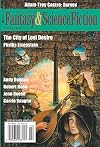
I think this is one of the strongest issues of F&SF that I've ever read. It was packed with goodness from front to back. As much as I enjoyed them all, there were a few stand-outs:
TO THE BEAUTIFUL SHINING TWILIGHT - Carrie Vaughn: a fantastic contemporary take on how humans mature and grow after their time questing in lands of fairies and lore. I appreciated the deep sense of realism to this story.
THE RIGHT NUMBER OF CATS - Jenn Reese: the title alone hooked me. What IS the right number of show more cats? As a cat person, this is a vital question. This story went in pleasantly unexpected directions as it explored the evolution of grief over time.
SURVEY - Adam-Troy Castro: THIS STORY. It's my favorite of the bunch because it's so horrific. I mean, I don't usually go for horror at all, and this delves into the deep psychological side of the genre and does it entirely through dialogue. On a technical level, that makes this masterful, but on a story level it works and is hella disturbing.
THE WASHER FROM THE FORD - Sean McMullen: I do love fresh takes on the fae and how they work, and this one was especially delightful as it utilized an oft-forgotten being, the washer from the ford, along with a realistic and smart human protagonist. show less
TO THE BEAUTIFUL SHINING TWILIGHT - Carrie Vaughn: a fantastic contemporary take on how humans mature and grow after their time questing in lands of fairies and lore. I appreciated the deep sense of realism to this story.
THE RIGHT NUMBER OF CATS - Jenn Reese: the title alone hooked me. What IS the right number of show more cats? As a cat person, this is a vital question. This story went in pleasantly unexpected directions as it explored the evolution of grief over time.
SURVEY - Adam-Troy Castro: THIS STORY. It's my favorite of the bunch because it's so horrific. I mean, I don't usually go for horror at all, and this delves into the deep psychological side of the genre and does it entirely through dialogue. On a technical level, that makes this masterful, but on a story level it works and is hella disturbing.
THE WASHER FROM THE FORD - Sean McMullen: I do love fresh takes on the fae and how they work, and this one was especially delightful as it utilized an oft-forgotten being, the washer from the ford, along with a realistic and smart human protagonist. show less
The Magazine of Fantasy & Science Fiction May June 2016 (Vol. 130, #5 & 6, whole # 725) by C. C. Finlay

This is definitely one of the better issues of the magazine. Not a single dud of a story and the weakest one in here is co-authored by Ted Chiang! The included fiction is:
7 • More Heat Than Light • novelette by Charlotte Ashley
28 • Last of the Sharkspeakers • novelette by Brian Trent
62 • The Nostalgia Calculator • short story by Rich Larson
88 • Coyote Song • novella by Pat MacEwen
134 • The Great Silence • (2015) • short story by Allora and Calzadilla and Ted Chiang
139 show more • Caribou: Documentary Fragments • short story by Joseph Tomaras
152 • Steamboat Gothic • novelette by Albert E. Cowdrey
173 • Ash • short story by Susan Palwick
190 • The Secret Mirror of Moriyama House • short story by Yukimi Ogawa
208 • The Long Fall Up • novelette by William Ledbetter
231 • The Stone War • novelette by Ted Kosmatka
There seems to be a little something of everything in this issue. We start off with an alternative history story with a sort of french revolution in Canada leading to a soldier story. Honor prevails. It was one of the weaker stories I thought, but OK. We then have a story set on an asteroid, Ceres, where future humans have a very strange society. I liked this one. We also have a CSI type story with heavy supernatural elements and I liked that one too. Fantasy, supernatural and some horror is the overriding element of most stories.
I think my favorite story here was 'The Long Fall Up' by William Ledbetter. show less
7 • More Heat Than Light • novelette by Charlotte Ashley
28 • Last of the Sharkspeakers • novelette by Brian Trent
62 • The Nostalgia Calculator • short story by Rich Larson
88 • Coyote Song • novella by Pat MacEwen
134 • The Great Silence • (2015) • short story by Allora and Calzadilla and Ted Chiang
139 show more • Caribou: Documentary Fragments • short story by Joseph Tomaras
152 • Steamboat Gothic • novelette by Albert E. Cowdrey
173 • Ash • short story by Susan Palwick
190 • The Secret Mirror of Moriyama House • short story by Yukimi Ogawa
208 • The Long Fall Up • novelette by William Ledbetter
231 • The Stone War • novelette by Ted Kosmatka
There seems to be a little something of everything in this issue. We start off with an alternative history story with a sort of french revolution in Canada leading to a soldier story. Honor prevails. It was one of the weaker stories I thought, but OK. We then have a story set on an asteroid, Ceres, where future humans have a very strange society. I liked this one. We also have a CSI type story with heavy supernatural elements and I liked that one too. Fantasy, supernatural and some horror is the overriding element of most stories.
I think my favorite story here was 'The Long Fall Up' by William Ledbetter. show less
Awards


You May Also Like


Associated Authors
Statistics
- Works
- 79
- Also by
- 30
- Members
- 1,167
- Popularity
- #22,033
- Rating
- 3.7
- Reviews
- 49
- ISBNs
- 13
- Languages
- 2
- Favorited
- 3