
Eliot A. Cohen
Author of Supreme Command: Soldiers, Statesmen, and Leadership in Wartime
About the Author
Eliot A. Cohen is the Robert E. Osgood Professor of Strategic Studies at Johns Hopkins University's School of Advanced International Studies (SAIS). He is the prize-winning author of several books, and a former counselor of the Department of State.
Works by Eliot A. Cohen
Conquered into Liberty: Two Centuries of Battles along the Great Warpath that Made the American Way of War (2011) 120 copies, 1 review
The Big Stick: The Limits of Soft Power and the Necessity of Military Force (2017) 84 copies, 2 reviews
Gulf War Air Power Survey, Volume IV: Weapons, Tactics, and Training and Space Operations (1994) 13 copies
Commandos and politicians: Elite military units in modern democracies (Harvard studies in international affairs) (1978) 6 copies
Gulf War Air Power Survey. 5 vols. 2 copies
Modern Warfare 1 copy
Associated Works
MHQ: The Quarterly Journal of Military History — Autumn 1991 (1991) — Author "The Might-Have-Beens of Pearl Harbor" — 22 copies
MHQ: The Quarterly Journal of Military History — Summer 1990 (1990) — Author "Military Misfortunes" — 17 copies
MHQ: The Quarterly Journal of Military History — Autumn 1996 (1996) — Author "Churchill and His Generals" — 13 copies
MHQ: The Quarterly Journal of Military History — Winter 2012 (2011) — Author "Roger's Rangers Ice Capade" — 2 copies
Tagged
Common Knowledge
- Birthdate
- 1956-04-03
- Gender
- male
- Education
- Maimonides School, Brookline, Massachusetts, USA
Harvard University (B.A.|Government|1977)
Harvard University John F. Kennedy School of Government (Ph.D.|Political Science|1982) - Occupations
- military analyst
public official - Organizations
- Project for the New American Century
Committee for the Liberation of Iraq
George W. Bush administration (2007-2009) - Nationality
- USA
- Birthplace
- Boston, Massachusetts, USA
- Associated Place (for map)
- Massachusetts, USA
Members
Reviews
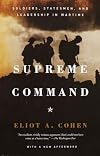
In "Supreme Command: Soldiers, Statesmen, and Leadership in Wartime" scholar Eliot Cohen asks what is it that distinguishes great leadership when war threatens annihilation to an idea, a country, a history, a people.
Think about it for a minute.
What would it mean if you and your neighbours, your home, your city, everything you know were threatened by a menace like Hitler and the German war machine?
Do you think you would be protected by the professional class of killers that is your show more military?
In the example of David Ben-Gurion, there was no experienced military. There was barely a war machine at all when Israel declared independence and faced the wrath of a 100 million Arabs surrounding it.
Ben-Gurion fashioned an effective leadership from men who could organize themselves, not just an impassioned group of partisans.
Among these great portraits of leadership under duress we find Lincoln taking firm hold over his generals, which would lead and which would be cast aside. We find Winston Churchill burrowing through the war plans questioning them, questioning their assumptions, documenting, reading, and revising. We find Georges Clemenceau finding the best in his generals Foch and Petain and engaging first hand in the trenches.
Cohen's point is that leadship does not wait for the professionals to take hold of the situation. Leaders get engaged, push themselves, and leave as little to chance as possible.
I can't imagine a scenario where Ulysses Grant gets the commission to lead the army under any other president. Lincoln saw someone absolutely determined to defeat the South.
Churchill's military leaders hated his meddling, fought him over everything, and yet they got the results.
Lincoln, Clemenceau, and Churchill all had their detractors. Before they took the reigns of power none of the elite in their homelands would have given them a chance of success.
All of these men were great readers. They were tireless. They were worldly. And they were tyrannical in pursuit of the good end.
Those are certainly the qualities I would want in my leader. Especially when somebody was trying to tear my country apart.
Wouldn't you? show less
Think about it for a minute.
What would it mean if you and your neighbours, your home, your city, everything you know were threatened by a menace like Hitler and the German war machine?
Do you think you would be protected by the professional class of killers that is your show more military?
In the example of David Ben-Gurion, there was no experienced military. There was barely a war machine at all when Israel declared independence and faced the wrath of a 100 million Arabs surrounding it.
Ben-Gurion fashioned an effective leadership from men who could organize themselves, not just an impassioned group of partisans.
Among these great portraits of leadership under duress we find Lincoln taking firm hold over his generals, which would lead and which would be cast aside. We find Winston Churchill burrowing through the war plans questioning them, questioning their assumptions, documenting, reading, and revising. We find Georges Clemenceau finding the best in his generals Foch and Petain and engaging first hand in the trenches.
Cohen's point is that leadship does not wait for the professionals to take hold of the situation. Leaders get engaged, push themselves, and leave as little to chance as possible.
I can't imagine a scenario where Ulysses Grant gets the commission to lead the army under any other president. Lincoln saw someone absolutely determined to defeat the South.
Churchill's military leaders hated his meddling, fought him over everything, and yet they got the results.
Lincoln, Clemenceau, and Churchill all had their detractors. Before they took the reigns of power none of the elite in their homelands would have given them a chance of success.
All of these men were great readers. They were tireless. They were worldly. And they were tyrannical in pursuit of the good end.
Those are certainly the qualities I would want in my leader. Especially when somebody was trying to tear my country apart.
Wouldn't you? show less
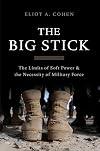
I found this unconvincing and a little unmemorable. I am currently an active duty Army officer, so I am more hawkish than average. I would readily agree that the US needs a strong military and that we can not rely of soft power to solve all international problems. however, I also know we spend plenty on defense and I'm not sure all of it is a good buy. Cohen indicates that we should spend more and increase capabilities, but i don't think he makes a good argument on that point. The US already show more spends more than the next several countries combined. That doesn't completely dissuade vastly poorer forces from defying us, with some degree of success, on a regular basis. He argues for increased capabilities, but doesn't get into resource allocation. show less
The "America can do no wrong" attitude starts to grate very quickly and in the end I can't tell if the author is arguing for or against use of military force. You could argue it's a nuanced stance but it's more to do with how meandering the narrative is.
And how many times is he going to tell us that America's capabilities are surely great but we can't talk about the details because it's a secret. Too late, I'm onto your secrets and will carelessly reveal the existence of the American moon show more base right here! show less
And how many times is he going to tell us that America's capabilities are surely great but we can't talk about the details because it's a secret. Too late, I'm onto your secrets and will carelessly reveal the existence of the American moon show more base right here! show less
As stated in the preface, "This is a book about leadership in wartime - or more precisely about the tension between two kinds of leadership, civil and military." Cohen examines the military leadership of four war statesmen he considers to have been "great": Lincoln, Clemenceau, Churchill, and Ben Gurion. Their genius lay in their abilities to: (1) manage people - especially, conflicting personalities - so as to utilize all of them fruitfully; (2) tolerate, and even encourage, disagreement; show more (3) be flexible (willingness to change with circumstances and/or new information); (4) understand the interplay of war and politics; (5) juggle political coalitions; (6) relently acquire of information through interrogation of military (making a continuous audit of the military's judgment); (7) goad commanders into action; (8) inspire ("exhibiting a mastery of political rhetoric"); and (9) make an effort to mold the peace as well as the war ("to shape a larger vision"). Above all, they, as individuals, made an actual difference in the outcome of the wars. Contrasts are drawn with leadership during Vietnam, Iraq I, and Iraq II. Cohen clearly favors close civilian oversight (preferably of course, by a great leader). Interesting and thought-provoking read. (JAF) show less
Awards

You May Also Like


Associated Authors
Statistics
- Works
- 23
- Also by
- 4
- Members
- 1,067
- Popularity
- #24,130
- Rating
- 3.5
- Reviews
- 10
- ISBNs
- 44
- Languages
- 1