
Charles, d'Orléans (1394–1465)
Author of Ballades et rondeaux
About the Author
Image credit: Photo © ÖNB/Wien
Works by Charles, d'Orléans
Fortunes Stabilnes: Charles of Orleans's English Book of Love : A Critical Edition (MEDIEVAL AND RENAISSANCE TEXTS AND STUDIES) (1994) 6 copies
The French chansons of Charles d'Orleans, with the corresponding Middle English chansons (1986) 2 copies
The French chansons of Charles d'Orleans, with the corresponding Middle English chansons (1986) 1 copy
Associated Works
World Poetry: An Anthology of Verse from Antiquity to Our Time (1998) — Contributor — 499 copies, 2 reviews
Oogst Der Tijden. keur uit de werken van schrijvers en dichters aller volken en eeuwen (1940) — Contributor — 12 copies
Tagged
Common Knowledge
- Canonical name
- d'Orléans, Charles,
- Legal name
- Duke of Orléans, Charles,
- Birthdate
- 1394-11-24
- Date of death
- 1465-01-04
- Gender
- male
- Occupations
- poet
- Nationality
- France
- Birthplace
- Paris, France
- Places of residence
- England
- Place of death
- Amboise, France
- Associated Place (for map)
- France
Members
Reviews
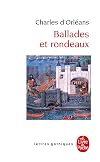
25th October 1415. Agincourt. In one of the most (in)famous battles of the Hundred Years War, the English armies led by Henry V would completely decimate the French nobility, in a decisive use of its archers and tactics that would change the face of warfare and chivalry alike. Under the pile of corpses stacking up on the battlefield would be found Charles d'Orléans, nephew of the French King Charles VI and leading head of the Armagnacs, one of the then most powerful houses in France (so show more powerful, in fact, that Charles d'Orléans was in line to inherit the French throne). Taken prisoner to England, the man was deemed far too much of a threat to English interest to be released under mere ransom, as was then customary. Charles d'Orléans, as a result, would therefore spend the next 25 years of his life into custody, in various part of England and including in the (in)famous Tower of London. What to do?
To counter boredom, the young Duke would... write poetry. Being anchored in the 15th century, his work, of course, reflected a style now associated mainly with the medieval era; his poems being essentially ballades or rondeaux, some of the commonest fixed forms of the time. However, being an adept at personifications (something that set him apart from most of his contemporaries) it also allowed him for highly creative metaphors, striking for their retelling of ever changing moods that one can still relates to e.g. love and sorrow, growing old, the futility of wars, boredom and melancholy etc. He is, in any case, far more accessible than a Villon, yet another key French poet of the same period! The fact that he relied a lot on repetitions (one of my personal, favourite devices when it comes to poetry) just make his verses even more gripping and enthralling.
Personally, then, I find it quite sad that when it comes to French medieval poetry from this specific era, his work still is not as well known as that of a Villon or a Christine de Pizan. His creativity and ability in writing verses so striking that they must be read again and again to be fully appreciated, let alone his very personal writing style allowing for plenty of no less striking ideas colliding in many arresting stanzas (thanks, again, to his reliance on linguistic devices which were not that commonly used back then) made him an original figure which cannot be ignored. He is, in any case, one of my favourite medieval poets.
Charles d'Orléans, as a highly valued prisoner of war, would ultimately be released in 1440 and go on to father who would become the French King Louis XII. His political role might have been dashed otherwise by a very long captivity, but the impact that it made upon his work truly made him a unique poet indeed. Ballades et Rondeaux is, quite frankly, a masterpiece. show less
To counter boredom, the young Duke would... write poetry. Being anchored in the 15th century, his work, of course, reflected a style now associated mainly with the medieval era; his poems being essentially ballades or rondeaux, some of the commonest fixed forms of the time. However, being an adept at personifications (something that set him apart from most of his contemporaries) it also allowed him for highly creative metaphors, striking for their retelling of ever changing moods that one can still relates to e.g. love and sorrow, growing old, the futility of wars, boredom and melancholy etc. He is, in any case, far more accessible than a Villon, yet another key French poet of the same period! The fact that he relied a lot on repetitions (one of my personal, favourite devices when it comes to poetry) just make his verses even more gripping and enthralling.
Personally, then, I find it quite sad that when it comes to French medieval poetry from this specific era, his work still is not as well known as that of a Villon or a Christine de Pizan. His creativity and ability in writing verses so striking that they must be read again and again to be fully appreciated, let alone his very personal writing style allowing for plenty of no less striking ideas colliding in many arresting stanzas (thanks, again, to his reliance on linguistic devices which were not that commonly used back then) made him an original figure which cannot be ignored. He is, in any case, one of my favourite medieval poets.
Charles d'Orléans, as a highly valued prisoner of war, would ultimately be released in 1440 and go on to father who would become the French King Louis XII. His political role might have been dashed otherwise by a very long captivity, but the impact that it made upon his work truly made him a unique poet indeed. Ballades et Rondeaux is, quite frankly, a masterpiece. show less

Vous pensiez connaître le Français votre langue maternelle et ne plus en être surpris, méfiance.
Jun 29, 2013French
Lists
Lectuurlijst (1)
You May Also Like
Associated Authors
Statistics
- Works
- 22
- Also by
- 4
- Members
- 80
- Popularity
- #224,853
- Rating
- 4.1
- Reviews
- 3
- ISBNs
- 12
- Languages
- 4