
Kazimir Malevich (1879–1935)
Author of Kazimir Malevich 1878-1935 en het suprematisme
About the Author
Works by Kazimir Malevich
Delphi Complete Works of Kazimir Malevich (Illustrated) (Delphi Masters of Art Book 59) (2020) 5 copies
Malevitch : [exposition rétrospective], 14 mars-15 mai 1978, Centre national d'art et de culture Georges Pompidou, Musï (1978) 4 copies
Kazimir Malevich, 1878-1935: Tekeningen uit de collectie van de Khardzhiev-Chaga Kunststichting (SMA cahiers) (1998) 4 copies
Of Absence and Presence 3 copies
Escritos de Malevich / Writings of Malevich (Espiritu Y La Letra / Spirit and Writtings) (Spanish Edition) (2008) 3 copies
Kasimir Malevich, Raku Kichizaemon XV : Kasimir Malevich drawings and Raku Kichizaemon XV Jikinyū tea bowls (2022) 2 copies
Kasimir Malewitsch, 1878-1935, das Spätwerk aus dem Staatlichen Russischen Museum St. Petersburg (German Edition) (2000) 2 copies
Kasimir Malewitsch zum 100 Geburtstag : Ausstellung Juni-Juli 1978, Galerie Gmurzynska, Köln 2 copies
Arkhiv N.I. Khardzhieva : Russkiĭ avangard. Materialy i dokumenty iz sobranii︠a︡ RGALI (2017) 2 copies
K. Malevich 1 copy
The Great Artists : Their lives, works and inspiration : 81 : Malevich (1986) — Illustrator — 1 copy
Associated Works
Theories of Modern Art: A Source Book by Artists and Critics (1968) — Contributor — 853 copies, 6 reviews
Black Square: Malevich and the Origin of Suprematism (2012) — Cover artist, some editions — 17 copies
Tagged
Common Knowledge
- Canonical name
- Malevich, Kazimir
- Legal name
- Malevich, Kazimir Severinovich
- Other names
- Malewicz, Kazimierz (birth name)
- Birthdate
- 1879-02-23
- Date of death
- 1935-05-15
- Gender
- male
- Education
- Moscow School of Painting, Sculpture and Architecture
- Occupations
- painter
art theorist - Relationships
- Lissitzky, El (protégé)
- Cause of death
- cancer
- Nationality
- Poland (ethncity)
Ukraine (birth and self-identification)
Russian Empire (subject)
USSR (subject) - Birthplace
- Kiev, Ukraine, Russian Empire
- Places of residence
- Kursk, Russian Empire
Moscow, Russian Empire - Place of death
- Leningrad, Russia, USSR
- Burial location
- Nemchinovka, Russia
Members
Reviews
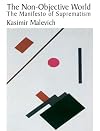
The Non-Objective World: The Manifesto of Supermatism contains not only Kasimir Malevich's manifesto but over 90 black-and-white prints, giving the reader a broad overview of the radical vision and creative output of this Russian avant-garde artist who had a profound influence on the course of modern abstract art.
To fully comprehend Malevich's innovation and revolutionary approach to art, imagine your average art-goers, men and women visiting galleries and museums, people who particularly show more enjoy the way an artist applies his or her skill in painting a broad summer landscape with swans in a lake and cows grazing in a meadow under clouds in the style of, say, John Constable, or perhaps a fruit and flower still life or portrait of a famous leader. Now imagine these same art loving men and women entering a gallery where the featured artwork is a painting of a black square on a white background. This was precisely the experience of art-goers during a 1913 exhibition in Russia. Predictably, the art-goers felt betrayed since their familiar art was nowhere to be found, such recognizable realistic art providing them with beautiful objects to look at and think about (concepts) as well as firm aesthetic grounding, a grounding serving art lovers since the time of the Renaissance.
Thus, Kasimir Malevich responded with his Supermatism Manifesto, a declaration of purpose and intent wherein Malevich wrote 65 bold statements expressing his philosophy and views on art, the artist and creativity, citing how the realism those art-goers hanker for has absolutely no value in the type of art worth creating since objectivity is meaningless and concepts are worthless. Rather, for Malevich, art expresses the fullest possible feeling and ignores the familiar appearance of objects. As stated in his Manifesto, in such a non-objective art there is a blissful sense of liberation and nothing is considered real except feeling. And the Supermatist does not observe or touch, the Supermatist feels.
So, how should we encounter his black square on a white background? Malevich's manifesto states the equation clearly: "The black square on the white field was the first form in which nonobjective feeling came to be expressed. The square = felling, the white field = the void beyond the feeling." Malevich goes on to state, "The Supermatists have deliberately given up objective representation of their surroundings in order to reach the summit of the true "unmasked art" and from this vantage point to view life through the prism of pure artistic feeling."
And he goes on further in stating, "Now that art, thanks to Suprematism, has come into its own that is, attained the pure, unapplied form and has recognized the infallibility of nonobjective feeling, it is attempting to set up a genuine world order, a new philosophy of life. It recognizes the nonobjectivity of the world and is no longer concerned with providing illustrations of the history of manners." This is strong language. No wonder Malevich moved to abstraction.
In addition to the Black Square, we have Malevich's memorable Black Circle, where, on a white field, the large black circle is positioned toward the top and on the right side of the square canvas. There is something unspeakably pure and unique about this painting, so simply yet so provocative. Who would have envisioned a painting of a black circle on a white field having such a transforming effect on viewers and the world of art? Perhaps, applying Malevich's equation of the black square, we unconsciously equate the black circle with our feelings and the white field as a realm beyond our feelings. Whatever the reason, we join Malevich in crossing an artistic threshold - we enter the modern world, a modern world with a place, both permanent and distinctive, for abstract art. And by launching this phase of modernism in his writing and his art, Kasimir Malevich occupies a prominent position in history. show less
The Non-Objective World: The Manifesto of Supermatism contains not only Kasimir Malevich's manifesto but over 90 black-and-white prints, giving the reader a broad overview of the radical vision and creative output of this Russian avant-garde artist who had a profound influence on the course of modern abstract art.
To fully comprehend Malevich's innovation and revolutionary approach to art, imagine your average art-goers, men and women visiting galleries and museums, people who particularly show more enjoy the way an artist applies his or her skill in painting a broad summer landscape with swans in a lake and cows grazing in a meadow under clouds in the style of, say, John Constable, or perhaps a fruit and flower still life or portrait of a famous leader. Now imagine these same art loving men and women entering a gallery where the featured artwork is a painting of a black square on a white background. This was precisely the experience of art-goers during a 1913 exhibition in Russia. Predictably, the art-goers felt betrayed since their familiar art was nowhere to be found, such recognizable realistic art providing them with beautiful objects to look at and think about (concepts) as well as firm aesthetic grounding, a grounding serving art lovers since the time of the Renaissance.
Thus, Kasimir Malevich responded with his Supermatism Manifesto, a declaration of purpose and intent wherein Malevich wrote 65 bold statements expressing his philosophy and views on art, the artist and creativity, citing how the realism those art-goers hanker for has absolutely no value in the type of art worth creating since objectivity is meaningless and concepts are worthless. Rather, for Malevich, art expresses the fullest possible feeling and ignores the familiar appearance of objects. As stated in his Manifesto, in such a non-objective art there is a blissful sense of liberation and nothing is considered real except feeling. And the Supermatist does not observe or touch, the Supermatist feels.
So, how should we encounter his black square on a white background? Malevich's manifesto states the equation clearly: "The black square on the white field was the first form in which nonobjective feeling came to be expressed. The square = felling, the white field = the void beyond the feeling." Malevich goes on to state, "The Supermatists have deliberately given up objective representation of their surroundings in order to reach the summit of the true "unmasked art" and from this vantage point to view life through the prism of pure artistic feeling."
And he goes on further in stating, "Now that art, thanks to Suprematism, has come into its own that is, attained the pure, unapplied form and has recognized the infallibility of nonobjective feeling, it is attempting to set up a genuine world order, a new philosophy of life. It recognizes the nonobjectivity of the world and is no longer concerned with providing illustrations of the history of manners." This is strong language. No wonder Malevich moved to abstraction.
In addition to the Black Square, we have Malevich's memorable Black Circle, where, on a white field, the large black circle is positioned toward the top and on the right side of the square canvas. There is something unspeakably pure and unique about this painting, so simply yet so provocative. Who would have envisioned a painting of a black circle on a white field having such a transforming effect on viewers and the world of art? Perhaps, applying Malevich's equation of the black square, we unconsciously equate the black circle with our feelings and the white field as a realm beyond our feelings. Whatever the reason, we join Malevich in crossing an artistic threshold - we enter the modern world, a modern world with a place, both permanent and distinctive, for abstract art. And by launching this phase of modernism in his writing and his art, Kasimir Malevich occupies a prominent position in history. show less
RYAV! PERCHATKI, 1908-1914 [ROAR! THE GAUNTLETS, 1908-1914]. by Velimir Khlebnikov, Kazimir Malevich and David Burliuk

Eu 3.500. 8vo (252 x 173mm), [limited to 1000 copies], printed on brown paper, 4 illustrations by Malevich and Burliuk,
Bonhams, 4 giugno 2014, eu. 4.045, RARE SIGNED COPY from an edition of no more than 1,000, autographed by Khlebnikov and Kruchenykh (twice) on the title page. This anthology of poems, plays and essays is one of the most important books of the Russian Futurist movement in which Zaum or Transrational language was used by the authors. The outrageous nature of the poetry was show more reinforced by the production of the book in which the text and pictures were printed on rough brown paper. The Futurist pictures provided by Malevich and Burliuk supplement the text rather than illustrate it. show less
Bonhams, 4 giugno 2014, eu. 4.045, RARE SIGNED COPY from an edition of no more than 1,000, autographed by Khlebnikov and Kruchenykh (twice) on the title page. This anthology of poems, plays and essays is one of the most important books of the Russian Futurist movement in which Zaum or Transrational language was used by the authors. The outrageous nature of the poetry was show more reinforced by the production of the book in which the text and pictures were printed on rough brown paper. The Futurist pictures provided by Malevich and Burliuk supplement the text rather than illustrate it. show less

Een van de bekendste schilderijen van Malevich is "Wit op wit". Als schilderij stelt dit natuurlijk niet veel voor, maar het is interessant om te zien wat voor ontwikkeling tot het ontstaan van dit schilderij heeft geleid. Gelukkig is Malevich na dit schilderij weer gewoon verder gegaan met het maken van figuratieve schilderijen die neigen naar het abstracte. Al meer dan 20 jaar geleden was er een grote overzichtstentoonstelling in het Stedelijk Museum in Amsterdam, waarbij ik erg onder de show more indruk was van zijn schilderijen. Van Malevich had ik toen nog nooit gehoord. Op klein formaat zoals in dit boekje doet het me niet zo veel. show less
Jan 23, 2013Dutch
You May Also Like


Associated Authors
Statistics
- Works
- 65
- Also by
- 9
- Members
- 510
- Popularity
- #48,630
- Rating
- 3.8
- Reviews
- 5
- ISBNs
- 79
- Languages
- 9