
Nancy J. Chodorow
Author of The Reproduction of Mothering: Psychoanalysis and the Sociology of Gender
About the Author
Nancy J. Chodorow is Training and Supervising Analyst, Boston Psychoanalytic Society and Institute, Professor of Sociology Emerita, University of California, Berkeley, and Lecturer Part-time in Psychiatry, Cambridge Health Alliance, Harvard Medical School. She is author of five previous books, show more including the groundbreaking The Reproduction of Mothering. show less
Image credit: UC Berkeley Sociology Department Website
Works by Nancy J. Chodorow
The Reproduction of Mothering: Psychoanalysis and the Sociology of Gender (1978) 306 copies, 1 review
Individualizing Gender and Sexuality: Theory and Practice (Relational Perspectives Book Series) (2011) 10 copies
Associated Works
Tagged
Common Knowledge
- Birthdate
- 1944-01-20
- Gender
- female
- Education
- Radcliffe College (BA)
Brandeis University (PhD) - Occupations
- psychoanalyst
sociologist - Organizations
- University of California, Berkeley
- Relationships
- Reich, Michael (spouse)
- Nationality
- USA
- Associated Place (for map)
- USA
Members
Reviews
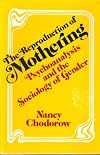
This is a psychoanalytic tour de force and a feminist classic, published in 1978. Much has changed for women in America since then, but the thrust and the force of her argument is as important as ever.
Chodorow argues that "the sexual division of labor and women's responsibility for child care are linked to and generate male dominance." A family dynamic in which the mother is the primary caretaker (primary object for the infant, as well as it's primary love), is bad for the psychological show more development of children, but worse for boys. Insofar as the family unit produces children who are un/fit for society, this must also be understood as a cultural problem. If mothering produces boys who are independent, averse to connection, prone to fear of women (in short patriarchal men), then Chodorow wonders if co-parenting might produce less anxiety about the feminine in boys, and therefore less hatred of women?
Chodorow denies that there is a biological imperative for mothers to mother (in a strong sense) beyond lactation. Technology makes it possible for a variety of others to participate in "mothering" practices.
The bulk of the book is a very careful analysis of the formation of the self from infancy to adolescence (through adulthood). Chodorow employs an object relations theory of psychoanalysis. Briefly object relations stresses the mental personality as an object, not a subject. If we feel out of control, we internalize, or "introject" objects (here, people or certain aspects of people) into ourselves, to try exercise some control within our mental life.
The primary object each infant seeks is the primary source of care, or love they encounter. In the current climate that is still typically the mother. The experience of oneness and identity with the mother is followed by an individuation from her (the end goal of the Oedipus Complex). This individuation occurs differently for boys and girls in the Mothering context. I'll try to be short. For boys, it is easy to turn from their mother and individuate because they are repressing their Oedipal desire for her. Similarly it is easy for them to idealize their (mostly absent) fathers, and their independence. However, girls do not have a pre/protosexual desire for the mother. Instead they see her as a model of relationality and connection, and as modeling mothering practices for her. Chodorow claims that the Oedipus complex happens differently (and much more slowly) in girls, because girls can love their (mostly absent) father alongside their mother. A consequence is that girls are actually more psychosexually developed than men. Another intriguing consequence, Noddings tells us, is that adult Mothered women will find it difficult to achieve sexual satisfaction because the sex act cannot recreate their cathected object of desire. Instead, she will have children, to recreate her triadic relationship between her mother and father.
Although much has changed both in women's positions in society since 1978, I anecdotally find that women still tend to be the primary caretakers, even among the more egalitarian couples I know. This is a very clever argument that women as sole care givers is bad for men, bad for women and bad for society. show less
Chodorow argues that "the sexual division of labor and women's responsibility for child care are linked to and generate male dominance." A family dynamic in which the mother is the primary caretaker (primary object for the infant, as well as it's primary love), is bad for the psychological show more development of children, but worse for boys. Insofar as the family unit produces children who are un/fit for society, this must also be understood as a cultural problem. If mothering produces boys who are independent, averse to connection, prone to fear of women (in short patriarchal men), then Chodorow wonders if co-parenting might produce less anxiety about the feminine in boys, and therefore less hatred of women?
Chodorow denies that there is a biological imperative for mothers to mother (in a strong sense) beyond lactation. Technology makes it possible for a variety of others to participate in "mothering" practices.
The bulk of the book is a very careful analysis of the formation of the self from infancy to adolescence (through adulthood). Chodorow employs an object relations theory of psychoanalysis. Briefly object relations stresses the mental personality as an object, not a subject. If we feel out of control, we internalize, or "introject" objects (here, people or certain aspects of people) into ourselves, to try exercise some control within our mental life.
The primary object each infant seeks is the primary source of care, or love they encounter. In the current climate that is still typically the mother. The experience of oneness and identity with the mother is followed by an individuation from her (the end goal of the Oedipus Complex). This individuation occurs differently for boys and girls in the Mothering context. I'll try to be short. For boys, it is easy to turn from their mother and individuate because they are repressing their Oedipal desire for her. Similarly it is easy for them to idealize their (mostly absent) fathers, and their independence. However, girls do not have a pre/protosexual desire for the mother. Instead they see her as a model of relationality and connection, and as modeling mothering practices for her. Chodorow claims that the Oedipus complex happens differently (and much more slowly) in girls, because girls can love their (mostly absent) father alongside their mother. A consequence is that girls are actually more psychosexually developed than men. Another intriguing consequence, Noddings tells us, is that adult Mothered women will find it difficult to achieve sexual satisfaction because the sex act cannot recreate their cathected object of desire. Instead, she will have children, to recreate her triadic relationship between her mother and father.
Although much has changed both in women's positions in society since 1978, I anecdotally find that women still tend to be the primary caretakers, even among the more egalitarian couples I know. This is a very clever argument that women as sole care givers is bad for men, bad for women and bad for society. show less
You May Also Like


Associated Authors
Statistics
- Works
- 10
- Also by
- 4
- Members
- 552
- Popularity
- #45,211
- Rating
- 3.7
- Reviews
- 1
- ISBNs
- 39
- Languages
- 6