

Dennis Calero
Author of X-Factor, Vol. 1: The Longest Night
Series
Works by Dennis Calero
Ray Bradbury's The Martian Chronicles: The Authorized Adaptation (2011) — Illustrator — 136 copies, 6 reviews
Supergirl and the Legion of Super-Heroes: The Quest for Cosmic Boy (2008) — Illustrator — 60 copies, 1 review
Supergirl and The Legion of Super-Heroes [2005] #32 — Illustrator — 3 copies
X-Men Noir #3 (of 4) — Illustrator — 2 copies
X-Men Noir #2 (of 4) — Illustrator — 2 copies
Vikings: Sword of Kings — Foreword — 2 copies
X-Men Noir #4 (of 4) — Illustrator — 2 copies
X-Factor [2006] #5 — Illustrator — 1 copy
X-Factor [2006] #6 — Illustrator — 1 copy
X-Men Noir: Mark of Cain #1 — Artist — 1 copy
X-Factor [2006] #3 — Illustrator — 1 copy
Marvel Noir - X-Men Bd. 2 1 copy
Associated Works
Kalpa Imperial: The Greatest Empire That Never Was (1983) — Cover artist, some editions — 685 copies, 21 reviews
Heroes: The World's Greatest Super Hero Creators Honor The World's Greatest Heroes 9-11-2001 (2001) — Colorist — 25 copies, 1 review
Tagged
Common Knowledge
- Birthdate
- 1972-01-02
- Gender
- male
- Short biography
- Calero is an award-winning writer and artist who helped developed "Xmen Noir" for Marvel Comics, as well as having worked on DC and Dark Horse Comics. Calero has also worked on entertainment projects for CBS Films and Weed Road Pictures and is currently working with famed horror writer Stephen King. He also adapted "The Martian Chronicles" by Ray Bradbury as a graphic novel for Hill & Wang.
He was nominated for the Harvey, an industry award recognizing excellence in comics, and has been recognized by the Society of Illustrators. - Nationality
- USA
- Birthplace
- Miami Beach, Florida, USA
- Associated Place (for map)
- Florida, USA
Members
Reviews
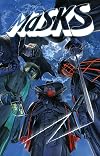
Masks is about the difference between "law" and "justice." It's about doing the wrong thing for the right reasons, and the struggle to do the right thing no matter what. And it's about the very fine line heroes walk and how badly things can go if they confuse the two.
This is my favorite sort of superhero (mask) storyline. I love watching what happens when heroes take the law into their own hands. Do they remain heroes or do they become villains? I especially like the contrast between the show more various masked heroes in the way they approach law and justice: this book gives us nearly the full spectrum from the very good to the very bad, and shows us that often it's all a matter of opinion.
My favorite character was The Shadow. He, for me, stands on the line between good and evil, clinging to his ideals of justice and going much further to enforce them than others would.
(Provided by publisher) show less
This is my favorite sort of superhero (mask) storyline. I love watching what happens when heroes take the law into their own hands. Do they remain heroes or do they become villains? I especially like the contrast between the show more various masked heroes in the way they approach law and justice: this book gives us nearly the full spectrum from the very good to the very bad, and shows us that often it's all a matter of opinion.
My favorite character was The Shadow. He, for me, stands on the line between good and evil, clinging to his ideals of justice and going much further to enforce them than others would.
(Provided by publisher) show less

Access a version of the below that includes illustrations on my blog.
This slim collection contains three stories (four issues originally, one double-sized) about Alan Scott, the original Green Lantern. One is a "retro" story, set in 1944; the other two feature him in the present day. The first story is "Brightest Day, Blackest Night," which tells the story of Alan's first run-in with Solomon Grundy in the Slaughter Swamp outside Gotham City. Nazi agents crash a passenger airplane in the show more swamp to get their hands on an inventor aboard it, as well as his invention, but run afoul of an angry Grundy. Green Lantern comes to the rescue, aided by his romantic interest, reporter Irene Miller, and taxi-driving sidekick Doiby Dickles. The story seems designed to show off the painted art of John K. Snyder III, which is brimming with atmosphere, and captures well both the brutality of Grundy and the majesty of the Green Lantern. Unfortunately, the art isn't consistently great at storytelling: though I thought on the one hand, the body language of Irene really brought her to life, on the other hand, there were times it was just completely unclear to me what was happening. That the scientist had a niece also on the plane who also survived the crash was something the illustrations only seemed to intermittently depict, for example.
The second story, "Johnny Mimic," is the best in the volume. Johnny Mimic is a criminal with an uncanny ability to recreate heists; Alan apprehended him back during the Golden Age, but let him go if he promised to be good—and he did. But decades later, the Super Human Advanced Defense Executive want Johnny to help them figure out a heist, and if Alan can't convince him nicely, S.H.A.D.E. will do it by force. The three-way tension between Alan, Johnny, and Father Time (leader of S.H.A.D.E.) is well done, and the story is genuinely surprising in terms of both what had happened and what goes on to happen. Johnny is not an actual preexisting character, but feels like one. The story does a strong job of playing Alan's optimism off the more cynical tone of contemporary comics. This is a solid, perfectly executed done-in-one comic with good moments of charm. Unsurprisingly, it's written by Tony Bedard who's good at this kind of thing in general, and Dennis Calero handles the art well.
The final story is "Giving Thanks"/"Ghosts of Christmas Past"—you might not be surprised to realize it takes place across the holiday season, going from Thanksgiving to Christmas. Alan battles perennial JSA villain Vandal Savage, who taunts him by seemingly bringing Jade back to life. It's a bit plodding at times (the battle went on too long with the same character beats repeated again and again), but the final ten pages or so really shined, as Alan must make a tough decision, and then we follow the emotional fallout of it. I get that she wasn't really there, but Jade felt very generic here, not the well-rounded character that Roy and Dann Thomas created in Infinity, Inc. Anyway, it's fine. I remember not liking how Jade was killed off in the Infinite Crisis Companion, but in my reading of JSA comics, I haven't gotten to her death yet. I'm curious to find out if she has any kind of meaningful role in JSA before she's killed, or if she's brought back just to die as so often happens with minor female superheroes.
The Justice Society and Earth-Two: « Previous in sequence | Next in sequence » show less
This slim collection contains three stories (four issues originally, one double-sized) about Alan Scott, the original Green Lantern. One is a "retro" story, set in 1944; the other two feature him in the present day. The first story is "Brightest Day, Blackest Night," which tells the story of Alan's first run-in with Solomon Grundy in the Slaughter Swamp outside Gotham City. Nazi agents crash a passenger airplane in the show more swamp to get their hands on an inventor aboard it, as well as his invention, but run afoul of an angry Grundy. Green Lantern comes to the rescue, aided by his romantic interest, reporter Irene Miller, and taxi-driving sidekick Doiby Dickles. The story seems designed to show off the painted art of John K. Snyder III, which is brimming with atmosphere, and captures well both the brutality of Grundy and the majesty of the Green Lantern. Unfortunately, the art isn't consistently great at storytelling: though I thought on the one hand, the body language of Irene really brought her to life, on the other hand, there were times it was just completely unclear to me what was happening. That the scientist had a niece also on the plane who also survived the crash was something the illustrations only seemed to intermittently depict, for example.
The second story, "Johnny Mimic," is the best in the volume. Johnny Mimic is a criminal with an uncanny ability to recreate heists; Alan apprehended him back during the Golden Age, but let him go if he promised to be good—and he did. But decades later, the Super Human Advanced Defense Executive want Johnny to help them figure out a heist, and if Alan can't convince him nicely, S.H.A.D.E. will do it by force. The three-way tension between Alan, Johnny, and Father Time (leader of S.H.A.D.E.) is well done, and the story is genuinely surprising in terms of both what had happened and what goes on to happen. Johnny is not an actual preexisting character, but feels like one. The story does a strong job of playing Alan's optimism off the more cynical tone of contemporary comics. This is a solid, perfectly executed done-in-one comic with good moments of charm. Unsurprisingly, it's written by Tony Bedard who's good at this kind of thing in general, and Dennis Calero handles the art well.
The final story is "Giving Thanks"/"Ghosts of Christmas Past"—you might not be surprised to realize it takes place across the holiday season, going from Thanksgiving to Christmas. Alan battles perennial JSA villain Vandal Savage, who taunts him by seemingly bringing Jade back to life. It's a bit plodding at times (the battle went on too long with the same character beats repeated again and again), but the final ten pages or so really shined, as Alan must make a tough decision, and then we follow the emotional fallout of it. I get that she wasn't really there, but Jade felt very generic here, not the well-rounded character that Roy and Dann Thomas created in Infinity, Inc. Anyway, it's fine. I remember not liking how Jade was killed off in the Infinite Crisis Companion, but in my reading of JSA comics, I haven't gotten to her death yet. I'm curious to find out if she has any kind of meaningful role in JSA before she's killed, or if she's brought back just to die as so often happens with minor female superheroes.
The Justice Society and Earth-Two: « Previous in sequence | Next in sequence » show less

Casino Royale is a strange choice for a graphic novel adaptation since much of the action takes place at tables and the tension is over the turn of a card. It's a story that requires imagination and skill to adapt effectively; sadly, this book shows neither.
This is less a graphic novel than it is an illustrated abridgment of novel. There's no effort to use the art to help tell the story; instead, large chunks of Fleming's prose are superimposed over bland drawings. It feels amateurish.
Skip show more this book and read the original instead—it's short and can be read in about the same amount of time it would take to watch the movie.
Received via NetGalley. show less
This is less a graphic novel than it is an illustrated abridgment of novel. There's no effort to use the art to help tell the story; instead, large chunks of Fleming's prose are superimposed over bland drawings. It feels amateurish.
Skip show more this book and read the original instead—it's short and can be read in about the same amount of time it would take to watch the movie.
Received via NetGalley. show less
As an adaption, I'd say this is quite good. Calero's art captures the atmosphere of a gritty spy world wonderfully, and Jensen's adaption of Fleming's novel is concise while still keeping Fleming's prose. As for the original story, "not my thing" is probably the best I can say about it. Bond is extremely sexist, even when he claims to love Vesper. The book is also littered with racist terms that aren't used anymore (at least, not used by anymore by people who don't want to use racist terms).
Lists
Awards


You May Also Like


Associated Authors
Statistics
- Works
- 38
- Also by
- 20
- Members
- 1,093
- Popularity
- #23,508
- Rating
- 3.6
- Reviews
- 47
- ISBNs
- 59
- Languages
- 5