
Beatrice Colin (1963–2019)
Author of The Luminous Life of Lilly Aphrodite
About the Author
Works by Beatrice Colin
Associated Works
Tagged
Common Knowledge
- Birthdate
- 1963-10-14
- Date of death
- 2019-02-06
- Gender
- female
- Education
- University of Glasgow
- Occupations
- journalist
playwright
writer - Agent
- Simon Trewin
- Cause of death
- cancer
- Nationality
- UK
- Birthplace
- London, England, UK
- Places of residence
- Glasgow, Scotland, UK
Brooklyn, New York, USA
London, England, UK - Associated Place (for map)
- UK
Members
Reviews

Superficial book fiend that I am, I confess that I chose this novel without a clue as to the subject simply because of the garish but eyecatching cover, which reminded me of Tretchikoff's painting. However, although it's true that you shouldn't judge a book by its cover, I wasn't disappointed. Beatrice Colin is a stunning writer, weaving poignant imagery into a bleak landscape of history, and redressing her own ignorance of time and place through the fictional biography of a German film show more star.
Lilly Nelly Aprhodite is born in Berlin at the end of the old century, but takes her first gasp of breath on New Year's Day, 1900, 'as if she was determined to wait'. Her parents, an actress and her Bavarian lover, make a suitably dramatic exit, and baby Lilly is raised in an orphanage where she finds Sister August, an inspiring role model, and Hanne Schmidt, her broken yet resilient best friend. Growing older with the twentieth century, Lilly is raised on a promise, like the future of Berlin itself, but is left to survive as best she can. The poverty and hunger experienced during the First World War continue in peace time, and Lilly is abandoned, neglected and abused time and again, with only Hanne's dubious company to fall back on. The two of them muddle through, with Lilly employed as a maid for a depressive countess and then working with Hanne in a 'tingle-tangle' nightclub, before being 'discovered' and launched into a briefly successful career as a film star. Lilly's life is intertwined with Berlin, and the rise and fall of the city between the wars, but also with the fate of two men who love her: a bashful soldier during the First World War, and the noble Russian who starts Lilly on the path to stardom.
It is hard to do justice to the powerful intimacy of this novel merely by describing the plot, because Lilly's 'luminous life' is part history and part fairy tale. Like the author, I have learned so much about Berlin between the wars, but Beatrice Colin's beautiful writing tempers harsh truth with her poetic phrasing: 'The city was full of the newly wed and newly widowed, half dressed in white, the other in black'. Even though Lilly's story is definitely depressing, and slowly paced for much of the book, I found myself almost instantly caught up in the narration and content to simply read and learn. show less
Lilly Nelly Aprhodite is born in Berlin at the end of the old century, but takes her first gasp of breath on New Year's Day, 1900, 'as if she was determined to wait'. Her parents, an actress and her Bavarian lover, make a suitably dramatic exit, and baby Lilly is raised in an orphanage where she finds Sister August, an inspiring role model, and Hanne Schmidt, her broken yet resilient best friend. Growing older with the twentieth century, Lilly is raised on a promise, like the future of Berlin itself, but is left to survive as best she can. The poverty and hunger experienced during the First World War continue in peace time, and Lilly is abandoned, neglected and abused time and again, with only Hanne's dubious company to fall back on. The two of them muddle through, with Lilly employed as a maid for a depressive countess and then working with Hanne in a 'tingle-tangle' nightclub, before being 'discovered' and launched into a briefly successful career as a film star. Lilly's life is intertwined with Berlin, and the rise and fall of the city between the wars, but also with the fate of two men who love her: a bashful soldier during the First World War, and the noble Russian who starts Lilly on the path to stardom.
It is hard to do justice to the powerful intimacy of this novel merely by describing the plot, because Lilly's 'luminous life' is part history and part fairy tale. Like the author, I have learned so much about Berlin between the wars, but Beatrice Colin's beautiful writing tempers harsh truth with her poetic phrasing: 'The city was full of the newly wed and newly widowed, half dressed in white, the other in black'. Even though Lilly's story is definitely depressing, and slowly paced for much of the book, I found myself almost instantly caught up in the narration and content to simply read and learn. show less

I love the time (1912) and place of this novel (Scotland). I was most intrigued with the background and interests of the characters. Cicely and her daughter, Kitty, travel to Scotland from their home in India with the intent to claim their (her husband's) inheritance. Her husband (George) is a rare plant collector who explores the globe seeking to discover new plant species. Unfortunately he has raked up extensive bills without generating income and their family is in dire need of funds. show more Malcolm and Antonia (George's sister) live in a rather run-down estate, Balmarra, located in Scotland and she also has a keen interest in plants. On the estate is an exquisite glass house with decorative ironwork which contains precious plants like palms, orchids, orange trees and roses. When Cicely and Kitty unexpectedly show up on Antonia's doorstep, Antonia is pleasantly surprised while Malcolm is suspicious. Cicely expects her trip there to obtain the inheritance will be simple and she plans to sell Balmarra providing her family with the income they need and then simply return to India. She's not terribly concerned about how this will impact Malcolm and Antonia. But things don't go as planned and her stay at Balmarra results in both adventures and misadventures. show less

To Capture What We Cannot Keep
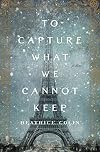
Impossible-to-remember title! (Authors, don’t do that!) Impossible to put down, though (at least for me). I must admit, I bought this book — preordered it, in fact — mostly on the basis of the gorgeous jacket illustration (Eiffel Tower, large snowflakes, metallic gold filigree border) and because I enjoy almost anything about Paris or the Eiffel Tower. And fortunately, this time it worked out for the best. The book is quite well written, and provides a lot show more of background about the construction of the Eiffel Tower, as well as some beautiful descriptions of Paris.
Overall, I really enjoyed the book, though some of the plot is far-fetched, and I was at times exasperated by the main character, Cait. It’s made clear to us more than once that she’s not like the typical Parisian woman, that she’s less conventional, more daring. But as the story unfolds, she fails again and again to stand up for herself and follow her heart. In addition, she sure doesn’t do a very good job of doing her job! She has no idea what her charges are up to and seems uninvolved with their comings and goings. I thought some plot elements were questionable. Jamie was at times just too cavalier to be believable (or in any way sympathetic). The duel just seemed slipped in there and not necessary. And why would Gustave care so much about whether Émile married Alice (i.e., enough to fire him)?
I liked it, though. Kept turning the pages, unwilling to pause for long. If you think of it as a romance novel, then it’s an especially intelligent and literary one. show less
Impossible-to-remember title! (Authors, don’t do that!) Impossible to put down, though (at least for me). I must admit, I bought this book — preordered it, in fact — mostly on the basis of the gorgeous jacket illustration (Eiffel Tower, large snowflakes, metallic gold filigree border) and because I enjoy almost anything about Paris or the Eiffel Tower. And fortunately, this time it worked out for the best. The book is quite well written, and provides a lot show more of background about the construction of the Eiffel Tower, as well as some beautiful descriptions of Paris.
Overall, I really enjoyed the book, though some of the plot is far-fetched, and I was at times exasperated by the main character, Cait. It’s made clear to us more than once that she’s not like the typical Parisian woman, that she’s less conventional, more daring. But as the story unfolds, she fails again and again to stand up for herself and follow her heart. In addition, she sure doesn’t do a very good job of doing her job! She has no idea what her charges are up to and seems uninvolved with their comings and goings. I thought some plot elements were questionable. Jamie was at times just too cavalier to be believable (or in any way sympathetic). The duel just seemed slipped in there and not necessary. And why would Gustave care so much about whether Émile married Alice (i.e., enough to fire him)?
I liked it, though. Kept turning the pages, unwilling to pause for long. If you think of it as a romance novel, then it’s an especially intelligent and literary one. show less
PEARL RULE @ 16%
Rating: 3* of five
The Publisher Says: Set against the construction of the Eiffel Tower, this novel charts the relationship between a young Scottish widow and a French engineer who, despite constraints of class and wealth, fall in love.
In February 1887, Caitriona Wallace and Émile Nouguier meet in a hot air balloon, floating high above Paris, France—a moment of pure possibility. But back on firm ground, their vastly different social strata become clear. Cait is a widow who show more because of her precarious financial situation is forced to chaperone two wealthy Scottish charges. Émile is expected to take on the bourgeois stability of his family's business and choose a suitable wife. As the Eiffel Tower rises, a marvel of steel and air and light, the subject of extreme controversy and a symbol of the future, Cait and Émile must decide what their love is worth.
Seamlessly weaving historical detail and vivid invention, Beatrice Colin evokes the revolutionary time in which Cait and Émile live—one of corsets and secret trysts, duels and Bohemian independence, strict tradition and Impressionist experimentation. To Capture What We Cannot Keep, stylish, provocative, and shimmering, raises probing questions about a woman's place in that world, the overarching reach of class distinctions, and the sacrifices love requires of us all.
I RECEIVED A DRC FROM THE PUBLISHER VIA NETGALLEY. THANK YOU.
My Review: Downloaded in 2016, the note I made for myself after abandoning the read that December (consider what December 2016 was like) was: "Émile...Concours Hippiques...guinguettes...zut alors!"
That made no sense, so I went back and re-read from the top. I got to chapter 6, ran into those words and thought, "I'm about sick of this," and quit again. It's better than competent writing, but I just do not care at all if straight people get together, cross class boundaries, find glory in the sack or end up holding it, in 2025. Straight ladies with historical tastes, Francophilia, and plucky-widow tolerances higher than mine are advised to seek it out.
Flatiron Books says "$11.99 please" at checkout. Read the sample, if it sounds good in your mental ear, go for it. show less
Rating: 3* of five
The Publisher Says: Set against the construction of the Eiffel Tower, this novel charts the relationship between a young Scottish widow and a French engineer who, despite constraints of class and wealth, fall in love.
In February 1887, Caitriona Wallace and Émile Nouguier meet in a hot air balloon, floating high above Paris, France—a moment of pure possibility. But back on firm ground, their vastly different social strata become clear. Cait is a widow who show more because of her precarious financial situation is forced to chaperone two wealthy Scottish charges. Émile is expected to take on the bourgeois stability of his family's business and choose a suitable wife. As the Eiffel Tower rises, a marvel of steel and air and light, the subject of extreme controversy and a symbol of the future, Cait and Émile must decide what their love is worth.
Seamlessly weaving historical detail and vivid invention, Beatrice Colin evokes the revolutionary time in which Cait and Émile live—one of corsets and secret trysts, duels and Bohemian independence, strict tradition and Impressionist experimentation. To Capture What We Cannot Keep, stylish, provocative, and shimmering, raises probing questions about a woman's place in that world, the overarching reach of class distinctions, and the sacrifices love requires of us all.
I RECEIVED A DRC FROM THE PUBLISHER VIA NETGALLEY. THANK YOU.
My Review: Downloaded in 2016, the note I made for myself after abandoning the read that December (consider what December 2016 was like) was: "Émile...Concours Hippiques...guinguettes...zut alors!"
That made no sense, so I went back and re-read from the top. I got to chapter 6, ran into those words and thought, "I'm about sick of this," and quit again. It's better than competent writing, but I just do not care at all if straight people get together, cross class boundaries, find glory in the sack or end up holding it, in 2025. Straight ladies with historical tastes, Francophilia, and plucky-widow tolerances higher than mine are advised to seek it out.
Flatiron Books says "$11.99 please" at checkout. Read the sample, if it sounds good in your mental ear, go for it. show less
Awards


You May Also Like


Associated Authors
Statistics
- Works
- 9
- Also by
- 1
- Members
- 819
- Popularity
- #31,141
- Rating
- 3.5
- Reviews
- 43
- ISBNs
- 62
- Languages
- 3