
Yvor Winters (1900–1968)
Author of Selected Poems
About the Author
Image credit: Courtesy Kenneth Fields
Works by Yvor Winters
In Defense of Reason: Primitivism and Decadence, Maule's Curse, The Anatomy of Nonsense, The Significance of the Bridge, Or What Are We To Think of Professor X. (1987) 63 copies, 1 review
Forms of Discovery: Critical & Historical Essays on the Forms of the Short Poem in English (1967) 15 copies
The Brink of Darkness 3 copies
Poets of the Pacific, Second Series 2 copies
The poetry of J.V. Cunningham 2 copies
Poems 2 copies
The Poetry of W.B. Yeats 2 copies
The Bare Hills 1 copy
The immobile wind 1 copy
The Journey and Other Poems 1 copy
The Strength of Art 1 copy
At the San Francisco Airport 1 copy
The Proof 1 copy
Associated Works
The Making of a Poem: A Norton Anthology of Poetic Forms (2000) — Contributor — 1,469 copies, 9 reviews
Literature: An Introduction to Fiction, Poetry, and Drama (1995) — Contributor, some editions — 1,018 copies, 7 reviews
World Poetry: An Anthology of Verse from Antiquity to Our Time (1998) — Contributor — 496 copies, 2 reviews
American Poetry: The Twentieth Century, Volume Two: E. E. Cummings to May Swenson (2000) — Contributor — 443 copies, 1 review
Tagged
Common Knowledge
- Legal name
- Winters, Arthur Yvor
- Birthdate
- 1900-10-17
- Date of death
- 1968-01-25
- Gender
- male
- Education
- University of Chicago
University of Colorado (BA & MA)
Stanford University (PhD|English, 1934) - Occupations
- poet
teacher
professor (college) - Organizations
- American Academy of Arts and Letters (Literature, 1956)
- Awards and honors
- Bollingen Prize (1961)
American Academy of Arts and Letters Academy Award (Literature, 1952) - Relationships
- Gunn, Thom (student)
Crane, Hart (friend) - Nationality
- USA
- Birthplace
- Chicago, Illinois, USA
- Places of residence
- Santa Fe, New Mexico, USA
- Place of death
- Los Altos, California, USA
- Associated Place (for map)
- USA
Members
Reviews

What began with no expectations ended up a benchmark experience in reading poetry. Opening the book, I'd never heard of Winters: the book was a gift. In what I now think of as my "first reading" (not all poems, perhaps half the collection), my overall impression was that Winters tried too hard -- not with every poem, only in specific places, though the impression of those specific places was pronounced. Other poems or lines seemed to work very well at evoking an image or a feeling, even as I show more failed to apprehend an overarching purpose. At the end of this reading session, I realised I could not state what I thought Winters was like, could not characterise his poetry in any specific way, and thought I should read more and try to develop a clearer sense of what I thought.
In my "second reading" (again not of all poems in the collection, but re-reading many from the first reading) I warmed to Winters and the sense of the book overall, as opposed to individual poems. I still had no firm sense of purpose, but I began to pick up on an abiding interest in stillness: in nature, in relationship. In this reading, I remarked specifically the poem "The Vision", it was odd in its subject matter (a dream of encountering a decapitated head), but wasn't a novelty or a jarring departure from other poems in the collection.
Thereafter, I dipped in multiple times: new poems, re-reads of poems from the first two readings. Usually I found Winters uneven, within the same poem identifying really strong and then really awkward portions. I spent some time reading about Winters and his place in contemporary American poetry, both at the Poetry Foundation and a New Yorker essay. After a prolonged read of perhaps the final quarter or third of the collection, I reflected I had a a strong impression I "got" what Winters was after in the poems collected here. That reading somehow suggested the classic concern of Spirit and Matter, or actual life along with the importance of abstract principles, and that Winters in his verse was grappling with what abstractions are, putting into as clear terms as possible what these meant for living, how they inform 'immortality' or a legacy left after one's death via culture, learning, and values passed on.
Much remains obscure to me, I still do not feel as confident or clear in reading verse compared to reading fiction or essays or non-fiction. But reading Winters' Collected Poems feels like a milepost in my efforts at understanding verse and the poetic tradition.
I had grown away from youth,
Shedding error where I could;
I was now essential wood,
Concentrating into truth;
What I did was small but good.
-- A Dream Vision show less
In my "second reading" (again not of all poems in the collection, but re-reading many from the first reading) I warmed to Winters and the sense of the book overall, as opposed to individual poems. I still had no firm sense of purpose, but I began to pick up on an abiding interest in stillness: in nature, in relationship. In this reading, I remarked specifically the poem "The Vision", it was odd in its subject matter (a dream of encountering a decapitated head), but wasn't a novelty or a jarring departure from other poems in the collection.
Thereafter, I dipped in multiple times: new poems, re-reads of poems from the first two readings. Usually I found Winters uneven, within the same poem identifying really strong and then really awkward portions. I spent some time reading about Winters and his place in contemporary American poetry, both at the Poetry Foundation and a New Yorker essay. After a prolonged read of perhaps the final quarter or third of the collection, I reflected I had a a strong impression I "got" what Winters was after in the poems collected here. That reading somehow suggested the classic concern of Spirit and Matter, or actual life along with the importance of abstract principles, and that Winters in his verse was grappling with what abstractions are, putting into as clear terms as possible what these meant for living, how they inform 'immortality' or a legacy left after one's death via culture, learning, and values passed on.
Much remains obscure to me, I still do not feel as confident or clear in reading verse compared to reading fiction or essays or non-fiction. But reading Winters' Collected Poems feels like a milepost in my efforts at understanding verse and the poetic tradition.
I had grown away from youth,
Shedding error where I could;
I was now essential wood,
Concentrating into truth;
What I did was small but good.
-- A Dream Vision show less

Yvor Winters was a beloved teacher and a minor poet whose criticism has a reputation for idiosyncrasy. In this book he savagely attacks T. S. Eliot, Hopkins, and Frost. He is less negative on Crane and Stevens; he has an ongoing critical war with Ransom. While some of this is daring to speak of the "elephant in the room", speaking of the aspects of some of these great poets' styles that have, perhaps, made others of us uncomfortable, but that are general not spoken of, much of the time one show more has the impression that he has such high standards and such narrow tastes, that there simply isn't much poetry he likes very much. The writing is old-fashionedly elegant, the argumentation is brilliant, the passion evident ... still, one prefers a critic who is more willing to like poems more easily and more broadly. show less
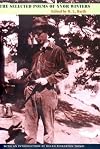
Winters was loved as a teacher, and influential as a critic, which explains a continuing interest in his small body of poetic work. I was intrigued enough by these poems to read this slim volume and its critical introduction through twice. While some will find poems to admire here, I'd be surprised if many will find much to love. These are formal rather chilly poems, whether in his early Imagist period, the middle neo-Augustan poems in heroic couplets, or the finely wrought lyrics (heavily show more influenced by the 16th and 17th English poets) of his later work. The language is precise, hard and crystalline, but often moves almost by indirection, whether with references so specific as become hermetic, or so symbolic as to become abstract. The intensity of the expression and the clearly heavily worked surface make lapses of tone and diction seem sloppy or precious depending on you point of view. show less

My opinion of this work is admittedly biased by the fact that I'm not a huge fan of strict formalist poetry. So the first 60-or-so pages that began this volume, consisting of Winters' work in modernist and imagist styles, was for the most part heavenly to me, while the subsequent 80 pages — following Winters' shift to a very strict formalism — failed, with a few exceptions, to really hold my interest.
Awards

You May Also Like


Associated Authors
Statistics
- Works
- 43
- Also by
- 16
- Members
- 439
- Popularity
- #55,771
- Rating
- 4.1
- Reviews
- 7
- ISBNs
- 29
- Favorited
- 1