
William Least Heat-Moon
Author of Blue Highways: A Journey into America
About the Author
William Least Heat-Moon was born of English-Irish-Osage ancestry in Kansas City, Missouri. He holds a doctorate in English and a bachelor's degree in photojournalism from the University of Missouri.
Image credit: Photo by Joe Mabel / Wikimedia Commons
Series
Works by William Least Heat-Moon
Blue Highways Revisited 1 copy
Blue Highways 1 copy
Associated Works
Tagged
Common Knowledge
- Canonical name
- Heat-Moon, William Least
- Legal name
- Trogdon, William Lewis
- Other names
- Heat Moon, William Least
- Birthdate
- 1939-08-27
- Gender
- male
- Education
- University of Missouri (BA|1961|MA|1962|Ph.D|1972|English)
University of Missouri (BA|1978|photojournalism) - Occupations
- travel writer
historian
professor
novelist - Organizations
- University of Missouri
- Awards and honors
- Christopher Award (1984)
Distinguished Literary Achievement, Missouri Humanities Council (2015) - Nationality
- USA
- Birthplace
- Kansas City, Missouri, USA
- Places of residence
- Columbia, Missouri, USA
- Associated Place (for map)
- Missouri, USA
Members
Reviews

For armchair tourists like myself, who prefer reading to travelling, William Least Heat-Moon is the perfect tour guide to late 1970s America. Part travelogue, part journey of self-discovery, Heat-Moon set off one day in his campervan - a 'self-propelled box' he calls 'Ghost Dancing' - to drive around the 'blue highways', or b-roads, of America, meeting a host of wacky characters along the way. Really, without photographic evidence of some of the people he strikes up conversations with, I show more would have my doubts about the authenticity of his anecdotes! My favourites are the droll Carolina deputy - 'Garrantee one thing, Wim. This boy wouldn't sleep up here mongst the whangdoodles withouten his peace of mind' - the two women running a cafe on a bombing range in Nevada, the disgruntled husband in Hat Creek, California, and the eighty year old keeper of local history on Smith Island, Maryland. Sometimes, fact is stranger than fiction!
Heat-Moon, on his circular journey of 'emergence' around the States - taking in places with odd names from the east, south, west and north of the country - is a friendly and instructive combination of Bill Bryson and John Steinbeck. In between random dialogues with strangers, Heat-Moon is full of insightful and lyrical descriptions of his homeland. I also love his turn of phrase, from 'the expression of a man pulling on wet swimming trunks' (think about it) to the 'texturised substitute in polystyrene sarcophagus' he was forced to eat in a fast food outlet. People, places and poetic imagery, all in one entertaining guide (could have done with less Walt Whitman quotes, though).
Not only has Blue Highways left me hungry for more travelogues - perhaps Zen and the Art of Motorcycle Maintenance - but I am also tempted to start reading about the history of America, which hopefully survives in books where shopping malls and parking lots have destroyed the living evidence in real life. show less
Heat-Moon, on his circular journey of 'emergence' around the States - taking in places with odd names from the east, south, west and north of the country - is a friendly and instructive combination of Bill Bryson and John Steinbeck. In between random dialogues with strangers, Heat-Moon is full of insightful and lyrical descriptions of his homeland. I also love his turn of phrase, from 'the expression of a man pulling on wet swimming trunks' (think about it) to the 'texturised substitute in polystyrene sarcophagus' he was forced to eat in a fast food outlet. People, places and poetic imagery, all in one entertaining guide (could have done with less Walt Whitman quotes, though).
Not only has Blue Highways left me hungry for more travelogues - perhaps Zen and the Art of Motorcycle Maintenance - but I am also tempted to start reading about the history of America, which hopefully survives in books where shopping malls and parking lots have destroyed the living evidence in real life. show less
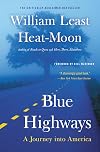
I've read many travelogues over the years. Some were bad, some were good, some were so good they made me anxious to take a similar journey (and sometimes I did). Of them all, this is the best.
It's William Least Heat Moon's circumnavigation of the United States, all the while avoiding the sterile super-highways usual for that purpose and trying to stay on the blue roads ... the secondary thoroughfares colored blue on road atlases before we all became reliant on GPS.
It's not just that he has a show more gift for a turn of phrase—a waitress with a "grudge of a face." Nor that he can describe the natural world so well that you can picture it—the Pine Barrens "six hundred fifty thousand acres (equal to Grand Canyon National Park) ... pitch pines and oaks and white cedars ... cranberry bogs and fields of high-bush blueberries opening the woods ... a stream [where] tannins had turned the transparent water the color of cherry cola .. a silence as if civilization had disappeared." Not even that he knows us—Americans—so well: "You might as well ask [the American traveler] to share his toothbrush as his bathroom."
It's all that plus a perfect blend of "This is what I saw" and "This is whom I met." It's a picture of place and people, many of them gone or going now. Colorful, rich, full of stories about how things got the way they are now, the people that embraced the changes and those who resisted them.
And you learn how to rate diners by the number of calendars on wall.
Absolutely read it. show less
It's William Least Heat Moon's circumnavigation of the United States, all the while avoiding the sterile super-highways usual for that purpose and trying to stay on the blue roads ... the secondary thoroughfares colored blue on road atlases before we all became reliant on GPS.
It's not just that he has a show more gift for a turn of phrase—a waitress with a "grudge of a face." Nor that he can describe the natural world so well that you can picture it—the Pine Barrens "six hundred fifty thousand acres (equal to Grand Canyon National Park) ... pitch pines and oaks and white cedars ... cranberry bogs and fields of high-bush blueberries opening the woods ... a stream [where] tannins had turned the transparent water the color of cherry cola .. a silence as if civilization had disappeared." Not even that he knows us—Americans—so well: "You might as well ask [the American traveler] to share his toothbrush as his bathroom."
It's all that plus a perfect blend of "This is what I saw" and "This is whom I met." It's a picture of place and people, many of them gone or going now. Colorful, rich, full of stories about how things got the way they are now, the people that embraced the changes and those who resisted them.
And you learn how to rate diners by the number of calendars on wall.
Absolutely read it. show less

The title PrairyErth is not some coy neologism; it’s from a quote by naturalist John Madson: “In a stroke of scientific shorthand, the soils of our central grasslands are sometimes called simply ‘prairyerths.’” This is a very deep look at one specific place—Chase County, Kansas—and it covers just about everything there is to know about the place: its geology, ecology, economy, and history.
William Least Heat-Moon has a way with words, so what could have been a dry encyclopedic show more iteration of facts is instead interesting and engaging.
Nevertheless, I found this book rather slow going: There’s only so much Chase County I can digest at a single sitting. The parts that I enjoyed most were descriptions of the tallgrass prairie:
William Least Heat-Moon has a way with words, so what could have been a dry encyclopedic show more iteration of facts is instead interesting and engaging.
“Boston Corbett, after he shot down John Wilkes Booth in Virginia, came out to Kansas where he would lie on his back, rifle locked toward the sky, and shoot hawks; I’m lying here in hopes the stars will shoot.”
“The bag he was about to carry across thirty-some miles of the Flint Hills I considered more of a chifforobe than a pack, a thing that can change one’s destination from a place to a hernia.”
Nevertheless, I found this book rather slow going: There’s only so much Chase County I can digest at a single sitting. The parts that I enjoyed most were descriptions of the tallgrass prairie:
“I came to understand that the prairies are nothing but grass as the sea is nothing but water, that most prairie life is within the place: under the stems, below the turf, beneath the stones. The prairie is not a topography that shows its all but rather a vastly exposed place of concealment, like the geodes so abundant in the county, where the splendid lies within the plain cover.”
“Almost everything I see in this place sooner or later brings me back to the grasses; after all, this is the prairie, a topography that so surprised Anglo culture when it began arriving that it found for this grand-beyond no suitable word in its immense vocabulary, and it resorted to the French of illiterate trappers: prairie. Except in accounts of novice travelers, these grasslands have never been meadows, heaths, moors, downs, wolds. A woman in Boston once said to me, Prairie is such a lovely word—and for so grim a place.”
“The thousands of acres that lay encircled around the knob I really didn’t see, not at first. I saw air, and I said, good god, look at all this air, and I recalled a woman saying, Seems the air here hasn’t ever been used before.”
“I was coming to see that facts carry a traveler only so far: at last he must penetrate the land by a different means, for to know a place in any real and lasting way is sooner or later to dream it. That’s how we come to belong to it in the deepest sense.”show less
For the past few days as I read Blue Highways by William Least Heat-Moon I have been glued to my computer so that I could use the Google maps to follow along with his journey. In 1978 after seeing his marriage fall apart and then his teaching job disappear, William Least Heat-Moon climbed into his van and set off to explore the byways of America. He tried to avoid all major routes and stick to the secondary roads that are marked by blue on the maps, hence the name of the book.
Setting off on show more the road with no set destination, just living moment by moment, I was green with envy. I would love to simply pack up and hit the roads for a tour around North America. The author travelled on very little money or comfort items, but managed to explore his country and meet and talk with some extremely interesting people all the while coming to terms with who he was and where he wanted to be. The book is rich in details of the trip. The sights, smells and tastes of America are detailed by this talented observer. By the time he headed for home in Missouri, he had completely circled the country.
As I read the book and checked the maps I was saddened by the changes that have occurred since then. Many of the roads have changed or no longer exist, and the same can be said for many of the small towns. Some have been swallowed up by ever expanding cities and some have just disappeared. It’s been over forty years since Blue Highways was published so at times this book seems more like a testament to days gone by. This became a journey of heart, mind and spirit for the author but he always kept America front and centre as the main character and delivers a wonderful road trip travelogue full of wit, humor and truth. show less
Setting off on show more the road with no set destination, just living moment by moment, I was green with envy. I would love to simply pack up and hit the roads for a tour around North America. The author travelled on very little money or comfort items, but managed to explore his country and meet and talk with some extremely interesting people all the while coming to terms with who he was and where he wanted to be. The book is rich in details of the trip. The sights, smells and tastes of America are detailed by this talented observer. By the time he headed for home in Missouri, he had completely circled the country.
As I read the book and checked the maps I was saddened by the changes that have occurred since then. Many of the roads have changed or no longer exist, and the same can be said for many of the small towns. Some have been swallowed up by ever expanding cities and some have just disappeared. It’s been over forty years since Blue Highways was published so at times this book seems more like a testament to days gone by. This became a journey of heart, mind and spirit for the author but he always kept America front and centre as the main character and delivers a wonderful road trip travelogue full of wit, humor and truth. show less
Lists
Carole's List (1)
Awards


You May Also Like


Associated Authors
Statistics
- Works
- 20
- Also by
- 4
- Members
- 6,710
- Popularity
- #3,648
- Rating
- 3.9
- Reviews
- 122
- ISBNs
- 105
- Languages
- 5
- Favorited
- 20