
David Almond
Author of Skellig
About the Author
David Almond was born on May 15, 1951 in the United Kingdom. He writes novels for children and young adults including The Savage, Slog's Dad, My Name Is Mina, The Boy Who Swam with Piranhas, and The Tightrope Walkers. He has received numerous awards including the Carnegie Medal for Skellig, two show more Whitbread Awards, the Michael L. Printz Award for young-adult books for Kit's Wilderness, the Smarties Prize and the Boston Globe Horn Book Award for The Fire-Eaters, the 2015 Guardian Children's Fiction Prize for A Song for Ella Grey, and the Hans Christian Andersen Award. (Bowker Author Biography) show less
Series
Works by David Almond
Associated Works
King Arthur and His Knights of the Round Table (1953) — Introduction, some editions — 4,218 copies, 29 reviews
The Great War: Stories Inspired by Items from the First World War (2015) — Contributor — 119 copies, 18 reviews
Sideshow: Ten Original Tales of Freaks, Illusionists and Other Matters Odd and Magical (2009) — Contributor — 65 copies, 1 review
So, What Kept You?: New Stories inspired by Anton Chekhov and Raymond Carver (2006) — Contributor — 4 copies
Tagged
Common Knowledge
- Birthdate
- 1951-05-15
- Gender
- male
- Education
- University of East Anglia (English and American Literature)
St Joseph's Grammar Technical School - Occupations
- author
- Awards and honors
- Hans Christian Andersen Award (2010)
Eleanor Farjeon Award (2013) - Nationality
- UK
- Birthplace
- Newcastle-upon-Tyne, Northumberland, England, UK
- Places of residence
- Newcastle-upon-Tyne, Northumberland, England, UK (birth)
Humshaugh, Northumberland, England, UK - Map Location
- England, UK
Members
Reviews
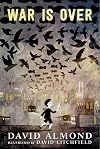
David Almond’s illustrated novella for children focuses on John, who lives in the north of England during the time of the Great War. As the book opens, the conflict has been dragging on for so long that the schoolboy can barely recall his soldier-father’s face. John’s mother works in the town’s ever-expanding munitions plant, which the author characterizes as a twentieth-century Blakeian “dark satanic mill”. Now over a mile long, the factory is a dangerous place, where explosions show more aren’t uncommon, and the women who work twelve-hour shifts risk serious injury and even death. Each day John asks his mam when it will all be over. He even writes to the king and the Archbishop of Canterbury. No answers come to assuage his fears for his parents. Some say the war will go on forever, that the boys will follow their fathers to the front and the girls their mothers to the munitions plant.
Almond repeatedly contrasts the oppressive shadow of war with the beauty and fragility of the natural world. For example, just before the school trip to the factory, aimed at educating students about the essential war work of their mothers, John asks his mam about her duties there. Likening the shells she fills at work to the to rose hips she gathers for making tea, she diagrams a casing with its top off. Unlike a rose hip with its “seeds of life” within, she explains, the casing of an artillery projectile is filled with the stuff of death: sharp shrapnel in resin. It is her job to fill the casings before their tops are screwed on. Yes, the Germans have these shells, too, she answers her son, but his father’s steel helmet should protect him.
The book’s central event is the students’ outing to the factory, where they will see women who are indistinguishable from each other, “diminished by the vastness of the machines that rattle, thud, squeal, and scream, making it seem “as if a great war was being played out here” in the town as well. The students’ head teacher, the militaristic Mr. Mackenzie, a fervent supporter of the war, has regularly reminded them that they’re all engaged in the conflict, something that baffles his charges. “How can children be at war?” asks Dorothy, a girl in John’s class. Events on the day of the school trip will make this question loom even larger for John.
To get to the factory, their teacher leads the students on a forced march, two-by-two, through the streets. On their way, they encounter a conscientious objector: an old man, Dorothy’s uncle Gordon, standing on a box in the town square near a delicate apple tree. He holds up etchings of the faces of boys and girls and declares that these young Germans are children just like John and his classmates, with fathers and mothers, brothers and sisters. Don’t believe what they tell you, Uncle Gordon calls out; children cannot be at war. “There are no monsters! [. . .] There are only lies! There is no need for war.”
As this “traitor”, “blasphemer”, “coward” and “conchie scum” of a man is beaten and chased away into the woods by the local police, he drops his pictures, which many students pick up. In a “traitorous” act, John tucks the etching of Jan, a young boy from Dusseldorf, in his pocket. Seeing the image of this young “enemy”, a boy so very like himself, has a profound effect on John. He will dream about Jan, believe that he sees him in the place where the children play war games at the edge of the woods, and even write a letter to him. For the latter act, he’ll be warned and threatened by the local police for being treasonous.
In time, this war will end, John’s father will be reintroduced to him, and the town will celebrate. The boy will begin to feel happy, maybe as happy as he’d been when he was very small, but he can’t be sure. He remembers neither that boy nor that time. The war consumed them. What he does know is that one day he will try to find his German friend.
Almond’s is a rich and beautifully written anti-war book. The book may focus on one war, but its title—which notably lacks the beginning definite article (i.e., “the”)—communicates the message that war is something that humans must move on from. It must end. The novella explores the fears and confusion that some children experience during wartime. It also shows the tendencies of more forceful, aggressive children to act out in games the ideological messages they’ve received from their elders. This is not a strictly realistic narrative: it shifts more than once into the world of dreams. Plot and characterization are not strong points. For this reason, I feel that Almond’s book is best presented to children as a read-aloud by a parent or a teacher. It is a sophisticated work that many kids might not respond to unless provided with opportunities for lots of discussion.
Rating: 3.5 show less
Almond repeatedly contrasts the oppressive shadow of war with the beauty and fragility of the natural world. For example, just before the school trip to the factory, aimed at educating students about the essential war work of their mothers, John asks his mam about her duties there. Likening the shells she fills at work to the to rose hips she gathers for making tea, she diagrams a casing with its top off. Unlike a rose hip with its “seeds of life” within, she explains, the casing of an artillery projectile is filled with the stuff of death: sharp shrapnel in resin. It is her job to fill the casings before their tops are screwed on. Yes, the Germans have these shells, too, she answers her son, but his father’s steel helmet should protect him.
The book’s central event is the students’ outing to the factory, where they will see women who are indistinguishable from each other, “diminished by the vastness of the machines that rattle, thud, squeal, and scream, making it seem “as if a great war was being played out here” in the town as well. The students’ head teacher, the militaristic Mr. Mackenzie, a fervent supporter of the war, has regularly reminded them that they’re all engaged in the conflict, something that baffles his charges. “How can children be at war?” asks Dorothy, a girl in John’s class. Events on the day of the school trip will make this question loom even larger for John.
To get to the factory, their teacher leads the students on a forced march, two-by-two, through the streets. On their way, they encounter a conscientious objector: an old man, Dorothy’s uncle Gordon, standing on a box in the town square near a delicate apple tree. He holds up etchings of the faces of boys and girls and declares that these young Germans are children just like John and his classmates, with fathers and mothers, brothers and sisters. Don’t believe what they tell you, Uncle Gordon calls out; children cannot be at war. “There are no monsters! [. . .] There are only lies! There is no need for war.”
As this “traitor”, “blasphemer”, “coward” and “conchie scum” of a man is beaten and chased away into the woods by the local police, he drops his pictures, which many students pick up. In a “traitorous” act, John tucks the etching of Jan, a young boy from Dusseldorf, in his pocket. Seeing the image of this young “enemy”, a boy so very like himself, has a profound effect on John. He will dream about Jan, believe that he sees him in the place where the children play war games at the edge of the woods, and even write a letter to him. For the latter act, he’ll be warned and threatened by the local police for being treasonous.
In time, this war will end, John’s father will be reintroduced to him, and the town will celebrate. The boy will begin to feel happy, maybe as happy as he’d been when he was very small, but he can’t be sure. He remembers neither that boy nor that time. The war consumed them. What he does know is that one day he will try to find his German friend.
Almond’s is a rich and beautifully written anti-war book. The book may focus on one war, but its title—which notably lacks the beginning definite article (i.e., “the”)—communicates the message that war is something that humans must move on from. It must end. The novella explores the fears and confusion that some children experience during wartime. It also shows the tendencies of more forceful, aggressive children to act out in games the ideological messages they’ve received from their elders. This is not a strictly realistic narrative: it shifts more than once into the world of dreams. Plot and characterization are not strong points. For this reason, I feel that Almond’s book is best presented to children as a read-aloud by a parent or a teacher. It is a sophisticated work that many kids might not respond to unless provided with opportunities for lots of discussion.
Rating: 3.5 show less
 This review was written for LibraryThing Early Reviewers.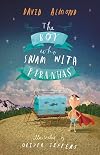
Stanley Potts lives with his aunt and uncle and has a pretty good life until his uncle loses his job, goes a bit batty, and decides to turn their house into a canning factory. After Uncle Ernie makes a very poor decision that results in a traumatic incident for Stanley, Stanley runs away from home to join a traveling carnival. He meets all sorts of interesting characters and starts an unlikely career as The Boy Who Swims with the Piranhas.
I love this quirky-but-lovely book. Stanley is such a show more great character: complex in his quiet confidence and empathetic manners. And the other characters are strange and rich and wonderful, too. Almond is a great storyteller, and I highly recommend this one. show less
I love this quirky-but-lovely book. Stanley is such a show more great character: complex in his quiet confidence and empathetic manners. And the other characters are strange and rich and wonderful, too. Almond is a great storyteller, and I highly recommend this one. show less

Part picture-book, part graphic novel, this lovely little volume from British author/illustrator team David Almond and Dave McKean imagines a world whose creation is incomplete. A lazy pantheon of gods lounges about on the clouds, admiring what they have created, while empty places exist in the world down below. Three children - Harry, Sue and Ben - take a hand at completing their world, each of them creating a new creature: Ben a mouse, Sue a bird, and Harry a snake. Their last creation show more however - a wolf - proves rather problematic, as he swallows Harry and Sue whole, leaving it to Ben to un-create him. Things are not so simple however, and the narrative concludes with a hint that the wolf won't stay un-created for long...
Almond and McKean have teamed up on other titles - The Savage, Slog's Dad - but Mouse Bird Snake Wolf is the first of their joint projects I have picked up. I am so glad I did, as I found it quite a thought-provoking little book. The writing is spare but powerful, the artwork intense and compelling, the final product an interesting meditation on the nature of creation. Is it complete? (obviously not in this world). Do we (human beings) have a role to play, in completing it? What is creation? And can things be unmade, once they are made? What is the relationship between the divine and the human? Between the creator and the created? Does the creator become his creation? These are all questions raised by the story here, remaining open-ended, as they should. The only thing here I didn't like, was the use of the figure of the wolf, as these creatures are so often (unjustly) vilified in story, standing in for our fears about the natural world. Of course, one could argue that since the wolf comes from a human figure in the story, its negative connotations are brought to life by humanity, rather than by any innate wolfiness, but again, the narrative here complicates ideas of creator/creation. Recommended to readers looking for more philosophical children's books. show less
Almond and McKean have teamed up on other titles - The Savage, Slog's Dad - but Mouse Bird Snake Wolf is the first of their joint projects I have picked up. I am so glad I did, as I found it quite a thought-provoking little book. The writing is spare but powerful, the artwork intense and compelling, the final product an interesting meditation on the nature of creation. Is it complete? (obviously not in this world). Do we (human beings) have a role to play, in completing it? What is creation? And can things be unmade, once they are made? What is the relationship between the divine and the human? Between the creator and the created? Does the creator become his creation? These are all questions raised by the story here, remaining open-ended, as they should. The only thing here I didn't like, was the use of the figure of the wolf, as these creatures are so often (unjustly) vilified in story, standing in for our fears about the natural world. Of course, one could argue that since the wolf comes from a human figure in the story, its negative connotations are brought to life by humanity, rather than by any innate wolfiness, but again, the narrative here complicates ideas of creator/creation. Recommended to readers looking for more philosophical children's books. show less

John is a child living in Great Britain during World War I - his father is away at war and his mother works in the town's munition factory. By chance, John sees a picture of a German boy, and discovers that the boy looking back at him is not a monster, but just another child, like himself. When he questions his mother about the boy, and how she can make missiles out of shrapnel that kill boys like Jan, she has no easy answers. John dreams that someday he and the children of Germany can live show more in peace together.
For such a short book, it carries a huge amount of hope and heart. Although it is about a war long since over, it is still relatable today, and always will be as long as we continue to use violence to solve our problems The beautiful illustrations capture both the horrific nature of war and the indomitable spirit of peace.
Thank you to Candlewick Press and LibraryThing for the advanced copy of this book!*
*This did not affect my review or rating. show less
For such a short book, it carries a huge amount of hope and heart. Although it is about a war long since over, it is still relatable today, and always will be as long as we continue to use violence to solve our problems The beautiful illustrations capture both the horrific nature of war and the indomitable spirit of peace.
Thank you to Candlewick Press and LibraryThing for the advanced copy of this book!*
*This did not affect my review or rating. show less
This review was written for LibraryThing Early Reviewers.Lists
Five star books (4)
A Novel Cure (1)
Magic Realism (1)
Read in 2003 (1)
Rising water (1)
Ghosts (1)
Awards


You May Also Like


Associated Authors
Statistics
- Works
- 62
- Also by
- 8
- Members
- 10,795
- Popularity
- #2,199
- Rating
- 3.7
- Reviews
- 609
- ISBNs
- 620
- Languages
- 21
- Favorited
- 17

