
Georges Dumézil (1898–1986)
Author of Gods of the Ancient Northmen
About the Author
Until his death, Georges Dumezil was the guiding light of the study of Indo-European civilizations. He taught at the College de France for many years, directed the Section des Sciences Religieuses of the Ecole des Hautes Etudes of the Sorbonne, and by the time he was elected to the Academie show more Francais in the fall of 1978, Dumezil had extended his influence worldwide. In essence, Dumezil's work effects a "paradigm shift" in the study of Indo-European mythology. Earlier scholars worked from a narrowly philological paradigm. Dumezil supplemented this approach with insights derived from functionalist sociology. His concern was not with isolated pieces but with systems. At its simplest, his basic idea is that Indo-European peoples share a "tripartite ideology"; they tend to think in specific groups of three. Dumezil postulated that initially Indo-European society was arranged hierarchically into three distinct groups: priests, warriors, and herder-cultivators. Corresponding to each group was a specific function: sovereignty, physical (primarily military) prowess, and sustenance. Furthermore, each group was represented collectively by gods and goddesses who shared its function. The hierarchical division of society has been preserved only in India (the upper three varnas, or classes), but its effects are widespread in the mythologies and religions of Indo-European peoples, and occasionally, as at Rome, in their accounts of their histories as well. Some scholars have always disputed Dumezil's theories. The most notable, recent critic has been British archaeological theorist Colin Renfrew. In the last few years, Dumezil, like many of his generation, has also been criticized for his politics. (Bowker Author Biography) show less
Series
Works by Georges Dumézil
Mythe et épopée. L'idéologie des trois fonctions dans les épopées des peuples indo-européens (1969) 28 copies
...Il monaco nero in grigio dentro Varennes: sotie nostradamica seguita da Divertimento sulle ultime parole di Socrate (1987) — Author — 18 copies, 1 review
Le roman des jumeaux et autres essais: Georges Dumézil ; (Bibliothèque des sciences humaines) (French Edition) (1994) 7 copies
Escitas y osetas : mitología y sociedad (Seccion de Obras de Antropologia) (Spanish Edition) (1989) 7 copies
Naissance d'Àrchanges (Jupiter Mars Quirinus, III). Essai sur la Formation de la Théologie zoroastrienne. (La Montagne Sainte-Geneviève) (1945) 3 copies
Contes lazes 2 copies
La Langue des Oubykhs 2 copies
Mit si epopee 1 copy
Flamen-brahman 1 copy
Hommages à Georges Dumézil 1 copy
Associated Works
Myth in Indo-European Antiquity (Publications of the UCSB Institute of Religious Studies) (1974) — Contributor — 12 copies
Tagged
Common Knowledge
- Canonical name
- Dumézil, Georges
- Legal name
- Dumézil, Georges Edmond Raoul
- Other names
- MARCENAY, Georges (pseudonym)
DUMÉZIL, Georges Edmond Raoul
DUMÉZIL, Georges - Birthdate
- 1898-03-04
- Date of death
- 1986-10-11
- Gender
- male
- Education
- École Normale Supérieure
- Occupations
- comparative philologist
translator
professor - Organizations
- Collège de France
École Pratique des Hautes Études - Awards and honors
- Académie francaise (1978)
- Relationships
- Dumézil, Claude (son)
- Short biography
- Georges Dumézil est un linguiste, historien des religions et anthropologue français.
Son parcours scolaire dans différents collèges et lycées - au grè des affectations de son père officier - l'amène à maîtriser 6 langues à 16 ans (dont 3 anciennes). A 18 ans, il est reçu premier au concours d'intégration de l'Ecole Normale Supérieure. Il y rencontre Michel Brial et Antoine Meillet. Il en sort en 19 19 et obtient l'agrégation de lettre. Il enseigne un cours temps au lycée de Beauvais en 1920 avant de partir comme lecteur de français à l'université de Varsovie en 1921. Il rentre en 1922 et prépare sa thèse de doctorat relative à la Mythologie et à la religion comparées qu'il soutient en 1924.
Il enseigne ensuite à l'université d'Istambul de 1925 à 1931 (Il y apprend les langues ossète, oubykh, tcherkesse, abkhaze) puis à celle d'Upsalla en suède de 19 31 à 1933 (dont il apprend la langue)
Revenu en France, il intégre l'Ecole pratique de 1935 à 1968, l'Ecole des langues orientale de 1937 à 19 49 et enfin le collège de France de 1949 à 1968. Il y enseigne l'histoire des religions et la Mythologie.
Auteur d'ouvrages fondamentaux, G Dumézil est réputé pour son explication de la théorie de la trifonctionnalité :
La société est organisée en 3 fonctions :
- la fonction du sacré et de la souveraineté ;
- la fonction guerrière ;
- la fonction de production et de reproduction.
G Dumézil influencera de manière importante la reflexion académique, notamment Georges Duby pour son approches des 3 ordres dans l'organisation de la société médiévale :
- Oratores, ceux qui prient (les clercs, le clergé)
- Bellatores, ceux qui combattent (les chevaliers, les nobles)
- Laboratores, ceux qui travaillent (les serfs, le tiers état)
Membre de nombreuses académies française et étrangères, Georges Dumézil est tout autant honoré et distingué. Il meurt en 1986 laissant une contribution majeure pour le développement des sciences comparées. Sa maîtrise d'une trentaine de langues - si elle lui facilitait de nombreux travaux - lui est parfois été reproché car pouvant primer sur la réflexion profonde. - Nationality
- France
- Birthplace
- Paris, France
- Places of residence
- Paris, France
Uppsala, Sweden
Istanbul, Turkey - Place of death
- Paris, France
- Associated Place (for map)
- France
Members
Reviews

So that’s what a pioneering comparative mythologer does all day!
Several essays from the discoverer if the Indo-European tripartite social structure; ranging from a massive structural comparison of the cosmic cycles in Norse myth and the Mahabharata conceived as a transfer of cosmic cycle into human time and terms (this central essay seething with Dumezil’s excitement, which can be shared and savored by anyone with any sort of geeky bent) to an explanation of the odd little pair of gods show more Byggvir and Beyla in Loki’s Flyting with supporting evidence from Lapp and Germanic folk-customs surviving long into Christian times, to
squibs explaining the mysterious Heimdall by relation to the Welsh seal-mermaid and the astral significance of the beasts inhabiting Yggdrasil.
Also a rather neat essay on the uniquely Germanic “downshift” of the Indo-European tripartite social functional structure.
(Scholarly footnotes dismissing weak arguments or wishing a source had documented his reports more thoroughly are fun, too.)
I loved this book! show less
Several essays from the discoverer if the Indo-European tripartite social structure; ranging from a massive structural comparison of the cosmic cycles in Norse myth and the Mahabharata conceived as a transfer of cosmic cycle into human time and terms (this central essay seething with Dumezil’s excitement, which can be shared and savored by anyone with any sort of geeky bent) to an explanation of the odd little pair of gods show more Byggvir and Beyla in Loki’s Flyting with supporting evidence from Lapp and Germanic folk-customs surviving long into Christian times, to
squibs explaining the mysterious Heimdall by relation to the Welsh seal-mermaid and the astral significance of the beasts inhabiting Yggdrasil.
Also a rather neat essay on the uniquely Germanic “downshift” of the Indo-European tripartite social functional structure.
(Scholarly footnotes dismissing weak arguments or wishing a source had documented his reports more thoroughly are fun, too.)
I loved this book! show less


"--Le moyne noir en gris dedans Varennes": Sotie nostradamique ; suivie d'un Divertissement sur les dernieres paroles de Socrate (French Edition) by Georges Dumézil
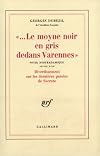
> Georges Dumézil, « … Le moyne noir en gris dedans varennes » ;
Id., Du mythe au roman ;
Id., La courtisane et les seigneurs colorés esquisses de mythologie
Se reporter au compte rendu de Jean-Paul LOUIS
In: Revue Esprit (1940-) No. 356 (10-11) (Octobre-Novembre 1984), pp. 324-326… ; (en ligne),
URL : https://esprit.presse.fr/article/louis-jean-paul/la-courtisane-et-les-seigneurs-...
Id., Du mythe au roman ;
Id., La courtisane et les seigneurs colorés esquisses de mythologie
Se reporter au compte rendu de Jean-Paul LOUIS
In: Revue Esprit (1940-) No. 356 (10-11) (Octobre-Novembre 1984), pp. 324-326… ; (en ligne),
URL : https://esprit.presse.fr/article/louis-jean-paul/la-courtisane-et-les-seigneurs-...
Sep 25, 2020 (Edited)French
Lists
You May Also Like


Associated Authors
Statistics
- Works
- 66
- Also by
- 4
- Members
- 1,242
- Popularity
- #20,660
- Rating
- 3.6
- Reviews
- 9
- ISBNs
- 113
- Languages
- 13
- Favorited
- 1


