

Thomas Alan Critchley (1919–1991)
Author of The Maul and the Pear Tree: The Ratcliffe Highway Murders, 1811
Works by Thomas Alan Critchley
Associated Works
Tagged
Common Knowledge
- Canonical name
- Critchley, Thomas Alan
- Birthdate
- 1919-03-11
- Date of death
- 1991-06-28
- Gender
- male
- Education
- Queen Elizabeth's Grammar School, Barnet, England, UK
- Occupations
- civil servant
- Short biography
- Born in East Barnet and attended elementary school. Tom Critchley was youngest of two brothers. His mother had been a teacher and his father was a research chemist at Johnson Matthey & Co Ltd. When he left Queen Elizabeth Grammar School with high marks at matriculation, he took the civil service exam and entered the at executive level. The war years were spent in the British Army and he married Margaret Robinson in 1942. His spare time in the army was spent writing, these works are unpublished. After the war and a brief time in urban planning Tom moved to the Home Office working in the Prison Commission and then the Police Department where author P D James became his assistant. They co-wrote and researched The Maul and the Pear Tree. He was principal private secretary to R A Butler when he was Home Secretary, secretary of the Royal Commission on the Police and one of Lord Denning's secretaries in the Profumo inquiry. Before retirement he was heading the urban deprivation department in the Home Office in the Wilson Government with ministers Claire Short and Alex Lyons, where he co ordinated volunteer bureaus up and down the country. He wrote The Civil Service Today in 1950 and ghost wrote The Home Office for Sir Frank Newsam apart from those books mentioned above. He and Margaret had three children, Carol born in 1943, Barbara born 1946 and Alan, born 1956.
- Nationality
- UK
- Birthplace
- East Barnet, England, UK
- Places of residence
- North London, England, UK
- Burial location
- cremated at Golders Green
- Associated Place (for map)
- England, UK
Members
Reviews
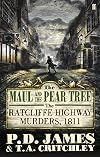
I deliberately began reading The Maul and the Pear Tree exactly two hundred years to the day that the horrific killing spree known as the Ratcliffe Highway murders began, on December 7th 1811. Four innocent people, including a babe in arms, were butchered in London's East End that first night, stretching the rudimentary resources of the parish, the local magistrates and the Thames police based in Wapping. It inaugurated a period of terror, suspicion and xenophobia in St George's and the show more neighbouring parishes and, through the medium of the press, a few weeks of morbid fascination in the public at large. It also led to questions in Parliament on the adequacy of current policing by neighbourhood watchmen, with a scornful analysis by the playwright Sheridan on the floor of the House of Commons.
Panic really set in when, twelve days later, a second attack resulting in three more horrific murders took place, also around the witching hour of midnight. Various locals were arrested and questioned at length until, in desperation, a certain John Williams was identified as the prime suspect. He appeared to commit suicide while in custody, and though he was neither accused in open court, let along judged guilty of the crimes, in the dying days of 1811 his body was paraded through East End streets before being buried at a crossroads with a stake to pin it in place.
Even at the time it was not universally accepted that Williams was the murderer or had even acted on his own. 160 years afterwards two colleagues at the Home Office, Dr Thomas Critchley and P D James (who had by then begun her crime-writing career), undertook a review of contemporary documents related to the murders and concluded that not only was Williams framed but may have even been murdered while in custody by one or two of the original perpetrators of the crimes. The authors' review was as forensic as was possible given the passage of time, the wholescale loss of much of the contemporary landscape and the lack of any material evidence; and yet their careful presentation, unsensational analysis and dispassionate discussion of what documentary evidence there remained allowed the careful reader to form their own impressions and guesses before the authors suggested their own conclusions. It is a fascinating and vivid read, though it requires close attention to events and details (the cast list alone numbers nearly eighty persons). It throws a bright light not only on the inadequacies of policing in Regency England (one of Critchley's areas of interest at the time) but also the lack of political will to reform; even the assassination of Spencer Percival, the Prime Minister, in 1812 was not a sufficient wake-up call to prompt a re-think.
This recent edition includes a new introduction by James and her tribute to the late Critchley, with a fine cover illustration in imitation of a contemporary engraving. A little problem with this paperback is that a key thoroughfare is obscured on the two-page map showing the localities which would only be revealed by breaking the spine; but these days just a little internet research easily provides the missing details. And, in deference to James' deserved popularity, her name now appears over Critchley's.
http://calmgrove.wordpress.com/2012/05/20/ratcliffe/ show less
Panic really set in when, twelve days later, a second attack resulting in three more horrific murders took place, also around the witching hour of midnight. Various locals were arrested and questioned at length until, in desperation, a certain John Williams was identified as the prime suspect. He appeared to commit suicide while in custody, and though he was neither accused in open court, let along judged guilty of the crimes, in the dying days of 1811 his body was paraded through East End streets before being buried at a crossroads with a stake to pin it in place.
Even at the time it was not universally accepted that Williams was the murderer or had even acted on his own. 160 years afterwards two colleagues at the Home Office, Dr Thomas Critchley and P D James (who had by then begun her crime-writing career), undertook a review of contemporary documents related to the murders and concluded that not only was Williams framed but may have even been murdered while in custody by one or two of the original perpetrators of the crimes. The authors' review was as forensic as was possible given the passage of time, the wholescale loss of much of the contemporary landscape and the lack of any material evidence; and yet their careful presentation, unsensational analysis and dispassionate discussion of what documentary evidence there remained allowed the careful reader to form their own impressions and guesses before the authors suggested their own conclusions. It is a fascinating and vivid read, though it requires close attention to events and details (the cast list alone numbers nearly eighty persons). It throws a bright light not only on the inadequacies of policing in Regency England (one of Critchley's areas of interest at the time) but also the lack of political will to reform; even the assassination of Spencer Percival, the Prime Minister, in 1812 was not a sufficient wake-up call to prompt a re-think.
This recent edition includes a new introduction by James and her tribute to the late Critchley, with a fine cover illustration in imitation of a contemporary engraving. A little problem with this paperback is that a key thoroughfare is obscured on the two-page map showing the localities which would only be revealed by breaking the spine; but these days just a little internet research easily provides the missing details. And, in deference to James' deserved popularity, her name now appears over Critchley's.
http://calmgrove.wordpress.com/2012/05/20/ratcliffe/ show less
I found this retelling of the Ratcliffe Highway murders covered off more angles than the traditional more lurid true crime book - a careful, evidence-based investigation of whether the right man was blamed, coupled with an evocative picture of the Georgian East End and nascent police force. If nothing else it is an interesting take on the importance of effective information-sharing and rigorous analysis at a time when it is most needed but least likely to happen: in the midst of crisis and show more panic. The only aspect that left me unsatisfied was the limited exploration of motive for the proposed guilty parties, although the authors are careful to note that the answer to this question probably lies in lost documents. Recommended for those interested in London's social history. show less

Being an armchair detective (of very limited abilities), I grabbed this book the moment I found it in my friend Big Dave's library. Considering the crime was already 160 years old when this book was written in 1971, the authors have done an amazing job of digging up files relating to the case and bringing the whole squalid story to life.
Lord knows if the authors have come to the right conclusion but I guess that is not the point of such books.
Lord knows if the authors have come to the right conclusion but I guess that is not the point of such books.
An unusual book to read, for me.
It is a look at two murders that happened in 1811 in London’s East End. Two families were murdered in their homes on two separate nights. The murders were extremely violent. The first was a tradesman, wife and baby; the second a pub owner, wife and servant.
Author P.D. James and historian T.A. Critchley heavily researched the murders in historical records from the era and published periodicals.
Not only do they write of the crime, they also five a picture of show more life in an area as rough as the East End was developing into. A formal police department had yet to be formed. Instead each parish took care of their own and didn’t share information. This meant a lot of information fell between the cracks. Because of the disjointed law system, it appears there was no justice done of either family.
It is a dry, historical read, with much detail. Interesting for someone who has a great interest of life and times in early 195h century London. show less
It is a look at two murders that happened in 1811 in London’s East End. Two families were murdered in their homes on two separate nights. The murders were extremely violent. The first was a tradesman, wife and baby; the second a pub owner, wife and servant.
Author P.D. James and historian T.A. Critchley heavily researched the murders in historical records from the era and published periodicals.
Not only do they write of the crime, they also five a picture of show more life in an area as rough as the East End was developing into. A formal police department had yet to be formed. Instead each parish took care of their own and didn’t share information. This meant a lot of information fell between the cracks. Because of the disjointed law system, it appears there was no justice done of either family.
It is a dry, historical read, with much detail. Interesting for someone who has a great interest of life and times in early 195h century London. show less
Lists
True Crime Books (1)
True Crime (1)
You May Also Like
Associated Authors
Statistics
- Works
- 3
- Also by
- 1
- Members
- 490
- Popularity
- #50,415
- Rating
- 3.4
- Reviews
- 11
- ISBNs
- 26
- Languages
- 3