
Marc Tyler Nobleman
Author of Brave Like My Brother
About the Author
Marc Tyler Nobleman is the author of "Bill the Boy Wonder: The Secret Co-Creator of Batman" (which changed history, inspiring both the Hulu documentary "Batman & Bill" and a TED talk), "Boys of Steel: The Creators of Superman" (which made the front page of "USA Today"), "Brave Like My Brother," and show more "The Chupacabra Ate the Candelabra"; upcoming titles include "Fairy Spell" and "Thirty Minutes Over Oregon." Marc has been invited to speak at schools, conferences, companies, and other venues from Thailand to Tanzania. He blogs about adventures in publishing at Noblemania. (Bowker Author Biography) show less
Image credit: Photo courtesy of Marc Tyler Nobleman
Series
Works by Marc Tyler Nobleman
Thirty Minutes Over Oregon: A Japanese Pilot's World War II Story (2018) — Author — 121 copies, 4 reviews
What's The Difference? - How to Tell Things Apart That Are Confusingly Close (2005) 96 copies, 3 reviews
Vocabulary Cartoon Of The Day: 180 Reproducible Cartoons That Help Kids Build a ROBUST and PRODIGIOUS Vocabulary (2005) 27 copies
Rescue in the Bermuda Triangle: An Isabel Soto History Adventure (Graphic Library: Graphic Expeditions) (2010) 18 copies
Vocabulary Cartoon of the Day for Grades 2-3: 180 Reproducible Cartoons That Expand Students' Vocabularies to Help Them Become Better Readers and Writers (2010) 12 copies
We The People Set/Lot 6 Books 12 copies
Solar System 3 copies
A Little Giant Book: 365 Things to Do Before You Grow Up: Explore, discover, try something new every day! (Little Giant Books) (2010) 3 copies
Associated Works
Tagged
Common Knowledge
- Canonical name
- Nobleman, Marc Tyler
- Birthdate
- 1972
- Gender
- male
- Occupations
- cartoonist
children's book author - Nationality
- USA
- Birthplace
- Hartford, Connecticut, USA
- Places of residence
- Cheshire, Connecticut, USA
Cos Cob, Connecticut, USA - Associated Place (for map)
- Connecticut, USA
Members
Reviews

Author Marc Tyler Nobleman and illustrator Eliza Wheeler tell the story of the Cottingley Fairies hoax in this engaging work of picture-book non-fiction. Angry at the adults in her family for scolding her younger cousin Frances, a sixteen-year-old English girl named Elsie Wright decided to play a trick on them, taking some pictures that she claimed proved the existence of fairies. The year was 1917, and photography was still new to many people. Eventually the cousins' trick grew beyond their show more fairy circle, convincing even the great Sir Arthur Conan Doyle that they had made a remarkable discovery. He used their photographs in his article on fairies, published in The Strand magazine, creating a widespread sensation. It would be many decades until the truth was revealed: the girls had faked the fairies, which were paper cut-outs propped up with sticks in each scene...
An absolutely lovely book, Fairy Spell: How Two Girls Convinced the World That Fairies Are Real pairs an engaging, informative text with beautiful illustrations. I knew the basic story of the Cottingley Fairies, but I thought Nobleman did an excellent job of expanding upon the better-known facts, and interpreting them in a convincing way. I appreciated his evident sympathy for the two young hoaxers, and the humane way he addressed their trickery. I also appreciated the inclusion of the actual photographs, although the real stand-out for me, visually speaking, was Eliza Wheeler's gorgeous illustrations, done in ink, watercolor and collage. Her color palette was immensely appealing, her human figures charming. I'd recommend this one to young fairy-lovers, and to anyone looking for engaging non-fiction picture-books about unusual and interesting children from the pages of history. show less
An absolutely lovely book, Fairy Spell: How Two Girls Convinced the World That Fairies Are Real pairs an engaging, informative text with beautiful illustrations. I knew the basic story of the Cottingley Fairies, but I thought Nobleman did an excellent job of expanding upon the better-known facts, and interpreting them in a convincing way. I appreciated his evident sympathy for the two young hoaxers, and the humane way he addressed their trickery. I also appreciated the inclusion of the actual photographs, although the real stand-out for me, visually speaking, was Eliza Wheeler's gorgeous illustrations, done in ink, watercolor and collage. Her color palette was immensely appealing, her human figures charming. I'd recommend this one to young fairy-lovers, and to anyone looking for engaging non-fiction picture-books about unusual and interesting children from the pages of history. show less
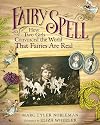
During World War I, two young cousins living together tell their parents that fairies can be found in their backyard. They beg and plead to use a camera to photograph the fairies as proof -- and their parents are confounded when they come back with two photographs showing the girls surrounded by fairies. The photographs soon find their way to the public and prestigious persons start believing fairies are real based on this evidence -- while skeptical others insist the photographs are show more faked.
This book provides a fascinating look at a slim slice of history that caught the attention of a nation repeatedly over the years. Nobleman writes clearly and succinctly about the incident, engaging readers with the story. Wheeler's illustrations are absolutely beautiful in their concurrent simplicity and detail. Likewise, the color palette is somehow both muted and bold. And, of course, no book about this story would be complete without including reproductions of the photographs themselves.
An author's note cautions readers not to assume that this the silliness of a simpler time and warns them to be vigilant in the era of the Internet as well, a brilliant point to make while bringing the ramifications of this story into the current day. show less
This book provides a fascinating look at a slim slice of history that caught the attention of a nation repeatedly over the years. Nobleman writes clearly and succinctly about the incident, engaging readers with the story. Wheeler's illustrations are absolutely beautiful in their concurrent simplicity and detail. Likewise, the color palette is somehow both muted and bold. And, of course, no book about this story would be complete without including reproductions of the photographs themselves.
An author's note cautions readers not to assume that this the silliness of a simpler time and warns them to be vigilant in the era of the Internet as well, a brilliant point to make while bringing the ramifications of this story into the current day. show less

I received Bill the Boy Wonder through Librarything's Early Readers program that gives members the chance to win a free book before publication in return for a review.
Honestly I was surprised when this arrived as I thought I'd won it because the website's program chose me based on the books in my library on pulp and comic book history. It turns out that this is really a kids picture book.
I'm sure that this is the sort of book that I'd have devoured at the age of six or seven.
While the show more book is mainly about how Bill Finger was really the main writer and creator of Batman and how Bob Kane took all the credit for himself, there's lots of material about the creation of Batman and Robin and the development of those characters in the golden and silver ages.
For the grown up me, however, the best part of the book was the author's note at the end. It is essentially a terrific fanzine article about his search for information about Finger and what he found.
He also includes many never-before-seen photos. Or at least all the ones he was able to find.
This author's note is packed with new and interesting information.
Nobleman should also be thanked for finding Finger's granddaughter and helping to see that Finger's residuals from DC Comics were redirected to her.
I still have a hard time wrapping my head around the whole package though. It's half kids picture book and half serious comic book scholarship for adults.
I think that this would have been a better project if it were split into a kids picture book about the entire history and development of Batman and all the folks who helped create it and a lengthy book for adults detailing the creative side of DC comics over the years.
Nobleman obviously has the research chops to do justice to a still-shrouded part of comic book history.
His author's note was so interesting that I'd love to see what he could do with a chapter on Major Malcolm Wheeler-Nickolson, one on Donenfeld and Liebowitz, a look at the Siegel and Schuster story, Marsten, and all the other creators, particularly the less well-known or recognized ones, the hook-up between National and All-American, and the Captain Marvel and Wonder Man lawsuits. There has to be a lot more buried stories and Nobleman seems to have a knack for digging them up. It'd be nice to see him try. show less
Honestly I was surprised when this arrived as I thought I'd won it because the website's program chose me based on the books in my library on pulp and comic book history. It turns out that this is really a kids picture book.
I'm sure that this is the sort of book that I'd have devoured at the age of six or seven.
While the show more book is mainly about how Bill Finger was really the main writer and creator of Batman and how Bob Kane took all the credit for himself, there's lots of material about the creation of Batman and Robin and the development of those characters in the golden and silver ages.
For the grown up me, however, the best part of the book was the author's note at the end. It is essentially a terrific fanzine article about his search for information about Finger and what he found.
He also includes many never-before-seen photos. Or at least all the ones he was able to find.
This author's note is packed with new and interesting information.
Nobleman should also be thanked for finding Finger's granddaughter and helping to see that Finger's residuals from DC Comics were redirected to her.
I still have a hard time wrapping my head around the whole package though. It's half kids picture book and half serious comic book scholarship for adults.
I think that this would have been a better project if it were split into a kids picture book about the entire history and development of Batman and all the folks who helped create it and a lengthy book for adults detailing the creative side of DC comics over the years.
Nobleman obviously has the research chops to do justice to a still-shrouded part of comic book history.
His author's note was so interesting that I'd love to see what he could do with a chapter on Major Malcolm Wheeler-Nickolson, one on Donenfeld and Liebowitz, a look at the Siegel and Schuster story, Marsten, and all the other creators, particularly the less well-known or recognized ones, the hook-up between National and All-American, and the Captain Marvel and Wonder Man lawsuits. There has to be a lot more buried stories and Nobleman seems to have a knack for digging them up. It'd be nice to see him try. show less
 This review was written for LibraryThing Early Reviewers.
Bill the Boy Wonder, written by Marc Tyler Nobleman and illustrated by Ty Templeton, is a fantastic picture book biography of Bill Fingerman, the “secret co-creator of Batman.” Templeton’s illustrations are diverse enough to capture both historical accounts and colorful recreations from classic comics. It’s a handsomely produced work, with its text captions and blocking resembling comic book panels. This is truly an all-ages book in that adults interested in comic book history are show more likely to get more out to the book from kids, but it’s still enjoyable and engaging enough for younger readers.
This is a well-researched book, too, with an extensive author’s note at the end detailing all the research that went into writing it. While a great emphasis of the book is about how Fingerman was cheated out of receiving credit for his role in Batman, it also covers his inspirations and creative process, and it‘s fascinating to think of all the things that culminated in some of pop-culture‘s most famous images.
The book is actually more positive towards Bob Kane than other books I’ve read, and it really emphasizes more on the positive of Fingerman‘s life, which I think is the better approach to make. The authorship of comics, especially in terms of who created a creator, is complicated because it often involves a team working for a company, and it is likely that the company holds the creative control over the character. This can lead to many writers, artists, or their heirs not seeing a cent of the millions a company makes from comics, merchandise, and movies featuring their characters and storylines. I hope with books like this and researchers like Marc Tyler Nobleman, creators will get the recognition they’ve earned for helping shape our culture and imaginations. show less
This is a well-researched book, too, with an extensive author’s note at the end detailing all the research that went into writing it. While a great emphasis of the book is about how Fingerman was cheated out of receiving credit for his role in Batman, it also covers his inspirations and creative process, and it‘s fascinating to think of all the things that culminated in some of pop-culture‘s most famous images.
The book is actually more positive towards Bob Kane than other books I’ve read, and it really emphasizes more on the positive of Fingerman‘s life, which I think is the better approach to make. The authorship of comics, especially in terms of who created a creator, is complicated because it often involves a team working for a company, and it is likely that the company holds the creative control over the character. This can lead to many writers, artists, or their heirs not seeing a cent of the millions a company makes from comics, merchandise, and movies featuring their characters and storylines. I hope with books like this and researchers like Marc Tyler Nobleman, creators will get the recognition they’ve earned for helping shape our culture and imaginations. show less
This review was written for LibraryThing Early Reviewers.Lists
Awards


You May Also Like


Associated Authors
Statistics
- Works
- 80
- Also by
- 2
- Members
- 2,317
- Popularity
- #11,081
- Rating
- 4.0
- Reviews
- 74
- ISBNs
- 190
- Languages
- 2
- Favorited
- 1
