
Brian MacArthur (1940–2019)
Author of The Penguin Book of Twentieth-Century Speeches
About the Author
Brian MacArthur was born in Essex, England on February 5, 1940. He was working for the Sunday Times during the Hitler Diaries scandal of 1983. He left the Sunday Times shortly after the scandal to became editor of the Western Morning News. After two years there, he became the founding editor of show more Today. He left Today in 1987 to rejoin the Sunday Times. From 2006 to 2010, he was the books editor of the Daily Telegraph. He wrote several books including Deadline Sunday, Surviving the Sword, For King and Country, and Eddy Shah: Today and the Newspaper Revolution. He edited The Penguin Book of Modern Speeches. He died of leukemia on March 24, 2019 at the age of 79. (Bowker Author Biography) show less
Works by Brian MacArthur
Associated Works
Tagged
Common Knowledge
- Birthdate
- 1940-02-05
- Date of death
- 2019-03-24
- Gender
- male
- Education
- University of Leeds
- Occupations
- journalist
editor - Organizations
- London Times
Today
Times Higher Education Supplement
Western Morning News
Daily Telegraph - Relationships
- Waller, Maureen (Wife)
Deschampsneufs, Peta (Wife) - Nationality
- UK
- Birthplace
- Chelmsford, Essex, England, UK
- Associated Place (for map)
- England, UK
Members
Reviews
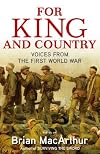
Published in 2008 to mark the 90th birthday of the signing of the Armistice, 'For King and Country' is an anthology allowing us to see WWI through the testimonies of those who experienced it first-hand -on the battlefronts or not.
If the author, focusing deliberately on the Western front and Gallipoli, gives us a glimpse into the life in the trenches, the choice of certain texts shows, also, life how it was back home. The memories of women who worked in ammunitions factories, newspapers show more articles depicting life in London (burdened by war and subjected to bombings) make for nice sketches of the big societal changes coming their ways...
With each chapter dedicated to a year, that Brian MacArthur introduces briefly, the book, rich in various sources (letters, poems, songs, speeches...) mostly British but not only (Americans, French, and Germans also have a voice) is a great portrayal of a whole era, and, of it mindset, largely incomprehensible for today's readers. The success of propaganda indeed can be difficult to fathom, and yet! It was it that sent a whole generation, at times teenagers barely fresh out of schools, to go and get themselves killed in the name of their country and their king. It was, also, it that made young girls very proud indeed to publicly insult men for not wearing the uniform, by offering them the infamous 'white feather' (the Order of the White Feather alone will gather more than 20,000 members!). Society was merciless for conscientious objectors, pacifists, deserters and mutineers, as reflected by some of their testimonies, also gathered in here.
Here's a powerful read, then, loaded with emotions, but which is, beyond a snapshot of an era, a deep and never irrelevant lesson about what are, too often, wars: of a terrible futility. The choice of one of Kipling's poems, the jingoist who had lost a son during the conflict, concludes it all brilliantly:
'If any question why we died,
Tell them, because our fathers lied.' show less
If the author, focusing deliberately on the Western front and Gallipoli, gives us a glimpse into the life in the trenches, the choice of certain texts shows, also, life how it was back home. The memories of women who worked in ammunitions factories, newspapers show more articles depicting life in London (burdened by war and subjected to bombings) make for nice sketches of the big societal changes coming their ways...
With each chapter dedicated to a year, that Brian MacArthur introduces briefly, the book, rich in various sources (letters, poems, songs, speeches...) mostly British but not only (Americans, French, and Germans also have a voice) is a great portrayal of a whole era, and, of it mindset, largely incomprehensible for today's readers. The success of propaganda indeed can be difficult to fathom, and yet! It was it that sent a whole generation, at times teenagers barely fresh out of schools, to go and get themselves killed in the name of their country and their king. It was, also, it that made young girls very proud indeed to publicly insult men for not wearing the uniform, by offering them the infamous 'white feather' (the Order of the White Feather alone will gather more than 20,000 members!). Society was merciless for conscientious objectors, pacifists, deserters and mutineers, as reflected by some of their testimonies, also gathered in here.
Here's a powerful read, then, loaded with emotions, but which is, beyond a snapshot of an era, a deep and never irrelevant lesson about what are, too often, wars: of a terrible futility. The choice of one of Kipling's poems, the jingoist who had lost a son during the conflict, concludes it all brilliantly:
'If any question why we died,
Tell them, because our fathers lied.' show less
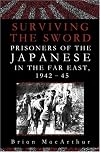
This is a very well written history of the prisoners held by the Japanese in Asia during World War II, most of which were British, Australian, and Scots. There was a much small contingent of Americans, of which my mother's first cousin, Louie, was one. He died at the hands of the Japanese after surviving the Bataan Death March and several years in POW camps, but died being transported by ship to Japan where he no doubt would have worked in a mine or factory had he not expired on the trip show more across. Reading this book gave me a very real sense of how he must have suffered. I only hope my mother and his family never knew how awful it was. This book is divided into chapters by the various camps or areas where the Japanese impressed the prisoners into building air fields, roads, bridges, train tracks, and their own camps. Besides the utter brutality of the Japanese toward all prisoners, I was most impressed by the camaraderie and ingenuity of the troops. Reading this book was very difficult, but also very important. I appreciate Brian MacArthur's excellent work in compiling this excellent history. show less
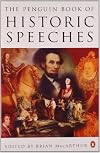
Took some time over this one, dipping in and out. Being set up in sections, it allows you to read speeches on related topics in isolation. The section are chronological, allowing the evolution of ideas and speech patterns the evolve as you read. The later speeches were a lot easier t read than the early one. Partly topic, partly use of vocabulary, partly that you've heard the recordings and so can hear the rhythm and intonation in your head while reading the words.
An interesting selection, show more but not something I think that I;ll be wanting to read more of. show less
An interesting selection, show more but not something I think that I;ll be wanting to read more of. show less

This vast collection of speeches I like to refer to as "Penguin America's American Book of American Speeches... America". The editor suffers from what can only be described as socio-centricism. Most of the speeches are American, British (particularly of the 19th century), French (Enlightenment thinkers), and Classical/Biblical. This strikes me as a sort of mythic American past building where Biblical and Classical history through English history lead inevitably to America today. Thus one may show more find little of the world outside of the United States here, except where it concerns the United States or is well known among it's people. show less
You May Also Like


Associated Authors
Statistics
- Works
- 13
- Also by
- 1
- Members
- 1,156
- Popularity
- #22,230
- Rating
- 3.7
- Reviews
- 8
- ISBNs
- 33
- Languages
- 1