
Alexander Souter (1873–1949)
Author of A Pocket Lexicon to the Greek New Testament
About the Author
Series
Works by Alexander Souter
Pelagius's Expositions of Thirteen Epistles of St. Paul: Introduction, No. 1 (Texts and Studies: Contributions to Biblical and Patristic L) (2004) — Editor — 5 copies
Pelagius's Expositions of Thirteen Epistles of St. Paul: Text: Number 2 (Texts and Studies: Contributions to Biblical and Patristic L) (2004) — Editor — 4 copies
NOVUM TESTAMENTUM GRAECE Textui a Retractatoribus Anglis Adhibito Brevem Adnotationem Criticam Subiecit. Editio Altera. Penitus Reformata (1947) 4 copies
Tagged
Common Knowledge
- Birthdate
- 1873-08-14
- Date of death
- 1949-01-17
- Gender
- male
Members
Reviews

Too old and too short. That is the tempting verdict. If this book were a basketball player, it would be out of a job.
The subject of New Testament Textual Criticism is a huge one -- thousands of manuscripts, dozens of translations into early languages, an immense number of quotations in early sources. The discussion of the canon of the New Testament is somewhat simpler (only a handful of books were disputed, with most of the arguments settled before Christianity became a legal religion and show more the number of Christian writings exploded). Put both together and you have something far too complex for a thin little book like this. And it's now more than half a century out of date, as well.
And yet, because textual criticism is so complex, there is no adequate one-volume textbook. There are short little books (e.g. by Black) that are simply too short. There are medium-length books (e.g. by Aland or Metzger) that are too quirky. (As well as some books, such as those by Comfort, that are both too short and too quirky.) There are some long books (e.g. those by Hort and Scrivener) which are simply too old.
Which means that every additional book is of a real help to students, even if it's on the dated side. And this one is at least new enough to use the modern system of symbols. It gives a good description of the problems of textual criticism, even though you'll need more than this to learn all the methods of solution.
Plus it has that section on the canon of the New Testament. Including a lot of useful source documents. For that, it remains a good introductory book. So it's a good book to have on your bookshelf -- as long as you're prepared to make it part of a team and don't ask it to succeed on its own. show less
The subject of New Testament Textual Criticism is a huge one -- thousands of manuscripts, dozens of translations into early languages, an immense number of quotations in early sources. The discussion of the canon of the New Testament is somewhat simpler (only a handful of books were disputed, with most of the arguments settled before Christianity became a legal religion and show more the number of Christian writings exploded). Put both together and you have something far too complex for a thin little book like this. And it's now more than half a century out of date, as well.
And yet, because textual criticism is so complex, there is no adequate one-volume textbook. There are short little books (e.g. by Black) that are simply too short. There are medium-length books (e.g. by Aland or Metzger) that are too quirky. (As well as some books, such as those by Comfort, that are both too short and too quirky.) There are some long books (e.g. those by Hort and Scrivener) which are simply too old.
Which means that every additional book is of a real help to students, even if it's on the dated side. And this one is at least new enough to use the modern system of symbols. It gives a good description of the problems of textual criticism, even though you'll need more than this to learn all the methods of solution.
Plus it has that section on the canon of the New Testament. Including a lot of useful source documents. For that, it remains a good introductory book. So it's a good book to have on your bookshelf -- as long as you're prepared to make it part of a team and don't ask it to succeed on its own. show less

I have spent a lot of time with this little lexicon, both in hardback and on Kindle, and it is in general well done and easy to use. I like that for many of the hapax legomena verbs (words that appear only once in the NT), it gives both the aorist stem and the imperfect stem as citation forms to aid in recognition.
A Glossary of Later Latin to 600 A.D. (Oxford University Press Academic Monograph Reprints) by Alexander Souter
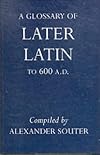
Not a bad book, but generally unnecessary. If you are reading Late Latin, you most likely are using a major Latin dictionary in tandem with this, either the Oxford Latin Dictionary or the Lewis and Short. For someone specializing in this period, the only dictionary you should be using is the L&S, and it covers everything in this book and in greater detail. If you mean only to dabble in Late Latin and are primarily a classicist, this is an acceptable addendum to the Oxford Latin Dictionary, show more which frustratingly stops its coverage at 200 AD. Generally though, this book is unnecessary. show less
If you're a scholar of Latin, especially the Early Middle Ages, then you need this book. It's where I turned if I couldn't find a word in the Oxford, or Niermeyer's.
You May Also Like


Associated Authors
Statistics
- Works
- 18
- Members
- 648
- Popularity
- #38,951
- Rating
- 3.7
- Reviews
- 6
- ISBNs
- 44
- Languages
- 2