
Wes Davis
Author of The Ariadne Objective: The Underground War to Rescue Crete from the Nazis
Works by Wes Davis
The Ariadne Objective: The Underground War to Rescue Crete from the Nazis (2013) 98 copies, 21 reviews
American Journey: On the Road with Henry Ford, Thomas Edison, and John Burroughs (2023) 35 copies, 1 review
Associated Works
Tagged
Common Knowledge
Members
Reviews

A riveting WWII spy story set in the Mediterranean, "The Ariadne Objective" carries the reader along on a whirlwind adventure with a band of misfit saboteurs. The author has done a tremendous amount of research, but his use of language makes the book flow more like a novel than a documentary. Half star short of five only because the darkness of the printing and the brightness of the paper made reading feel a bit stark at times.
 This review was written for LibraryThing Early Reviewers.
I love the kind of books that take one small piece of an historic event and break it down so that people with very little knowledge about the subject can understand a bit of the larger concept. That’s just what Wes Davis did in his new book about the British operatives at work on the Greek Isle of Crete during the occupation by the Nazis during WWII. Volumes and volumes have been written about WWII and I’ve read some of them but this one, with its honing in on such a small aspect of the show more monumental event was very well done and a great read. Oh and it didn’t hurt that the story was centered on Patrick Leigh Fermor, who went on to become a celebrated British travel writer, and his role in the abduction of a German general from Crete and his transport to Cairo and a British prisoner of war camp.
It wasn’t the kind of book that had me madly turning pages because the work in these kinds of situations is methodical and sometimes slow. It was interesting how long it takes for the plan to develop and I had to wonder how they didn’t get discouraged with the hold-ups caused mostly by weather and the conditions in the Mediterranean. It was fascinating too, to see how the British operatives used the Cretan partisans who wanted desperately to free their country from Nazi occupation and risked everything to make it happen.
Now I will happily continue Patrick Leigh Fermor’s story because I happen to own two of his travel memoirs and he seems like just the sort of guy I’d like to follow. Highly recommended. show less
It wasn’t the kind of book that had me madly turning pages because the work in these kinds of situations is methodical and sometimes slow. It was interesting how long it takes for the plan to develop and I had to wonder how they didn’t get discouraged with the hold-ups caused mostly by weather and the conditions in the Mediterranean. It was fascinating too, to see how the British operatives used the Cretan partisans who wanted desperately to free their country from Nazi occupation and risked everything to make it happen.
Now I will happily continue Patrick Leigh Fermor’s story because I happen to own two of his travel memoirs and he seems like just the sort of guy I’d like to follow. Highly recommended. show less
This review was written for LibraryThing Early Reviewers.During WWII with the Nazis occupying Crete a small band of British military officers, recruited for their knowledge of Greek, were trained in intelligence gathering, espionage and clandestine warfare. They were then dropped into Crete from the air and inserted by sea, and proceeded to make life uncertain and often miserable for German troops.
They were scholars and writers and travelers and eccentrics. The group included future travel writer Patrick Leigh Fermor, among others that became show more known later for writing. The operatives organized and armed Cretan guerillas and caused general havoc among the occupiers. A particularly bold operation resulted in the kidnapping and exfiltration of a German general who years later stated he was treated “chivalrously, like a knight.”
The Adriane Objective is a gripping, well-written, and superbly researched look into a unique niche of WWII history. show less
They were scholars and writers and travelers and eccentrics. The group included future travel writer Patrick Leigh Fermor, among others that became show more known later for writing. The operatives organized and armed Cretan guerillas and caused general havoc among the occupiers. A particularly bold operation resulted in the kidnapping and exfiltration of a German general who years later stated he was treated “chivalrously, like a knight.”
The Adriane Objective is a gripping, well-written, and superbly researched look into a unique niche of WWII history. show less
This review was written for LibraryThing Early Reviewers.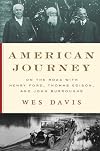
In 1918 the American industrialist Henry Ford undertook an auto-camping road trip in the Great Smoky Mountains at the border between North Carolina and Tennessee. The grand culmination of various shorter trips exploring rural America, his companions – as on the previous sojourns – were unlikely. Joining Ford was John Burroughs, an American naturalist who damned the automobile as the ‘scourge of nature’ and enjoyed an existence that was, in his words, ‘all vacation’. Having met in show more 1913, the pair’s obvious differences were meliorated by a shared admiration for the writings of Ralph Waldo Emerson, their friendship secured when Ford gave Burroughs a Model T so that he could ramble the countryside with newfound efficiency. Burroughs’ deep connection with nature, meanwhile, helped Ford better understand the agrarian past which he saw disappearing in the rearview mirror.
Ford’s friendship with Thomas Edison – the third passenger – had peaked at the Panama-Pacific International Exposition in 1915. As the pair toured various stalls which promised a brave, industrialised future, they were drawn to a display which argued that these same forward-thinking goals might be achieved through the careful management of America’s vast natural resources. By the time the two celebrities pushed their way out of this garden exhibit, Ford’s ‘agrarian nostalgia’ and Edison’s deep curiosity for botanical science had reached boiling point. Both felt that they needed to return to ‘nature’s laboratory’, and fast, if they – and America – were to reach their – and its – true potential. Various road trips in pursuit of this quest followed.
In American Journey: On the Road with Henry Ford, Thomas Edison, and John Burroughs Wes Davis follows Ford, Edison and Burroughs as they plan their short escapes to the country, debate – and compromise – on their diverging opinions on the First World War, and navigate the ups-and-downs of business life. A fourth character, the tyre magnate Harvey Firestone, also appears halfway through the book, joining the trio (who had taken to calling themselves ‘the Vagabonds’) for their grand 1918 expedition, which Davis only arrives at in his penultimate chapter.
Sadly, the book falls short in its analysis of the trips’ true significance. As Davis sees it, the trio understood their trips as an opportunity to uncover ‘their own deep, rural roots and reattach themselves to the nation’s rooted, agrarian past’. To this end, they would ‘rough it’ in tents along the sides of mountains and streams, fend for themselves on the bucolic backroads of rural America and wake every morning to birdsong, all in an attempt to better understand how industrial progress and agrarian origins might coexist in efficient harmony.
Ford and Edison eagerly donned the costume of celebrity itinerants. They regularly stopped at farms, not only to camp for the night, but also to ‘play farmer’, scything grass and chopping wood. So, too, did they enjoy conversing with their gentleman-naturalist, Burroughs, on the warble of a bird, taxonomy of a plant or a line from Emerson. They revelled in the constant gaggle of fans and pressmen who sought a quippy line or a quick photo. They drove brand-new Ford automobiles loaded with every piece of gear possible, were occasionally joined by a ride-along celebrity chef, and followed by a ‘small city’ of well-outfitted luxury tents. The tour more closely resembled a glamping trip than a backwoods bivouacking slog.
Read the rest of the review at HistoryToday.com.
Vaughn Scribner is Associate Professor in History at the University of Central Arkansas. Under Alien Skies: Environment, Suffering, and the Defeat of the British Military in Revolutionary America is forthcoming. show less
Ford’s friendship with Thomas Edison – the third passenger – had peaked at the Panama-Pacific International Exposition in 1915. As the pair toured various stalls which promised a brave, industrialised future, they were drawn to a display which argued that these same forward-thinking goals might be achieved through the careful management of America’s vast natural resources. By the time the two celebrities pushed their way out of this garden exhibit, Ford’s ‘agrarian nostalgia’ and Edison’s deep curiosity for botanical science had reached boiling point. Both felt that they needed to return to ‘nature’s laboratory’, and fast, if they – and America – were to reach their – and its – true potential. Various road trips in pursuit of this quest followed.
In American Journey: On the Road with Henry Ford, Thomas Edison, and John Burroughs Wes Davis follows Ford, Edison and Burroughs as they plan their short escapes to the country, debate – and compromise – on their diverging opinions on the First World War, and navigate the ups-and-downs of business life. A fourth character, the tyre magnate Harvey Firestone, also appears halfway through the book, joining the trio (who had taken to calling themselves ‘the Vagabonds’) for their grand 1918 expedition, which Davis only arrives at in his penultimate chapter.
Sadly, the book falls short in its analysis of the trips’ true significance. As Davis sees it, the trio understood their trips as an opportunity to uncover ‘their own deep, rural roots and reattach themselves to the nation’s rooted, agrarian past’. To this end, they would ‘rough it’ in tents along the sides of mountains and streams, fend for themselves on the bucolic backroads of rural America and wake every morning to birdsong, all in an attempt to better understand how industrial progress and agrarian origins might coexist in efficient harmony.
Ford and Edison eagerly donned the costume of celebrity itinerants. They regularly stopped at farms, not only to camp for the night, but also to ‘play farmer’, scything grass and chopping wood. So, too, did they enjoy conversing with their gentleman-naturalist, Burroughs, on the warble of a bird, taxonomy of a plant or a line from Emerson. They revelled in the constant gaggle of fans and pressmen who sought a quippy line or a quick photo. They drove brand-new Ford automobiles loaded with every piece of gear possible, were occasionally joined by a ride-along celebrity chef, and followed by a ‘small city’ of well-outfitted luxury tents. The tour more closely resembled a glamping trip than a backwoods bivouacking slog.
Read the rest of the review at HistoryToday.com.
Vaughn Scribner is Associate Professor in History at the University of Central Arkansas. Under Alien Skies: Environment, Suffering, and the Defeat of the British Military in Revolutionary America is forthcoming. show less
Lists
You May Also Like


Statistics
- Works
- 7
- Also by
- 1
- Members
- 206
- Popularity
- #107,331
- Rating
- 3.9
- Reviews
- 22
- ISBNs
- 15
- Languages
- 1
