
Tony Horwitz (1958–2019)
Author of Confederates in the Attic: Dispatches from the Unfinished Civil War
About the Author
Anthony Lander Horwitz was born in Washington, D. C. on June 9, 1958. He received a bachelor's degree in history from Brown University and a master's degree from the Columbia University Graduate School of Journalism in 1983. After working as a union organizer in Mississippi, he became a newspaper show more reporter. He was an education reporter for The Fort Wayne News-Sentinel in Indiana from 1983 to 1984 and a general assignment reporter for The Sydney Morning Herald in Australia from 1985 to 1987. He joined The Wall Street Journal in 1990 as a foreign correspondent in Europe and the Middle East. He and his wife Geraldine Brooks won the Overseas Press Club's Hal Boyle Award in 1990 for their coverage of the Persian Gulf war. He returned to the United States in 1993 and was assigned to The Journal's Pittsburgh bureau. He won the 1995 Pulitzer Prize for national reporting for his accounts of working conditions in low-wage jobs. He later wrote for The New Yorker on the Middle East before becoming an author of nonfiction books. His first book, Confederates in the Attic: Dispatches from the Unfinished Civil War, was published in 1998. His other books included Blue Latitudes: Boldly Going Where Captain Cook Has Gone Before, A Voyage Long and Strange: Rediscovering the New World, Midnight Rising: John Brown and the Raid That Sparked the Civil War, and Spying on the South: An Odyssey Across the American Divide. He died on May 27, 2019 at the age of 60. (Bowker Author Biography) show less
Disambiguation Notice:
Tony Horwitz was born Anthony Horwitz, not to be confused with British author Anthony Horowitz (sometimes misspelled as Horwitz), the author of Stormbreaker.
Image credit: Courtesy of Allen and Unwin
Works by Tony Horwitz
Blue Latitudes: Boldly Going Where Captain Cook Has Gone Before (2002) — Author — 1,858 copies, 48 reviews
Associated Works
The Civil War Monitor. Volume 5, Number 3, Fall 2015 — Contributor — 2 copies
MHQ: The Quarterly Journal of Military History — Winter 2012 (2011) — Author "John Brown's Blood Oath" — 2 copies
Tagged
Common Knowledge
- Canonical name
- Horwitz, Tony
- Legal name
- Horwitz, Anthony Lander
- Birthdate
- 1958-06-09
- Date of death
- 2019-05-27
- Gender
- male
- Education
- Brown University (BA|History|1981)
Columbia University Graduate School of Journalism (MA|1983)
Sidwell Friends School - Occupations
- journalist
author - Organizations
- The Wall Street Journal
New Yorker magazine
New York Times
Society of American Historians - Awards and honors
- Pulitzer Prize (National Reporting ∙ 1995)
James Aronson Award (1994) - Agent
- Kris Dahl
- Relationships
- Brooks, Geraldine (1) (wife)
- Cause of death
- cardiac arrest
- Nationality
- USA
- Birthplace
- Washington, D.C., USA
- Places of residence
- Martha's Vineyard, Massachusetts, USA
Waterford, Virginia, USA
Sydney, New South Wales, Australia - Place of death
- Washington, D.C., USA
- Map Location
- Washington DC, USA
- Disambiguation notice
- Tony Horwitz was born Anthony Horwitz, not to be confused with British author Anthony Horowitz (sometimes misspelled as Horwitz), the author of Stormbreaker.
Members
Reviews

Horwitz's voyages around the flashpoints of 'first contact' in North America are not so much strange as frustrating and inconclusive - not for us, mind you, but for him. Aware from the start that so much of what 'actually happened' is shrouded in myth, he wants, if he can, to discover whatever shreds of 'true fact' might still remain to be gleaned about the first explorers to the continent, focusing primarily on those who came funded by the Spanish or the English. (Champlain is mysteriously show more omitted.) Horwitz's method is to read extensively, decide on a strategy (people to meet and places to go), but once there, Horwitz is able to remain faithful to his set desires (say, to go out on the Mississippi or meet a member of the Pamunkey tribe in Virginia) while also being flexible and open-minded and that is the at the heart of what makes his quests so enjoyable. He isn't shy of admitting despair and defeat, so his stories are always as much about the present day and how people perceive the past (including himself) as the attempt to unearth and expose 'the truth'. He's in the story without taking it over, so that you feel, as a reader, that you could almost be him (if you were a little braver and more persistent). Beginning with the Vikings remote settlement in the far north, he then follows Columbus, Coronado, de Vaca, De Soto, Ponce de Leon, Ribault (the lone Frenchman in Florida), Menendez, John Smith, Pocohontas, Gosnold and finally, Plymouth. Over and over again, reasonable to decent intentions disintegrate into misunderstandings and bloodbaths - truly it is a tale of woe and destruction. The present-day myths we've plastered over the 'real' story, however, have become part of the story, and Horwitz concludes wisely that what we imagine, rightly or wrongly, ends up informing and determining the present - not that what 'really happened' becomes irrelevant, but that disentangling the threads is not do-able. There was plenty I didn't know, the tension, for example, in St. Augustine, Florida, the tension between Protestant and Catholic perceptions - it's not a big thing, but I didn't know it existed at all. The image of the Spanish conquistadors wandering through the prairies first clad in armor and eventually in nothing but old skins, is one I won't let go of quickly. I could ramble on but suffice it to say that it's a fine read, informative and lively, and the sort of book I would take with me on a driving tour around the US. **** show less
"Midnight Rising" makes the point that the John Brown raid on Harper's Ferry was much more significant in terms of national history than I'd ever considered. Before reading this book, I had thought of John Brown as being a religious extremist, half-mad with abolitionist fervor, famous more for the folly of his raid than for his importance in the anti-slavery movement. While Horwitz doesn't do much to change my mind about John Brown himself, he does add depth and breadth about the man and his show more beliefs.
More importantly, Horwitz discusses the impact the raid had on the national psyche, especially in further separating the abolitionist northerners from slave holding southerners. One of the outcomes of the raid was to inflame the south against the "aggression" of northerners, resulting in speeches and discussions of southern secession from the Union. So by the time of Lincoln's election, the stage was already set for the formation of the Confederacy. show less
More importantly, Horwitz discusses the impact the raid had on the national psyche, especially in further separating the abolitionist northerners from slave holding southerners. One of the outcomes of the raid was to inflame the south against the "aggression" of northerners, resulting in speeches and discussions of southern secession from the Union. So by the time of Lincoln's election, the stage was already set for the formation of the Confederacy. show less
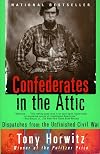
In Confederates in the Attic, journalist Tony Horwitz tours many historic southern Civil War battle sites and towns, struck by how alive and important the Civil War remains for so many Southerners. I can't believe it took this long for me to read this one; I loved his Blue Latitudes, about the voyages of Captain Cook, and I'd thought about this one many times. It took my LT brother Mark singing its praises on the phone to get me in gear.
Among other things, Horwitz becomes involved in Civil show more War enactments, where "hardcore" participants will go to great lengths for authenticity:
“Look at these buttons,” one soldier said, fingering his gray wool jacket. “I soaked them overnight in a saucer filled with urine.” Chemicals in the urine oxidized the brass, giving it the patina of buttons from the 1860s. “My wife woke up this morning, sniffed the air and said, ‘Tim, you’ve been peeing on your buttons again.”
No surprise, issues of race remain important. "Vicksburg confirmed the dispiriting pattern I'd seen elsewhere in the South . . . Everywhere, it seemed, I had to explore two pasts and two presents, one white, one black, separate and unreconcilable. The past had poisoned the present and the present, in turn, now poisoned remembrance of things past." Horwitz's sense of humor helps make the sometimes difficult journey companionable, and there are insights galore:
“You asked how I'd define prejudice. That's it. Making assumptions about people you've never met.” (I love this one!)
“The way I see it," King said, "your great-grandfather fought and died because he believed my great-grandfather should stay a slave. I'm supposed to feel all warm inside about that?”
“For Robert Lee Hodge, {participating in Civil War reenactments} was also a way of life. As the Marlon Brando of battlefield bloating, he was often hired for Civil War movies.” (This specialist in battlefield bloating becomes an important traveling companion; I think that's a photo of him on the cover).
Anyway, I can't think of a reason not to give this five stars. It was written in 1998, but feels like he wrote it yesterday. It gave me more insights into how Trump supporters view the world than any other book I've read, including Hillbilly Elegy. A favored few can create page-turning nonfiction, and this guy is one of them. I want to read more of his; probably his A Voyage Long and Strange next. show less
Among other things, Horwitz becomes involved in Civil show more War enactments, where "hardcore" participants will go to great lengths for authenticity:
“Look at these buttons,” one soldier said, fingering his gray wool jacket. “I soaked them overnight in a saucer filled with urine.” Chemicals in the urine oxidized the brass, giving it the patina of buttons from the 1860s. “My wife woke up this morning, sniffed the air and said, ‘Tim, you’ve been peeing on your buttons again.”
No surprise, issues of race remain important. "Vicksburg confirmed the dispiriting pattern I'd seen elsewhere in the South . . . Everywhere, it seemed, I had to explore two pasts and two presents, one white, one black, separate and unreconcilable. The past had poisoned the present and the present, in turn, now poisoned remembrance of things past." Horwitz's sense of humor helps make the sometimes difficult journey companionable, and there are insights galore:
“You asked how I'd define prejudice. That's it. Making assumptions about people you've never met.” (I love this one!)
“The way I see it," King said, "your great-grandfather fought and died because he believed my great-grandfather should stay a slave. I'm supposed to feel all warm inside about that?”
“For Robert Lee Hodge, {participating in Civil War reenactments} was also a way of life. As the Marlon Brando of battlefield bloating, he was often hired for Civil War movies.” (This specialist in battlefield bloating becomes an important traveling companion; I think that's a photo of him on the cover).
Anyway, I can't think of a reason not to give this five stars. It was written in 1998, but feels like he wrote it yesterday. It gave me more insights into how Trump supporters view the world than any other book I've read, including Hillbilly Elegy. A favored few can create page-turning nonfiction, and this guy is one of them. I want to read more of his; probably his A Voyage Long and Strange next. show less
Baghdad in the mid 1980s was such a volatile place to be. For Tony Horwitz to be bombing around (pun totally intended) Arabia was insane. There he was, in a land where even local weather reports and maps were banned. Think about it. As a left handed, Jewish stringer, he was not the most popular person to be wandering about those parts of the middle east. He met many people who exclaimed, "Death to America!" before gushing about Disneyland or Hollywood. Despite the dangers and hatreds, his show more narrative is more than slightly tongue-in-cheek and a lot more than a little funny. He scoffs at roadblocks manned by a 7' cardboard soldier (while the real military gets stoned on qat). He makes light of millions of crushing fanatics at Khomeini's funeral. He jokes about not being able to find his wife cloaked in a chador. At the same time as being funny, he is keenly observant. One of my favorites notes - while middle eastern air travel is not the safest; the oxygen masks made be missing, but at least passengers know which direction they should bow their heads in prayer thanks to a "Mecca indicator" on the ceiling of their aircraft. show less
Lists
Awards


You May Also Like


Associated Authors
Statistics
- Works
- 11
- Also by
- 3
- Members
- 9,927
- Popularity
- #2,395
- Rating
- 4.0
- Reviews
- 277
- ISBNs
- 93
- Languages
- 8
- Favorited
- 36
