
Alice Marriott (1910–1992)
Author of Sequoyah: Leader of the Cherokees
About the Author
Works by Alice Marriott
Indian Pictographs in Texas 1 copy
Associated Works
Tagged
Common Knowledge
- Canonical name
- Marriott, Alice
- Legal name
- Marriott, Alice Lee
- Birthdate
- 1910-01-08
- Date of death
- 1992-03-18
- Gender
- female
- Education
- Oklahoma City University (BA|1930)
University of Oklahoma (BA|1935) - Occupations
- historian
anthropologist - Organizations
- University of Oklahoma
U.S. Department of the Interior Indian Arts and Crafts Board
Muskogee Public Library - Awards and honors
- Oklahoma Historians Hall of Fame (2004)
Oklahoma City University Achievement Award (1968)
Oklahoma Hall of Fame (1958)
University of Oklahoma Achievement Award (1952)
Oklahoma Journalism Hall of Fame (1973)
Oklahoma Writer of the Year Award (1957) - Nationality
- USA
- Birthplace
- Wilmette, Illinois, USA
- Places of residence
- Oklahoma City, Oklahoma, USA
Nambe, New Mexico, USA - Place of death
- Oklahoma City, Oklahoma, USA
- Associated Place (for map)
- USA
Members
Reviews
Maria: The Potter of San Ildefonso (The Civilization of the American Indian Series) by Alice Marriott

An excellent biography by an ethnographer, based on conversations with the subject, ending in 1943 with the death of Maria's husband. Maria was born in the 1880's, a time when there were many changes in Native American life due to encroaching white (Anglo) society. As a child she was attracted to learning pottery making from her aunt. Apparently children were given freedom to follow their inclinations--her older sister loved farming & horses and so spent her days helping their father.
Rather show more than telling us how the culture was run, we see by example the conversational pauses and suggestions rather than direct criticism of a person. Even so, Maria chooses to marry Julian despite her parents cautions & the cultural norm of parents choosing the children's spouses. The norm is upheld by the parents acceptance & participation in exchanges with Julian's family. While Julian had good qualities, he was not as tied to the land, preferring working away rather than farming. He had a good mind, could puzzle out details & drawings without writing them down, and enjoyed figuring out new techniques which helped Maria make different pottery that tourists would buy. Maria enjoyed trading and selling, but was very shy around white strangers--no cause or explanation was given for that.
While Marriott describes Maria as gracious woman of strong character, we see how often Maria had to hold her feelings inside in order to meet the challenges in her life: when her daughter died, when her husband had to be away during that death, when her husband was drinking, when her sister became deaf.
It reads like a novel--very engrossing--but Maria's speech seems overly simple to me, especially when her replies to various people are given. There is little focus on her children, other than her daughter's brief life and death which so affected her & Julian. We learn about her later children only incidentally. It isn't clear how child care is arranged in the society. We do see how home ownership is transferred between family members, that there is often sharing of households, and there are a number of conversations where advice was given, which show us the cultural values.
The book includes a chronology of Maria's pottery making, details of the illustrated pottery, and a bibliography [quite dated, given the age of the book]. show less
Rather show more than telling us how the culture was run, we see by example the conversational pauses and suggestions rather than direct criticism of a person. Even so, Maria chooses to marry Julian despite her parents cautions & the cultural norm of parents choosing the children's spouses. The norm is upheld by the parents acceptance & participation in exchanges with Julian's family. While Julian had good qualities, he was not as tied to the land, preferring working away rather than farming. He had a good mind, could puzzle out details & drawings without writing them down, and enjoyed figuring out new techniques which helped Maria make different pottery that tourists would buy. Maria enjoyed trading and selling, but was very shy around white strangers--no cause or explanation was given for that.
While Marriott describes Maria as gracious woman of strong character, we see how often Maria had to hold her feelings inside in order to meet the challenges in her life: when her daughter died, when her husband had to be away during that death, when her husband was drinking, when her sister became deaf.
It reads like a novel--very engrossing--but Maria's speech seems overly simple to me, especially when her replies to various people are given. There is little focus on her children, other than her daughter's brief life and death which so affected her & Julian. We learn about her later children only incidentally. It isn't clear how child care is arranged in the society. We do see how home ownership is transferred between family members, that there is often sharing of households, and there are a number of conversations where advice was given, which show us the cultural values.
The book includes a chronology of Maria's pottery making, details of the illustrated pottery, and a bibliography [quite dated, given the age of the book]. show less
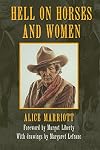
The world of the West has been from the beginning a man's world, but there are homes and wives and children there, too. And although the time of water hauled in barrels and of homemade candles is long past, the ranch wife of today must be prepared to deal with housekeeping, shopping, and personal problems in wholly original ways as the need arises. For ranches are usually far from town and neighbors are scattered, so that good humor and a good sense of humor, as well as the more conventional show more virtues of courage and fortitude, must be possessed by the ranch woman.
For more than eighteen months Alice Marriott traveled the cattle country from Wyoming to Florida–visiting, observing, and talking with the women on the ranches and with their men. This book is the story of these women, who share with their men-folks the problems and pleasures of ranch life. It's about the city girl transformed into ranch wife, about the women who were born on ranches, and about their families and the cattle they raise.
She reports on the modern roundups, the cattle sales, the courage of both men and women in the face of a howling blizzard, and the tragedy of a cow with a broken leg. Here they are-the real people of the cattle country and the real things that happen to them in a society in which the man's work is sharply distinguished from the woman's. show less
For more than eighteen months Alice Marriott traveled the cattle country from Wyoming to Florida–visiting, observing, and talking with the women on the ranches and with their men. This book is the story of these women, who share with their men-folks the problems and pleasures of ranch life. It's about the city girl transformed into ranch wife, about the women who were born on ranches, and about their families and the cattle they raise.
She reports on the modern roundups, the cattle sales, the courage of both men and women in the face of a howling blizzard, and the tragedy of a cow with a broken leg. Here they are-the real people of the cattle country and the real things that happen to them in a society in which the man's work is sharply distinguished from the woman's. show less

Plains Indian Mythology is a book of stories some passed down orally. The stories are grouped in 4 sections; The creation of the world, tales that teach ways of behavior, stories on Europeans visiting North America, and yarns from the current day.
I thoroughly love reading about mythology from different colonies and histories of how the world was created. It is interesting how so many different countries and races can have similar but yet different stories. This also happens with the many show more opposed plains Indians.
The newer tales were not as intriguing as the creation of mythologies. They did not seem like a story it just like someone babbling.
I continue to read lore of different colonies and the magic and folklore because it has made me realize how alike all humans are. Plus mythology is fun. show less
I thoroughly love reading about mythology from different colonies and histories of how the world was created. It is interesting how so many different countries and races can have similar but yet different stories. This also happens with the many show more opposed plains Indians.
The newer tales were not as intriguing as the creation of mythologies. They did not seem like a story it just like someone babbling.
I continue to read lore of different colonies and the magic and folklore because it has made me realize how alike all humans are. Plus mythology is fun. show less
Lists
Awards


You May Also Like


Associated Authors
Statistics
- Works
- 25
- Also by
- 3
- Members
- 1,088
- Popularity
- #23,608
- Rating
- 3.6
- Reviews
- 3
- ISBNs
- 45
- Languages
- 1