
Leonard J. Rosen
Author of All Cry Chaos
About the Author
Series
Works by Leonard J. Rosen
Tagged
Common Knowledge
- Birthdate
- 1954-01-07
- Gender
- male
- Occupations
- teacher
- Agent
- Aevitas Creative Management
- Nationality
- USA
- Birthplace
- Baltimore, Maryland, USA
- Places of residence
- Massachusetts, USA
- Associated Place (for map)
- USA
Members
Reviews

I'm not sure what I expected when I picked this book up, but it was actually much better than anticipated. It has quite a noir feel to it: with a troubled main character facing off against great challenges, by himself for the most part. There is a very strong mystery in here, and a great emotional component to top it off.
You'll root for Henri to solve the crime, fix his troubles, and save himself, but you won't know for sure, until the end, whether he suceeds or not. He is a very likeable show more and relatable main character, and his motivation to solve the mystery stems from a very human place. There is a thread of 'mathematics as the underpinning of reality' (i.e. the existence/origin of everything can be calculated) which could be too heavy if you really thought about it, but you're not forced to do so in order to follow the plot - and it does add another little dimension to the story.
All in all, it was a great, suspenseful and compelling crime-mystery novel with a noir-ish setting and a likeable but troubled main character. I am looking forward to the next book to be released in this series (even though this one had no cliff-hanger at all.). show less
You'll root for Henri to solve the crime, fix his troubles, and save himself, but you won't know for sure, until the end, whether he suceeds or not. He is a very likeable show more and relatable main character, and his motivation to solve the mystery stems from a very human place. There is a thread of 'mathematics as the underpinning of reality' (i.e. the existence/origin of everything can be calculated) which could be too heavy if you really thought about it, but you're not forced to do so in order to follow the plot - and it does add another little dimension to the story.
All in all, it was a great, suspenseful and compelling crime-mystery novel with a noir-ish setting and a likeable but troubled main character. I am looking forward to the next book to be released in this series (even though this one had no cliff-hanger at all.). show less

All Cry Chaos is detective work and philosophy. It is a book about God and science. All in all, it is a very satisfying read that brings up the big questions if you want to see them and an intimate book about solving a mystery if you don’t. It is a complicated and challenging book written in a beautifully straightforward style.
Henri Poincare is the fictional great-grandson of a real mathematician, Jules Henri Poincare. It is a charming conceit and ties together many of the elements of show more this book. He is a father and grandfather and a loving husband. He works for Interpol and is assigned the case of an explosion in which one man, Dr. Fenster, dies. Soon there are clues pointing Henri to Dr. Fenster’s former fiancé. It’s also about a criminal brought to justice by Henri and the effects of that upon Henri’s family. And, just like a fractal starting at one point and expanding forever in the same pattern, the book ties supposedly disparate actions, emotions, and theories together. It’s rather stunning, when all’s said and done.
This book will keep you on your toes. The mystery of a man’s death becomes rocket fuel, fractals, stock market trends and profit, adoption, love, tragedy, abandonment, sacrifice, and forgiveness. show less
Henri Poincare is the fictional great-grandson of a real mathematician, Jules Henri Poincare. It is a charming conceit and ties together many of the elements of show more this book. He is a father and grandfather and a loving husband. He works for Interpol and is assigned the case of an explosion in which one man, Dr. Fenster, dies. Soon there are clues pointing Henri to Dr. Fenster’s former fiancé. It’s also about a criminal brought to justice by Henri and the effects of that upon Henri’s family. And, just like a fractal starting at one point and expanding forever in the same pattern, the book ties supposedly disparate actions, emotions, and theories together. It’s rather stunning, when all’s said and done.
This book will keep you on your toes. The mystery of a man’s death becomes rocket fuel, fractals, stock market trends and profit, adoption, love, tragedy, abandonment, sacrifice, and forgiveness. show less
 This review was written for LibraryThing Early Reviewers.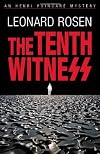
The Tenth Witness
by Leonard Rosen
The Permanent Press
Reviewed by Karl Wolff
“I begin, therefore, as I have for thirty years: with the body of a man floating face down in the slack water of Terschelling Island.” Henri Poincare, the narrator, continues, “And the world is well rid of him.” The body's identity and how Henri comes about to justify this homicide will propel The Tenth Witness forward. Beginning off the Dutch coast in late spring 1978, Henri Poincare and his fellow engineer show more Alec Chin are set to salvage the HMS Lutine. The Lutine sank off the coast in 1799, laden with tons of gold. But before Henri begins work on the salvaging operation, he decides to take a short vacation by hiking across the mud flats of the Wadden Sea. His guide is Liesel Kraus, an athletic beauty with a troubling past.
As Henri finds himself falling in love with Liesel, he decides to investigate the Kraus family. Liesel gives Henri a copy of a biography of Otto von Kraus, the patriarch of the family and mastermind behind Kraus Steel. The current head of Kraus Steel is Liesel's brother Anselm. What confounds Henri is how the Kraus family acquired (or preserved?) its wealth. According to the biography of Otto von Kraus, he was a member in good standing of the Nazi Party. He used slave labor, but was exonerated from prosecution of war crimes due to the positive testimonies of ten witnesses. This strikes a nerve with Henri, since his uncle was Jewish and he understands the evil perpetrated by the Nazi regime, even if the Kraus family wants to whitewash it.
In an attempt to get to the bottom of this, Henri attempts to meet the surviving witnesses. Except the witnesses he plans to meet end up dying in dubious circumstances.
The convenient deaths occur at the same time Anselm woos Henri into working as a consultant for Kraus Steel. He takes Henri to a ship-breaking yard in India. While Anselm sees the unsafe conditions as just another line on a budget ledger, the ship-breaking yard horrifies Henri. He also sees parallels between the ship-breaking yard and Nazi slave labor. (And a delightful example to bring up to opponents of raising the American minimum wage.) Anselm recruited Henri's talents because he wants Henri to come up with a process for salvaging computers and other electronic equipment. After a near fatal accident in the lab working on an electronics salvaging process, Henri has to face some tough choices. The trouble continues to mount as Anselm's recruitment techniques turn into strong arm tactics and the biography Liesel gave to Henri becomes less and less credible. Henri's torturous conflicts with the family business and his love for Liesel draw him deeper and deeper into corporate corruption and a race hatred he's finding everywhere, even within himself.
The Tenth Witness is a prequel to Leonard Rosen's critically acclaimed and Macavity Award-winning first novel, All Cry Chaos. Why did I give the novel a perfect 10? It is a combination of the excellent writing, compelling characters, and its tapestry of histories. It weaves together the history of the HMS Lutine, the Second World War and the Holocaust, and the Seventies. Histories reflect and refract off other histories, putting the novel in the category of Seventies Eurothrillers with Nazi villains (think Marathon Man and more tangentially, The Night Porter). In the Sixties and Seventies, the German population wanted to sweep the Nazi war crimes under the carpet and just get along with their lives. At least that's what the parents told their children who now asked that tricky question, “Grandpa, what did you do during the War?” It also brings to light the criminal atrocities done in the name of saving a nickel like ship-breaking by an indentured worker class and our current practice of recycling electronics in a less than healthful manner. But who cares about them? Buy that new iPhone that's a quarter inch thinner and forget where the last one went … or what it is doing to the worker's eyes and lungs.
Leonard Rosen ties together all these disparate narrative strands in a book less than 300 pages long. The various histories and personalities melded together seamlessly, reminding me of the baroque complexity of Alan Moore's Watchmen. It is a stunning achievement.
Out of 10/10
https://driftlessareareview.com/2014/02/21/cclap-fridays-the-tenth-witness-by-le... show less
by Leonard Rosen
The Permanent Press
Reviewed by Karl Wolff
“I begin, therefore, as I have for thirty years: with the body of a man floating face down in the slack water of Terschelling Island.” Henri Poincare, the narrator, continues, “And the world is well rid of him.” The body's identity and how Henri comes about to justify this homicide will propel The Tenth Witness forward. Beginning off the Dutch coast in late spring 1978, Henri Poincare and his fellow engineer show more Alec Chin are set to salvage the HMS Lutine. The Lutine sank off the coast in 1799, laden with tons of gold. But before Henri begins work on the salvaging operation, he decides to take a short vacation by hiking across the mud flats of the Wadden Sea. His guide is Liesel Kraus, an athletic beauty with a troubling past.
As Henri finds himself falling in love with Liesel, he decides to investigate the Kraus family. Liesel gives Henri a copy of a biography of Otto von Kraus, the patriarch of the family and mastermind behind Kraus Steel. The current head of Kraus Steel is Liesel's brother Anselm. What confounds Henri is how the Kraus family acquired (or preserved?) its wealth. According to the biography of Otto von Kraus, he was a member in good standing of the Nazi Party. He used slave labor, but was exonerated from prosecution of war crimes due to the positive testimonies of ten witnesses. This strikes a nerve with Henri, since his uncle was Jewish and he understands the evil perpetrated by the Nazi regime, even if the Kraus family wants to whitewash it.
In an attempt to get to the bottom of this, Henri attempts to meet the surviving witnesses. Except the witnesses he plans to meet end up dying in dubious circumstances.
The convenient deaths occur at the same time Anselm woos Henri into working as a consultant for Kraus Steel. He takes Henri to a ship-breaking yard in India. While Anselm sees the unsafe conditions as just another line on a budget ledger, the ship-breaking yard horrifies Henri. He also sees parallels between the ship-breaking yard and Nazi slave labor. (And a delightful example to bring up to opponents of raising the American minimum wage.) Anselm recruited Henri's talents because he wants Henri to come up with a process for salvaging computers and other electronic equipment. After a near fatal accident in the lab working on an electronics salvaging process, Henri has to face some tough choices. The trouble continues to mount as Anselm's recruitment techniques turn into strong arm tactics and the biography Liesel gave to Henri becomes less and less credible. Henri's torturous conflicts with the family business and his love for Liesel draw him deeper and deeper into corporate corruption and a race hatred he's finding everywhere, even within himself.
The Tenth Witness is a prequel to Leonard Rosen's critically acclaimed and Macavity Award-winning first novel, All Cry Chaos. Why did I give the novel a perfect 10? It is a combination of the excellent writing, compelling characters, and its tapestry of histories. It weaves together the history of the HMS Lutine, the Second World War and the Holocaust, and the Seventies. Histories reflect and refract off other histories, putting the novel in the category of Seventies Eurothrillers with Nazi villains (think Marathon Man and more tangentially, The Night Porter). In the Sixties and Seventies, the German population wanted to sweep the Nazi war crimes under the carpet and just get along with their lives. At least that's what the parents told their children who now asked that tricky question, “Grandpa, what did you do during the War?” It also brings to light the criminal atrocities done in the name of saving a nickel like ship-breaking by an indentured worker class and our current practice of recycling electronics in a less than healthful manner. But who cares about them? Buy that new iPhone that's a quarter inch thinner and forget where the last one went … or what it is doing to the worker's eyes and lungs.
Leonard Rosen ties together all these disparate narrative strands in a book less than 300 pages long. The various histories and personalities melded together seamlessly, reminding me of the baroque complexity of Alan Moore's Watchmen. It is a stunning achievement.
Out of 10/10
https://driftlessareareview.com/2014/02/21/cclap-fridays-the-tenth-witness-by-le... show less
Looks like the only other reviewers got a free book in exchange. I paid for my copy. And am not disappointed that I did either.
I did read the first book when it came out, so this prequel was not my first introduction to Henri. I have to admit I was lost at the start of the book because it was very difficult to bring my head back to Henri's past when it was so different from the present day story I had liked so much. Normally I don't like historical fiction, and this book did brush right show more along the edge of that (i.e. Nazi war crimes)... I read fiction for escapes from reality, not to recap the horrendous activities humans have gotten up to in the past. And I like justice that is meaningful (i.e. the bad guys get their just desserts asap after they commit their crimes)... in fact, I like vigilante justice where bad guys get their just desserts immediately. To read about Nazi crimes where most of the murderers got away and/or were brought to justice after they had lived the better parts of their lives free is just not satisfying. So they convict an 80 year old of war crimes - so what, he already lived the best part of his life off the backs of the people he murdered.
Okay, okay... rant over... anyway, it was a good story and I like Henri's character. He is a noir kinda guy and believes that justice might have to come outside the box. I will read more in this series, even if it were set in the past. show less
I did read the first book when it came out, so this prequel was not my first introduction to Henri. I have to admit I was lost at the start of the book because it was very difficult to bring my head back to Henri's past when it was so different from the present day story I had liked so much. Normally I don't like historical fiction, and this book did brush right show more along the edge of that (i.e. Nazi war crimes)... I read fiction for escapes from reality, not to recap the horrendous activities humans have gotten up to in the past. And I like justice that is meaningful (i.e. the bad guys get their just desserts asap after they commit their crimes)... in fact, I like vigilante justice where bad guys get their just desserts immediately. To read about Nazi crimes where most of the murderers got away and/or were brought to justice after they had lived the better parts of their lives free is just not satisfying. So they convict an 80 year old of war crimes - so what, he already lived the best part of his life off the backs of the people he murdered.
Okay, okay... rant over... anyway, it was a good story and I like Henri's character. He is a noir kinda guy and believes that justice might have to come outside the box. I will read more in this series, even if it were set in the past. show less
Lists
Awards


You May Also Like


Associated Authors
Statistics
- Works
- 16
- Members
- 575
- Popularity
- #43,588
- Rating
- 3.9
- Reviews
- 56
- ISBNs
- 59
- Languages
- 6
