
Pauline W. Chen
Author of Final Exam: A Surgeon's Reflections on Mortality
About the Author
Pauline W. Chen is a liver transplant and liver cancer surgeon, as well as a prolific author. Her work has been nominated for a National Magazine Award, and she has written for a number of publications, including The Virginia Quarterly Review, The New York Times, The Washington Post, and Prevention show more Magazine. She also speaks regularly to medical and general audiences across the country. She is the author of Final Exam: A Surgeon's Reflections on Mortality, a New York Times bestseller that has been translated and sold in a dozen countries across the world. show less
Image credit: Joanne Chan
Works by Pauline W. Chen
Tagged
Common Knowledge
- Canonical name
- Chen, Pauline W.
- Other names
- Chen, Pauline
- Birthdate
- 1964
- Gender
- female
- Education
- Harvard University
Northwestern University - Occupations
- doctor
professor
columnist - Organizations
- The New York Times
University of California, Los Angeles - Nationality
- USA
- Associated Place (for map)
- USA
Members
Reviews
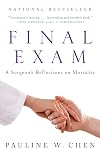
Final Exam is a beautiful, moving piece of non-fiction. Both scholarly and intensely personal, Dr. Chen's first book is a concise but thorough description of her own experiences with death and dying throughout her medical training and the effect it has had on her professional and personal relationships with the dying. Her experiences are largely universal -- her descriptions of her first patient whose death she felt responsible for echoed -- and she backs them up with citations from the show more medial literature about the exposures trainees have to death and their reactions.
Despite the fact that I am well-versed in the palliative literature and had read many of the articles Dr. Chen cited her personal experiences lend a depth and character to the discussion that is priceless. Dr. Chen's strength is that she is brutally honest. She describes unflinchingly her avoidance of patients that were dying and her regret of being too terse at times. She discusses events that other medical non-fiction would gloss over.
My only grievances with the book is the end-notes. The book is rife with them (at one point there are three end notes corresponding to a single sentence) and they are not marked at all in the main text, although they are designed to refer to particular sentences in the main text. The end notes are written in a different style than the main narrative, and detract from the flow. By and large they fall into three categories: those that are essential to the text and directly related to the main text; those that are essential to the text, but not directly related to the main text and those that are not essential. The first two categories should have been integrated into the narrative and the third should have been eliminated. show less
Despite the fact that I am well-versed in the palliative literature and had read many of the articles Dr. Chen cited her personal experiences lend a depth and character to the discussion that is priceless. Dr. Chen's strength is that she is brutally honest. She describes unflinchingly her avoidance of patients that were dying and her regret of being too terse at times. She discusses events that other medical non-fiction would gloss over.
My only grievances with the book is the end-notes. The book is rife with them (at one point there are three end notes corresponding to a single sentence) and they are not marked at all in the main text, although they are designed to refer to particular sentences in the main text. The end notes are written in a different style than the main narrative, and detract from the flow. By and large they fall into three categories: those that are essential to the text and directly related to the main text; those that are essential to the text, but not directly related to the main text and those that are not essential. The first two categories should have been integrated into the narrative and the third should have been eliminated. show less
This book did not help me with the feeling that Doctors Are Bad because they are vainglorious snots who are best avoided. I really understand the patient with advanced breast cancer who got no medical intervention until her breast was actually rotting away. I usually feel that whatever doctor I deal with is more interested in getting payment than in delivering care, more interested in getting out of the exam room than in answering questions, etc.
Granted, I am more prejudiced against doctors show more than most people: my family has three doctors, and every one of them is an awful person in one way or another. I once worked for a doctor who hated people in general and loved to torment her support staff in particular. (Thank God that one wasn't a surgeon. The thought of a knife in her hand still gives me the willies). My problem is mostly that these people really seem to feel their grand Doctorhood puts them on a level far. far above little me. These are the sort of person who can hear "Stop, I am not comfortable with this discussion," and say indignantly, "I am a Doctor, I will discuss whatever I wish." No, sometimes you are a family member who ought to know when to use some manners.
But enough about this reader's doctor dislike. I did not read this book carefully but rather in a feverish haze of illness. Why did I read a book I probably wouldn't like while I was sick? Because it was on top of the TBR pile and I liked the feeling of being able to cross it off my list. I admit I probably missed a lot.
I was struck by the amount of loving detail about the author's first cadaver, who was probably her most memorable patient. This part of the book was very touching. Especially when compared to the patient-avoidance techniques Dr. Chen developed later in her career.
Was the cadaver her favorite patient because it didn't talk back, and no difficult conversations had to occur on its behalf? Or is this a story about how the practice of modern medicine turns starry-eyed idealistic little People Helpers into dog-tired drones servicing the insurance industry more than the patient population?
Doctor Chen ended up saving her precious professional time by developing the back-out-of-the-room technique to cut off tiresome and tedious patient questions, and who figured that she could just skip all those difficult conversations with patients and families about death because somebody else would probably do it, so she wasn't really lying and she wasn't really shirking her responsibilities. Ugh. How horrible to feel that this woman paid more attention and gave better care to her first cadaver than to some of the sick people who ended up cluttering her busy schedule.
Why is it that doctors are in love with their mastery of technology, but avoid pain management? One would think that a terminal case could have all the drugs they wanted, but no. It is common to suffer moderate to severe pain at the end, because pain makes doctors uncomfortable. I think about that paradigm when I think that dying peacefully in the back yard will be much more dignified than going to hospital. show less
Granted, I am more prejudiced against doctors show more than most people: my family has three doctors, and every one of them is an awful person in one way or another. I once worked for a doctor who hated people in general and loved to torment her support staff in particular. (Thank God that one wasn't a surgeon. The thought of a knife in her hand still gives me the willies). My problem is mostly that these people really seem to feel their grand Doctorhood puts them on a level far. far above little me. These are the sort of person who can hear "Stop, I am not comfortable with this discussion," and say indignantly, "I am a Doctor, I will discuss whatever I wish." No, sometimes you are a family member who ought to know when to use some manners.
But enough about this reader's doctor dislike. I did not read this book carefully but rather in a feverish haze of illness. Why did I read a book I probably wouldn't like while I was sick? Because it was on top of the TBR pile and I liked the feeling of being able to cross it off my list. I admit I probably missed a lot.
I was struck by the amount of loving detail about the author's first cadaver, who was probably her most memorable patient. This part of the book was very touching. Especially when compared to the patient-avoidance techniques Dr. Chen developed later in her career.
Was the cadaver her favorite patient because it didn't talk back, and no difficult conversations had to occur on its behalf? Or is this a story about how the practice of modern medicine turns starry-eyed idealistic little People Helpers into dog-tired drones servicing the insurance industry more than the patient population?
Doctor Chen ended up saving her precious professional time by developing the back-out-of-the-room technique to cut off tiresome and tedious patient questions, and who figured that she could just skip all those difficult conversations with patients and families about death because somebody else would probably do it, so she wasn't really lying and she wasn't really shirking her responsibilities. Ugh. How horrible to feel that this woman paid more attention and gave better care to her first cadaver than to some of the sick people who ended up cluttering her busy schedule.
Why is it that doctors are in love with their mastery of technology, but avoid pain management? One would think that a terminal case could have all the drugs they wanted, but no. It is common to suffer moderate to severe pain at the end, because pain makes doctors uncomfortable. I think about that paradigm when I think that dying peacefully in the back yard will be much more dignified than going to hospital. show less
This review originally appeared on my blog www.gimmethatbook.com.
Final Exam was a book I picked up myself from the library. It was on my own personal reading list, which I haven’t been really able to get to these days. This is not a new book; it was published in 2007, but the ideas that Dr Chen speaks of should be relevant and in use today.
The mission of all doctors is to maintain life–by performing surgery, by prescribing medication, by encouraging life changes such as dieting or show more quitting smoking. But–everyone eventually dies, no matter how brilliant the surgeon was, or how much weight a patient lost. Many doctors gloss over this fact and prefer to focus on living and making a better quality of life.
Who will champion a better quality of death? No, Dr Chen is not going to talk about euthanasia, or discuss funeral services. She is going to bring to the forefront a subject that has been assiduously avoided in human medicine for a long time: death is very much a part of life, and it should not be spoken of in hushed tones or pushed to the back of one’s mind. To truly care for your patients, you must realize that death is truly part of life.
No one wants to consider their own mortality, especially someone who is going to the hospital for an operation. Dr Chen postulates that all doctors can give better care by embracing their own personal feelings and fears about death, and listening to what their patients are telling them, either with words or what their body is saying.
There is a great deal of explicit description in Final Exam: of medical procedures and people struggling to die, those with sickness or those who have developed complications after surgery. Dr Chen starts out with her own personal experience with a cadaver in medical school and brings us all the way to her visceral reaction when a good friend of hers dies.
This book’s message is a powerful one, and not for the faint of heart. I thoroughly applaud Dr Chen for suggesting that doctors make themselves more emotionally available and vulnerable. Too often a patient’s death is couched in a sense of failure, of medicine gone wrong. A delicate balance needs to be attained, and I hope Dr Chen has started a dialogue by writing this book.
I loved this. You can pick up your own copy here. show less
First off, let me say this: I love a book with a good bibliography. It makes me feel like I am in knowledgable hands. No, that was not a surgeon joke. Because of this exhaustive bibliography I want to subscribe to all these medical journals. I know Dr. Chen reads them to stay up on her field, but I would just love to see her filing system. It must be stupendous. Either that, or she's got a wicked e-subscription file.
A close family member died recently, and this book is exceptional in show more explaining what was happening. Not from a biological system standpoint, but from a medical system standpoint. Dr. Chen delves deeply into the reflexive reaction a physician has to the process of dying. They were taught to fix problems. When the problems are no longer fixable, then things become much more personal.
Our family member died at home, surrounded by those she loved. She was not given false hope, and she was not subjected to the "full court press" in her final days. Reading this book made me glad that was the case, and made me much more conscious of the decisions there are to be made within the bounds of medicine. show less
A close family member died recently, and this book is exceptional in show more explaining what was happening. Not from a biological system standpoint, but from a medical system standpoint. Dr. Chen delves deeply into the reflexive reaction a physician has to the process of dying. They were taught to fix problems. When the problems are no longer fixable, then things become much more personal.
Our family member died at home, surrounded by those she loved. She was not given false hope, and she was not subjected to the "full court press" in her final days. Reading this book made me glad that was the case, and made me much more conscious of the decisions there are to be made within the bounds of medicine. show less
Lists
Awards

You May Also Like


Statistics
- Works
- 3
- Members
- 535
- Popularity
- #46,548
- Rating
- 3.8
- Reviews
- 17
- ISBNs
- 9
- Languages
- 1
- Favorited
- 1