
P. T. Forsyth (1848–1921)
Author of The Soul of Prayer
About the Author
Image credit: public domain
Series
Works by P. T. Forsyth
Religion in Recent Art: Expository Lectures on Rossetti, Burne Jones, Watts, Holman Hunt and Wagner (2017) 5 copies
The Person and Place of Jesus Christ: The Congregational Union Lecture (Classic Reprint) (2015) 3 copies
Descending on Humanity and Intervening in History: Notes from the Pulpit Ministry of P. T. Forsyth (2013) 3 copies
P. T. Forsyth and the cure of souls: an appraisement and anthology of his practical writings, (1970) 2 copies
Christian aspects of evolution 2 copies
Socialism, the Church and the Poor 2 copies
Thgis Life and the Next 1 copy
This Life and the Next 1 copy
Associated Works
The Company of Preachers: Wisdom on Preaching, Augustine to the Present (2002) — Contributor — 199 copies, 2 reviews
Tagged
Common Knowledge
- Legal name
- Forsyth, Peter Taylor
- Other names
- 富希士
- Birthdate
- 1848-05-12
- Date of death
- 1921-11-11
- Gender
- male
- Education
- University of Aberdeen
University of Göttingen - Occupations
- clergyman
theologian - Nationality
- UK
- Places of residence
- Aberdeen, Scotland, UK
Göttingen, Germany - Associated Place (for map)
- UK
Members
Reviews

Forsyth produced one of the most profound titles in the history of theological writing, and the book is no bridesmaid to the title. As so often one might be reminded of L.P. Hartley's famous statement 'the past is another country'; Forsyth's methodology and language are a different way of doing things to that of contemporary theological discourse. The reader must step beyond 21st century parameters. But having done that one will find Forsyth driving to the heart of hermeneutical and show more soteriological issues that are timeless.
In particular, early in the lectures (for in the main part that is what these essays were) Forsyth overcomes that perennial chestnut, the wedge driven between Paul and Jesus (13). Throughout the work, timelessly, he refuses to allow a cleavage between Christ of Faith and Jesus of History. Paul could not have made the soteriological and christological claims that he did make if they did not ring true to the ears of those who knew the oral traditions of Jesus' teachings and the broad facts of Jesus' peculiar life. Nor can the historical experiences be diverted from the doxological experience of Christ in the experience of the earliest Christian realms: 'A Christianity merely ethical, refined, or sympathetic certainly makes for the social state, if you can keep it up, but the Christianity that makes for the Church is of a much more intimate, personal and positive kind' (33).
Forsyth, if I may import Anselmian concepts, never forgets how great a thing sin is, and therefore will never allow a merely liberal agenda of the betterment of the human state to dictate terms of theological language.
Of course the practice of theological discourse today no longer has space for the rhetorical methods into which Forsyth often soars. In particular engagement with an imaginary interlocutor and with posed questions becomes tedious to a post-modern ear. There are, to be honest, flights of fancy and questions begged, too. But ultimately his early emphasis on the holiness of God, and later on the judgement of God are timeless theological truths, jettisoned by post-modernity at peril; 'There can be no talk of propitiation in the sense of mollification, or of purchasing God's grace, in any religion founded on the Bible' (186)
The Cruciality of the Cross is a timeless gem. Sadly too many students of Christian faith will not be able to overcome the hurdle of Victorian prose. Their loss is immeasurable; we need Forsyth's emphases now even more than we did in 1909 show less
In particular, early in the lectures (for in the main part that is what these essays were) Forsyth overcomes that perennial chestnut, the wedge driven between Paul and Jesus (13). Throughout the work, timelessly, he refuses to allow a cleavage between Christ of Faith and Jesus of History. Paul could not have made the soteriological and christological claims that he did make if they did not ring true to the ears of those who knew the oral traditions of Jesus' teachings and the broad facts of Jesus' peculiar life. Nor can the historical experiences be diverted from the doxological experience of Christ in the experience of the earliest Christian realms: 'A Christianity merely ethical, refined, or sympathetic certainly makes for the social state, if you can keep it up, but the Christianity that makes for the Church is of a much more intimate, personal and positive kind' (33).
Forsyth, if I may import Anselmian concepts, never forgets how great a thing sin is, and therefore will never allow a merely liberal agenda of the betterment of the human state to dictate terms of theological language.
Of course the practice of theological discourse today no longer has space for the rhetorical methods into which Forsyth often soars. In particular engagement with an imaginary interlocutor and with posed questions becomes tedious to a post-modern ear. There are, to be honest, flights of fancy and questions begged, too. But ultimately his early emphasis on the holiness of God, and later on the judgement of God are timeless theological truths, jettisoned by post-modernity at peril; 'There can be no talk of propitiation in the sense of mollification, or of purchasing God's grace, in any religion founded on the Bible' (186)
The Cruciality of the Cross is a timeless gem. Sadly too many students of Christian faith will not be able to overcome the hurdle of Victorian prose. Their loss is immeasurable; we need Forsyth's emphases now even more than we did in 1909 show less

This is a profound book, which was written in 1917, and is still so profound, most find it too difficult to read. It is worth the effort, for it provides us with a much needed theodicy, on a global scale, fulfilling the author's words in another place - "theology means to think in centuries" (The Work of Christ).
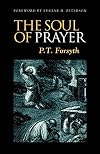
First four chapters were kind of flowery and "spiritual" sounding, too abstract where I couldn't pin down what the authro was getting at, at least, that's how I took it. Felt like I was reading the same ol' same ol' on prayer...nothing new.
Then chapter 5 seemed to change tone, more practical and insightful, and by the time I got through the last two chapters (6 and 7), he had stated very meaningful and deep things about prayer in a way that I have never read about prayer in any other book. show more For example, in the last chaoter, the author states that insistent prayer is a form of resistence to God's will, "a resistance that God loves". He further suggests, "Prayer is an encounter of wills - till one or the other gives way."
The last chapter makes reading the whole book, which is really short, worth it. I'm glad I didn't put it down as I was tempted to do while reading the earlier chapters. show less
Then chapter 5 seemed to change tone, more practical and insightful, and by the time I got through the last two chapters (6 and 7), he had stated very meaningful and deep things about prayer in a way that I have never read about prayer in any other book. show more For example, in the last chaoter, the author states that insistent prayer is a form of resistence to God's will, "a resistance that God loves". He further suggests, "Prayer is an encounter of wills - till one or the other gives way."
The last chapter makes reading the whole book, which is really short, worth it. I'm glad I didn't put it down as I was tempted to do while reading the earlier chapters. show less

This book addresses the most crucial problem facing the Church and society today with timeliness and pertinence. Peter Taylor Forsyth built his theology around major themes in the Christian tradition - the authority of the Bible, the centrality of the cross and the life of faith. And this book contains 8 of Forsyth's essays, speaking to questions that were important in his day but that are equally important today. Forsyth was born in 1848.
You May Also Like


Associated Authors
Statistics
- Works
- 48
- Also by
- 1
- Members
- 923
- Popularity
- #27,802
- Rating
- 4.1
- Reviews
- 5
- ISBNs
- 130
- Languages
- 1
- Favorited
- 1