
K. Scott Oliphint
Author of Covenantal Apologetics: Principles and Practice in Defense of Our Faith
About the Author
K. Scott Oliphint is professor of apologetics and systematic theology at Westminster Theological Seminary. He is the author of numerous articles and books, including Covenantal Apologetics and Know Why You Believe. He is also coeditor of the two-volume Christian Apologetics Past and Present: A show more Primary Source Reader and a contributor to Four Views on Christianity and Philosophy. show less
Image credit: via Goodreads
Series
Works by K. Scott Oliphint
Covenantal Apologetics: Principles and Practice in Defense of Our Faith (2013) 431 copies, 2 reviews
The Battle Belongs to the Lord: The Power of Scripture for Defending Our Faith (2003) 334 copies, 1 review
Should You Believe in God? (Christian Answers to Hard Questions) (Apologia) (2013) 143 copies, 2 reviews
Four Views on Christianity and Philosophy (Counterpoints: Bible and Theology) (2016) — Contributor — 110 copies, 2 reviews
Christianity and the Role of Philosophy (Christian Answers to Hard Questions) (Apologia) (2013) 50 copies, 1 review
Associated Works
A Theological Guide to Calvin's Institutes: Essays and Analysis (Calvin 500) (2008) — Contributor, some editions — 328 copies, 1 review
Tagged
Common Knowledge
- Birthdate
- 1955
- Gender
- male
- Education
- West Texas State University (BS, 1978)
Westminster Theological Seminary (M.A.R., 1983; Th.M., 1984; Ph.D., 1994) - Nationality
- USA
- Associated Place (for map)
- USA
Members
Reviews
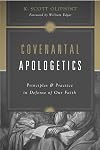
Apologetics. Epistemology. Thomism. Van Tillian Presuppositionalism. Terminology can be a beast sometimes. Labels, which are designed to communicate substantial amounts of truth in a word or few, are less than helpful when a person is unfamiliar with them and can become detrimental when either the meaning of the label is debated or the label itself is misunderstood.
I still remember at a church where I was on staff that I found out through the grapevine that I believed only 144,000 people show more would ever be saved. It seemed that because I had been labeled a "Calvinist" and thus believed in "election" then it was the case that I believed in only the salvation of the 144,000. While I am sure it shocked many in the church that I would believe such, none were as shocked as I was. Labels. They can be helpful. They can be confusing. They can be downright harmful.
Scott Oliphint makes the case in Covental Apologetics that this might just be the case with the label of "Presuppostional Apologetics". Oliphint feels it is time to move away from the terminology "presuppositional" and move towards a label more representative of the method itself, and one without the negative connotations that "presuppostional" enjoys.
Although, for that matter, "apologetics" itself is a word that is a bit loaded in our common vernacular. Oliphint does well to define "apologetics" and then offer an apologetic for its use. While many, from Barth to Kuyper to Spurgeon, have expressed reservations in regards to the discipline of apologetics, Oliphint shows that it is a discipline that is shown in Scripture to be allowable and beneficial, while also being directly commanded.(and one in which all these men engaged, even if they did not do so in a way that they would label as "apologetics")
"Christian apologetics is the application of biblical truth to unbelief. Really it is no more complicated than that. But it is complicated by the fact that there are so many theological permutations of biblical truth and almost no end to the variations and contours of unbelief. Not only so, but there have been, are, and will continue to be attacks of every sort that seek to destroy the truth of the Christian faith. So as one thinks about and commences to defend the Christian faith, things can become complex."
Oliphint makes the case that the Christian apologetic is one that is distinctly covenantal, one that is based on the fact that all humans are in a covenant relationship with God and are either in Adam, as covenant head, or in Christ, as covenant head.
"(B)asic to everything else we will say, we should recognize that every person on the face of the earth is defined, in part, by his relationship to a covenant head. That is, there are two, and only two, postions that are possible for humanity, and only one of which can be actual for each person at a given time. A person is either, by nature (after the fall into sin), in Adam, in which case he is opposed to and in rebellion against God, or he is in Christ, in which case by grace a person is not guilty before God but is an heir of eternal life. This is the covenantal status of humanity, and it assumes in each case, a relationship to God."
This is the crux of a covenantal (presuppostional) apologetic. Using Paul's argument from Romans 1, Oliphint shows that God has made Himself known to all men and men either receive this and acknowledge Him, or they rebel against Him and suppress this knowledge. As covenantal creatures we enjoy a sensus divinitatus, a "sense of the divine". This "sense of the divine" influences how we form our arguments with unbelievers and how we approach the discipline of apologetics.
Oliphint offer ten tenets to guide the Covenantal approach to apologetics. These tenets are:
"1. The faith we are defending must begin with, and necessarily include, the triune God--Father, Son, and Holy Spirit--who, as God, condescends to create and to redeem.
2. God's covenantal revelation is authoritative by virtue of what it is, and any covenantal, Christian apologetic will necessarily stand on and utilize that authority in order to defend Christianity.
3. It is the truth of God's revelation, together with the Holy Spirit, that brings about a covenantal change from one who is in Adam to one who is in Christ.
4. Man(male and female) as image of God is in covenant with the triune God for eternity.
5. All people know the true God, and that knowledge entails covenantal obligations.
6. Those who are and remain in Adam suppress the truth that they know. Those who are in Christ see the truth for what it is.
7. There is an absolute covenantal antithesis between Christian theism and any other, opposing position. Thus, Christianity is true and anything opposing it is false.
8. Suppression of the truth, like the depravity of sin, is total but not absolute. Thus, every unbelieving position will necessarily have within it ideas, concepts, notions, and the like that it has taken and wrenched from their true, Christian context.
9. The true, covenantal knowledge of God in man, together with God's universal mercy, allows for persuasion in apologetics.
10. Every fact and experience is what it is by virtue of the covenantal, all-controlling plan and purpose of God."
These tenets are fleshed out beautifully throughout the remainder of the book.
There were many outstanding moments in this book. One of the more memorable for me was Oliphint's chapter on the role of persuasion in apologetics and how he moved from the classical, educational Trivium (grammar, logic, and rhetoric) to the theological trivium (the principial nature of Scripture, the sensus divinitatus, and God's universal mercy) to the trivium of persuasion (ethos, pathos, and logos). The mixture of theology, philosophy, history, and Scripture applied so beautifully to the discipline of apologetics, specifically persuasion, and showing how critical the pathos of the apologist is, was wonderful. Chapter 4 alone is worth the price of the book.
And if chapter 4 alone is worth the price of the book then the reader should be ready to receive much more than they have paid for. This book is a great book. Oliphint deals with a broad range of subjects and he does so in a manner that will not easily lose his audience. There are a few spots where it feels like the current may sweep the reader away, but Oliphint does a fine job helping the reader find solid, familiar ground pretty quickly in these cases. The discussion on probability as it relates to a naturalistic worldview get pretty heady pretty quickly, but it is definitely worth looking at and was especially edifying to me.
Oliphint includes three model-discussions to see how a "Covenant Apologist" would deal with different worldviews. These discussions are informative and challenging, and frankly, just fun to read.
If you have any interest in knowing what Van Tillian, or presuppositonal, apologetics proposes, this is the book for you. I have to be honest, I get lost in Van Til quotes and have never been able to convince myself to dive into his work. Frame and Bahnsen are good, but as far as clarity and an engaging style, Oliphint, to me at least, is head and shoulders above his peers. This is a book that the reader will enjoy and learn from, regardless of whether or not you end up embracing this particular apologetic. show less
I still remember at a church where I was on staff that I found out through the grapevine that I believed only 144,000 people show more would ever be saved. It seemed that because I had been labeled a "Calvinist" and thus believed in "election" then it was the case that I believed in only the salvation of the 144,000. While I am sure it shocked many in the church that I would believe such, none were as shocked as I was. Labels. They can be helpful. They can be confusing. They can be downright harmful.
Scott Oliphint makes the case in Covental Apologetics that this might just be the case with the label of "Presuppostional Apologetics". Oliphint feels it is time to move away from the terminology "presuppositional" and move towards a label more representative of the method itself, and one without the negative connotations that "presuppostional" enjoys.
Although, for that matter, "apologetics" itself is a word that is a bit loaded in our common vernacular. Oliphint does well to define "apologetics" and then offer an apologetic for its use. While many, from Barth to Kuyper to Spurgeon, have expressed reservations in regards to the discipline of apologetics, Oliphint shows that it is a discipline that is shown in Scripture to be allowable and beneficial, while also being directly commanded.(and one in which all these men engaged, even if they did not do so in a way that they would label as "apologetics")
"Christian apologetics is the application of biblical truth to unbelief. Really it is no more complicated than that. But it is complicated by the fact that there are so many theological permutations of biblical truth and almost no end to the variations and contours of unbelief. Not only so, but there have been, are, and will continue to be attacks of every sort that seek to destroy the truth of the Christian faith. So as one thinks about and commences to defend the Christian faith, things can become complex."
Oliphint makes the case that the Christian apologetic is one that is distinctly covenantal, one that is based on the fact that all humans are in a covenant relationship with God and are either in Adam, as covenant head, or in Christ, as covenant head.
"(B)asic to everything else we will say, we should recognize that every person on the face of the earth is defined, in part, by his relationship to a covenant head. That is, there are two, and only two, postions that are possible for humanity, and only one of which can be actual for each person at a given time. A person is either, by nature (after the fall into sin), in Adam, in which case he is opposed to and in rebellion against God, or he is in Christ, in which case by grace a person is not guilty before God but is an heir of eternal life. This is the covenantal status of humanity, and it assumes in each case, a relationship to God."
This is the crux of a covenantal (presuppostional) apologetic. Using Paul's argument from Romans 1, Oliphint shows that God has made Himself known to all men and men either receive this and acknowledge Him, or they rebel against Him and suppress this knowledge. As covenantal creatures we enjoy a sensus divinitatus, a "sense of the divine". This "sense of the divine" influences how we form our arguments with unbelievers and how we approach the discipline of apologetics.
Oliphint offer ten tenets to guide the Covenantal approach to apologetics. These tenets are:
"1. The faith we are defending must begin with, and necessarily include, the triune God--Father, Son, and Holy Spirit--who, as God, condescends to create and to redeem.
2. God's covenantal revelation is authoritative by virtue of what it is, and any covenantal, Christian apologetic will necessarily stand on and utilize that authority in order to defend Christianity.
3. It is the truth of God's revelation, together with the Holy Spirit, that brings about a covenantal change from one who is in Adam to one who is in Christ.
4. Man(male and female) as image of God is in covenant with the triune God for eternity.
5. All people know the true God, and that knowledge entails covenantal obligations.
6. Those who are and remain in Adam suppress the truth that they know. Those who are in Christ see the truth for what it is.
7. There is an absolute covenantal antithesis between Christian theism and any other, opposing position. Thus, Christianity is true and anything opposing it is false.
8. Suppression of the truth, like the depravity of sin, is total but not absolute. Thus, every unbelieving position will necessarily have within it ideas, concepts, notions, and the like that it has taken and wrenched from their true, Christian context.
9. The true, covenantal knowledge of God in man, together with God's universal mercy, allows for persuasion in apologetics.
10. Every fact and experience is what it is by virtue of the covenantal, all-controlling plan and purpose of God."
These tenets are fleshed out beautifully throughout the remainder of the book.
There were many outstanding moments in this book. One of the more memorable for me was Oliphint's chapter on the role of persuasion in apologetics and how he moved from the classical, educational Trivium (grammar, logic, and rhetoric) to the theological trivium (the principial nature of Scripture, the sensus divinitatus, and God's universal mercy) to the trivium of persuasion (ethos, pathos, and logos). The mixture of theology, philosophy, history, and Scripture applied so beautifully to the discipline of apologetics, specifically persuasion, and showing how critical the pathos of the apologist is, was wonderful. Chapter 4 alone is worth the price of the book.
And if chapter 4 alone is worth the price of the book then the reader should be ready to receive much more than they have paid for. This book is a great book. Oliphint deals with a broad range of subjects and he does so in a manner that will not easily lose his audience. There are a few spots where it feels like the current may sweep the reader away, but Oliphint does a fine job helping the reader find solid, familiar ground pretty quickly in these cases. The discussion on probability as it relates to a naturalistic worldview get pretty heady pretty quickly, but it is definitely worth looking at and was especially edifying to me.
Oliphint includes three model-discussions to see how a "Covenant Apologist" would deal with different worldviews. These discussions are informative and challenging, and frankly, just fun to read.
If you have any interest in knowing what Van Tillian, or presuppositonal, apologetics proposes, this is the book for you. I have to be honest, I get lost in Van Til quotes and have never been able to convince myself to dive into his work. Frame and Bahnsen are good, but as far as clarity and an engaging style, Oliphint, to me at least, is head and shoulders above his peers. This is a book that the reader will enjoy and learn from, regardless of whether or not you end up embracing this particular apologetic. show less
Not for the faint at heart—or uninitiated in Latin or philosophy or logic. Oliphint begins and ends with a critique of open theism and all along the way seeks to show that God as essential takes on contingencies as creator, but this is not who he essentially is. Oliphint makes an eimi/eikon distinction and seeks to prove that his condescension allows him to interact, really, with his creation without abandoning who he essentially is. This condescension is, of course, through the show more logos—Jesus Christ. There is a lot of hard reading and interaction with many other authors and their works. A slow absorbing pace is necessary to appreciate and understand the arguments. What was most frustrating is the hint early on that he would deal with the fact that creator is not essentially who God is, yet he created anyway. He does not ultimately answer the question why. That is what I was hoping for all along. show less
Not for the faint at heart—or uninitiated in Latin or philosophy or logic. Oliphint begins and ends with a critique of open theism and all along the way seeks to show that God as essential takes on contingencies as creator, but this is not who he essentially is. Oliphint makes an eimi/eikon distinction and seeks to prove that his condescension allows him to interact, really, with his creation without abandoning who he essentially is. This condescension is, of course, through the show more logos—Jesus Christ. There is a lot of hard reading and interaction with many other authors and their works. A slow absorbing pace is necessary to appreciate and understand the arguments. What was most frustrating is the hint early on that he would deal with the fact that creator is not essentially who God is, yet he created anyway. He does not ultimately answer the question why. That is what I was hoping for all along. show less
Christianity and the Role of Philosophy (Christian Answers to Hard Questions) (Apologia) by K. Scott Oliphint
K. Scott Oliphint gives the reader a brief tour of philosphy as it relates to the Christian. He lays out the basics of philsopy's big three:metaphysics, epistemology, and ethics. He shows how, despite some possible disagreement, there is no true consensus on answers to the questions posed by the big 3. Oliphint uses an analogy of road map vs GPS and argues that philosophy is akin to a road map. The user of philosophy is not sure where one begins and finds it hard to figure out how to get to show more where you're going or seek to go.(He uses it better than I am)
"Philosophy, by and large, in its quest for and love of wisdom, has tied itself to the first way above(that of road map as opposed to GPS), it has sought to discover the answer to its big three questions by looking around its limited surroundings, using whatever maps may be available at the time, and moving inexorably toward some destination."
This has led the pursuit of philosophy to show "little to no progress" in answering the questions it seeks to answer, at least in any definitive way.
Christianity also seeks to answer these big questions. "What is the nature of ultimate reality?"(metaphysics) and "How do I know that?"(epistemology) are both questions that Christianity seeks to answer. But, the difference for the Christian is that the Christian has a "view from above", a "GPS" that orients the Christian to where they are and gives direction from there. This "GPS" is the revelation of God.
Oliphint then outlines possible ways that philosophy and theology interact and settles on the fact that theology governs philosophy and then goes on to defend this position by looking at the principia of both theology and philosophy. Oliphint argues that since "reason does not have the perogative to act independently of what God has determined" and that God is "the principium essendi of all disciplines, since it is from God alone that any and every discipline derives anything and everything that it is and has." Or, a "simpler way to put this is that God is the Creator and Sustainer of all things." So, being said, philosophy is subservient to theology.
For a short book this is quite detailed. It is fun. Oliphint is clear and engaging, as always. This book has a nice glossary and some great questions to guide the reader's study. This is well worth the cost, both time and money. show less
"Philosophy, by and large, in its quest for and love of wisdom, has tied itself to the first way above(that of road map as opposed to GPS), it has sought to discover the answer to its big three questions by looking around its limited surroundings, using whatever maps may be available at the time, and moving inexorably toward some destination."
This has led the pursuit of philosophy to show "little to no progress" in answering the questions it seeks to answer, at least in any definitive way.
Christianity also seeks to answer these big questions. "What is the nature of ultimate reality?"(metaphysics) and "How do I know that?"(epistemology) are both questions that Christianity seeks to answer. But, the difference for the Christian is that the Christian has a "view from above", a "GPS" that orients the Christian to where they are and gives direction from there. This "GPS" is the revelation of God.
Oliphint then outlines possible ways that philosophy and theology interact and settles on the fact that theology governs philosophy and then goes on to defend this position by looking at the principia of both theology and philosophy. Oliphint argues that since "reason does not have the perogative to act independently of what God has determined" and that God is "the principium essendi of all disciplines, since it is from God alone that any and every discipline derives anything and everything that it is and has." Or, a "simpler way to put this is that God is the Creator and Sustainer of all things." So, being said, philosophy is subservient to theology.
For a short book this is quite detailed. It is fun. Oliphint is clear and engaging, as always. This book has a nice glossary and some great questions to guide the reader's study. This is well worth the cost, both time and money. show less
You May Also Like


Associated Authors
Statistics
- Works
- 39
- Also by
- 4
- Members
- 2,577
- Popularity
- #9,974
- Rating
- 4.1
- Reviews
- 11
- ISBNs
- 51
- Languages
- 1
- Favorited
- 1