
Jerry Brotton
Author of A History of the World in 12 Maps
About the Author
Jerry Brotton is Professor of Renaissance Studies at Queen Mary University of Loudon and a leading expert in the history of cartography. He presented the BBC4 series Maps: Power, Plunder and Possession in 2010 and is the author of numerous critically acclaimed books, including Global Interests: show more Renaissance Art between East and West (Reaktion, 2000; co-written with Lisa Jardine) and the award-winning and best-selling A History of the World in Twelve Maps (2012). show less
Image credit: Jerry Brotton, , Erba, Italy, 5th September 2014
Works by Jerry Brotton
El bazar del Rinascimento 1 copy
Associated Works
Tagged
Common Knowledge
- Legal name
- Brotten, Jeremy
- Birthdate
- 1969
- Gender
- male
- Education
- University of London (PhD - Queen Mary College)
University of Essex (MA - Sociology of Literature)
University of Sussex (BA Hons - English) - Occupations
- cartographer
map historian
university professor - Organizations
- University of London (Queen Mary College)
- Relationships
- Jardine, Lisa (Directeur de thèse)
Holmes, Rachel (partner) - Nationality
- UK
- Birthplace
- Bradford, Yorkshire, England, UK
- Places of residence
- London, England, UK
- Associated Place (for map)
- England, UK
Members
Reviews
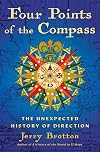
On December 7, 1972, the Apollo 17 takes the famous "Blue Marble Shot" of Earth, with the South Pole at the top. But you wouldn't know it now because NASA inverted the image to align it with the public's expectations of what is "up" and what is "down." Being that Earth is a metal layered globe, the cardinal directions are relative. East and West are culturally flexible and true North changes by about 15 km every year. Linguistically, the directions are "deictic" meaning that they shift show more according to a person's point of view. The U.S. identifies itself on an East-West axis, but Canada is North-South. If you are Inuit, living above 68° N, the Pole Star is impractical and unreliable. For the ancient Egyptians, Upper was south, and Lower was north due to the Nile's flow. Scientifically speaking, "there is no reason why North should necessarily sit at the top." After all, the world's first compass, invented by the Chinese, pointed South. Beginning with the East and ending with the West, Brotton attempts to answer the question of the dominant North.
While I took plenty of notes from this one, I don't think Brotton is quite successful here. It's no secret that the North is dominant due to European influence. But one either needs a timeline of colonization to explain that OR have a book of global fun facts about the cardinal directions instead. Brotton tries to do both, and the crowded structure of the book leads to a lot of back and forth. What's more, although Brotton criticizes the West, it is still the dominant perspective throughout the book. The cultural nuances of Chinese, Islamic, and Indigenous cosmology are lost as Brotton jumps from one to the other as needed. I even had to fact check a few. But Brotton's passion for maps certainly comes through. Their descriptions of famous maps and types were excellent! The book certainly makes you think and readjust your perspective! show less
While I took plenty of notes from this one, I don't think Brotton is quite successful here. It's no secret that the North is dominant due to European influence. But one either needs a timeline of colonization to explain that OR have a book of global fun facts about the cardinal directions instead. Brotton tries to do both, and the crowded structure of the book leads to a lot of back and forth. What's more, although Brotton criticizes the West, it is still the dominant perspective throughout the book. The cultural nuances of Chinese, Islamic, and Indigenous cosmology are lost as Brotton jumps from one to the other as needed. I even had to fact check a few. But Brotton's passion for maps certainly comes through. Their descriptions of famous maps and types were excellent! The book certainly makes you think and readjust your perspective! show less
This book doesn't exactly do what its title suggests it will, but it couldn't possibly do that anyway, so let's just set that aside as hyperbole. Brotton does offer profiles of important maps and atlases from Ptolemy to Google Earth, using each as a jumping-off point to explore an aspect of mapmaking as a social, political, religious, or technological exercise. it can be a bit dense, and better integration of the illustrations would have been helpful, but the text held my attention show more throughout and the book would likely be of interest to readers with a general interest in cartographic history. show less
This has a wealth of information and in some ways is fascinating, but it's also very dense. It reads more as a textbook than a pop tour of maps. So took a while to get through and occasionally felt like a bit of a trudge, but ultimately worth the effort. It made me feel sad that now we just use Google there won't be beautiful physical maps which capture a moment in time and history in the same way.
Maps serve two functions. They give you information—where people have been, places people have mapped, and the names given to those places. They also give you a destination, they let the heart roam over distant lands, and hope for an adventurous future. This information and hope have driven human history in more ways than we think. Beginning with a cuneiform clay tablet found in the site of the ancient city of Sippar in Babylonia, maps exist as an interesting window into how a civilization show more (or at least the mapmaker) views the world. In the 15th century, when the technology and means caught up to the desire to explore, the edges of the maps begin to be filled in and mankind got a truer picture of the world it inhabits. Jerry Brotton’s History of the World in Twelve Maps is a look at the world by investigating maps created at key points in history and what those maps say about the humans making them.
The twelve maps that Brotton uses range from Ptolemy’s map conceived around 150 CE up through the maps created by Google Earth. Each map encompasses a trait of the age. For instance, Gerard Mercator’s 1569 world map embodies the tolerance of Dutch explorers, the Cassini family’s 1793 map of France tells just as much about the nationalism at play as it does about the mapmaking of the day, and the Peters Projection of 1973 starts to incorporate the equality movement into cartography. There’s just as much history as there is geography in this book, and it’s a delightfully full book. Brotton’s inclusion of different projections, mapping methods, and illustrations is quite appreciated. Believe it or not, there are books on geography out there without maps, and they can be incredibly frustrating. Brotton’s research is pretty wide-ranging and inclusive, so you can easily move your way to other sources if you want to. All in all, this was a very good book with a ton of information. show less
The twelve maps that Brotton uses range from Ptolemy’s map conceived around 150 CE up through the maps created by Google Earth. Each map encompasses a trait of the age. For instance, Gerard Mercator’s 1569 world map embodies the tolerance of Dutch explorers, the Cassini family’s 1793 map of France tells just as much about the nationalism at play as it does about the mapmaking of the day, and the Peters Projection of 1973 starts to incorporate the equality movement into cartography. There’s just as much history as there is geography in this book, and it’s a delightfully full book. Brotton’s inclusion of different projections, mapping methods, and illustrations is quite appreciated. Believe it or not, there are books on geography out there without maps, and they can be incredibly frustrating. Brotton’s research is pretty wide-ranging and inclusive, so you can easily move your way to other sources if you want to. All in all, this was a very good book with a ton of information. show less
Lists
Travel (1)
Awards


You May Also Like


Associated Authors
Statistics
- Works
- 14
- Also by
- 3
- Members
- 2,876
- Popularity
- #8,907
- Rating
- 3.8
- Reviews
- 53
- ISBNs
- 73
- Languages
- 11
