

Lynne Truss
Author of Eats, Shoots & Leaves: The Zero Tolerance Approach to Punctuation
About the Author
Lynne Truss was born on May 31, 1955, in Kingston upon Thames, England. She is an English writer and journalist. Her book Eats, Shoots & Leaves: The Zero Tolerance Approach to Punctuation was a best-seller in 2003. Truss received a first-class honors degree in English Language and Literature from show more University College London in 1977. After graduation, she worked for the Radio Times as a sub-editor before moving to the Times Higher Education Supplement as the deputy literary editor in 1978. From 1986 to 1990, she was the literary editor of The Listener and was an arts and books reviewer for The Independent on Sunday before joining The Times in 1991. She currently reviews books for The Sunday Times. She has also written numerous books including Tennyson's Gift; Going Loco; Eats, Shoots and Leaves: The Zero Tolerance Approach to Punctuation; and Talk to the Hand: The Utter Bloody Rudeness of the World Today, or Six Good Reasons to Stay Home and Bolt the Door. (Bowker Author Biography) show less
Series
Works by Lynne Truss
Eats, Shoots & Leaves: The Zero Tolerance Approach to Punctuation (2003) — Author — 16,657 copies, 343 reviews
Associated Works
That's Not English: Britishisms, Americanisms, and What Our English Says About Us (2015) — Foreword — 181 copies, 27 reviews
Femmes de Siècle: Stories from the 90s - Women Writing at the End of Two Centuries (1992) — Contributor — 18 copies
Tagged
Common Knowledge
- Birthdate
- 1955-05-31
- Gender
- female
- Education
- The Tiffin Girls' School
University College London (BA - English Language and Literature, 1977)
Courtauld Institute of Art, University of London (Dipl. 2012) - Occupations
- literary editor
journalist - Organizations
- Radio Times
Times Higher Education
The Listener
The Independent
The Times
The Sunday Times (show all 7)
Women's Refuge Project - Awards and honors
- University of Brighton (Honorary Doctorate, 2005)
Royal Society of Literature (Fellow, 2005)
Detection Club (2021) - Agent
- Anthony Goff (David Higham Associates)
- Nationality
- UK
- Birthplace
- Kingston upon Thames, Surrey, England, UK
- Places of residence
- Petersham, Surrey, England, UK
Brighton, Sussex, England, UK
Bloomsbury, London, England, UK - Map Location
- England, UK
Members
Reviews
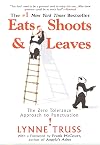
My Achilles heel as a writer has always been commas. I hate them! At the newspaper where I used to work at I once had an editor tell me to start putting commas in wherever I didn’t have them and to delete all the ones I’d already put in.
Truss’ funny little book is a great rundown of the importance of punctuation. She includes lots of great anecdotes about funny punctuation mistakes, but also really helpful tips. I’ve always been particularly annoyed when people write “it’s” show more and mean “its.” I’m sure many other writers have their own grammatical pet peeves and she touches on most of them.
One point Truss makes, which I really agree with, is the importance of maintaining correct grammar in the new mediums we use. If texting, email and blogging have become our main forms of written communication (more than books, newspaper and magazines) then we shouldn’t be lax in the way we write. The fact that our way of communicating is changing so rapidly puts a stronger importance in making sure that communication is the best that it can be.
BOTTOM LINE: An entertaining and informative look at punctuation. Pick it up if you share her disdain for a misplaced apostrophe. show less
Truss’ funny little book is a great rundown of the importance of punctuation. She includes lots of great anecdotes about funny punctuation mistakes, but also really helpful tips. I’ve always been particularly annoyed when people write “it’s” show more and mean “its.” I’m sure many other writers have their own grammatical pet peeves and she touches on most of them.
One point Truss makes, which I really agree with, is the importance of maintaining correct grammar in the new mediums we use. If texting, email and blogging have become our main forms of written communication (more than books, newspaper and magazines) then we shouldn’t be lax in the way we write. The fact that our way of communicating is changing so rapidly puts a stronger importance in making sure that communication is the best that it can be.
BOTTOM LINE: An entertaining and informative look at punctuation. Pick it up if you share her disdain for a misplaced apostrophe. show less
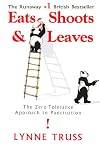
Eats, Shoots & Leaves is not your ordinary grammar book. Yes, it does contain examples of how to properly use a comma, a colon, and a semi-colon as well as how to properly use an apostrophe. But, if that's really all the reader is looking for, then I would advise buying another book that's more akin to a handbook.
What Lynne Truss does in this text is provide a wonderful historical perspective for how our punctuation marks came to be and how their usage was formed and has changed show more historically. In addition, Truss laments the state to which punctuation, and thus, writing skills have sunk over the last few decades. She offers us both this historical perspective on punctuation as well as her lament with great humor and aplomb.
Overall I would give the book 4 out of 5 stars. It doesn't quite reach the 5 star mark for me because I think that she fails to look at the internet and email as anything but a negative communication tool. Truss, especially in her last chapter, takes the Internet to task and comments that she agrees with Truman Capote, that what is done online is merely typing, not writing. In thus doing, she separates the cognitive act of writing from the act of pressing keys on a keyboard as if what qualifies as writing can only be done with pen or pencil. And in so doing, she fails to acknowledge the hundreds of studies in the field of Computers and Writing (a sub-discipline of English and Composition or Rhetoric and Composition) that examine the writing via computer and the profound pedagogical advances in computer-mediated communication.
While I appreciate Truss' call for us, as sticklers of punctuation and grammar, to "fight like tigers to preserve our punctuation", I think that she carries her derision of Internet based communications too far. show less
What Lynne Truss does in this text is provide a wonderful historical perspective for how our punctuation marks came to be and how their usage was formed and has changed show more historically. In addition, Truss laments the state to which punctuation, and thus, writing skills have sunk over the last few decades. She offers us both this historical perspective on punctuation as well as her lament with great humor and aplomb.
Overall I would give the book 4 out of 5 stars. It doesn't quite reach the 5 star mark for me because I think that she fails to look at the internet and email as anything but a negative communication tool. Truss, especially in her last chapter, takes the Internet to task and comments that she agrees with Truman Capote, that what is done online is merely typing, not writing. In thus doing, she separates the cognitive act of writing from the act of pressing keys on a keyboard as if what qualifies as writing can only be done with pen or pencil. And in so doing, she fails to acknowledge the hundreds of studies in the field of Computers and Writing (a sub-discipline of English and Composition or Rhetoric and Composition) that examine the writing via computer and the profound pedagogical advances in computer-mediated communication.
While I appreciate Truss' call for us, as sticklers of punctuation and grammar, to "fight like tigers to preserve our punctuation", I think that she carries her derision of Internet based communications too far. show less
Characters: The apostrophe, the comma, the semi-colon, the colon, the dash, and the hyphen
Plot: Of course, there is no plot. But there is plenty of passion as well as lots of laughs. I confess I am one of those people who was not at all intrigued by the glowing reviews of this little book, a book starring, after all, the apostrophe, the comma, the semi-colon, the colon, the dash, and the hyphen. How interesting could it be? Even though my mother was a true stickler who read every book with a show more pencil in hand, who corrected the text even in library books, and who, furthermore, sent letters to the authors about the mistakes she found, I have never been overly bothered by a lapsed comma or misplaced apostrophe. I correct it mentally, of course, like all normal people do, and then move on with my life. But this book is wonderful! It’s not just about punctuation: it’s about the history of punctuation; it’s full of anecdotes about George Bernard Shaw, James Thurber, George Orwell and others; it’s so totally British as well, having been left as Ms. Truss wrote it and not edited for us Yanks; and it’s hilariously informative, a combination not usually associated with books about punctuation. Pick this book up and read any page—and I do mean any page: from the dedication, the Acknowledgements, the Foreward, Publisher’s Note, Preface, and/or Introduction—and you will be hooked, entertained and informed in short order. show less
Plot: Of course, there is no plot. But there is plenty of passion as well as lots of laughs. I confess I am one of those people who was not at all intrigued by the glowing reviews of this little book, a book starring, after all, the apostrophe, the comma, the semi-colon, the colon, the dash, and the hyphen. How interesting could it be? Even though my mother was a true stickler who read every book with a show more pencil in hand, who corrected the text even in library books, and who, furthermore, sent letters to the authors about the mistakes she found, I have never been overly bothered by a lapsed comma or misplaced apostrophe. I correct it mentally, of course, like all normal people do, and then move on with my life. But this book is wonderful! It’s not just about punctuation: it’s about the history of punctuation; it’s full of anecdotes about George Bernard Shaw, James Thurber, George Orwell and others; it’s so totally British as well, having been left as Ms. Truss wrote it and not edited for us Yanks; and it’s hilariously informative, a combination not usually associated with books about punctuation. Pick this book up and read any page—and I do mean any page: from the dedication, the Acknowledgements, the Foreward, Publisher’s Note, Preface, and/or Introduction—and you will be hooked, entertained and informed in short order. show less
Talk to the Hand: The Utter Bloody Rudeness of the World Today, or Six Good Reasons to Stay Home and Bolt the Door by Lynne Truss
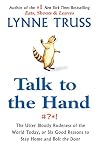
I blame myself. Or as author Lynne Truss would have it, I blame my Effing self. I should have been wise to the kind of book Talk to the Hand: #?*! The Utter Bloody Rudeness of the World Today, or Six Good Reasons to Stay Home and Bolt the Door would prove to be: the lament of the agéd against the young. But somehow I never even saw it coming.
Talk to the Hand rapidly degenerates into a diatribe against Generations X, Y and the Millenials.
In fairness, Truss can see her own crotchetiness — on rare occasion.
Actually, Truss’ observation is incorrect. When I was still in high school, my younger brother brought to my attention a lament about how the young were feckless, rude and disrespectful of their elders and betters. The writer bemoaning this new generation lived in Ancient Egypt.
People diagnosed with OCD know in their heads that they shouldn’t be washing their hands at every turn, but they can’t make themselves stop. But, as with someone with OCD, although Truss seems to know in her heart that every generation of senior citizens vilify the young, she can’t manage to make herself stop. If anything, she revs up the invective even more with each ensuing chapter.
In the chapter, “The First Good Reason: Was That so Hard to Say?,” Truss asks, “Should we get out more? Or is going out the problem, and we should actually stay in?” The answer is neither. Truss should instead read Judith Martin’s Miss Manners' Guide for the Turn-of-the-Millennium. Then she can be free to get out more — but not till then.
Naturally, I would never recommend Martin’s Star-Spangled Manners: In Which Miss Manners Defends American Etiquette to Miss Truss. After all, wouldn’t implying that American manners outclassed Truss’ own British ones be rude? show less
Talk to the Hand rapidly degenerates into a diatribe against Generations X, Y and the Millenials.
Point out bad manners to anyone younger thanshow more
thirty-five, and you risk a lash-back reflex response of shocking disproportion. “Excuse me, I think your child dropped with sweet wrapper.” “Why don’t you Eff Off, you fat cow,” comes the automatic reply. A man on a London bus recently told off a gang of boys, and was set on fire. Another was stabbed to death when he objected to someone throwing food at his girlfriend. How many of us dare to cry, “Get off that skateboard, you hooligan!” in such a moral climate?The problem here is that, as Judith Martin (a.k.a. “Miss Manners”) points out in her own etiquette guides, calling people out on their rude behavior is, in itself, rude. (There are other, more satisfactory and effective ways to protect one’s self from bad behavior.) But Truss never once acknowledges that ironic conundrum.
In fairness, Truss can see her own crotchetiness — on rare occasion.
If one takes the view that modern-day manners are superior to the cheerful spit-and-stamp of olden times, a paradox begins to emerge: while standards have been set ever higher, people have become all the more concerned that standards are actually dropping. Basically, people have been complaining about the state of manners since at least the fifteenth century.
Actually, Truss’ observation is incorrect. When I was still in high school, my younger brother brought to my attention a lament about how the young were feckless, rude and disrespectful of their elders and betters. The writer bemoaning this new generation lived in Ancient Egypt.
People diagnosed with OCD know in their heads that they shouldn’t be washing their hands at every turn, but they can’t make themselves stop. But, as with someone with OCD, although Truss seems to know in her heart that every generation of senior citizens vilify the young, she can’t manage to make herself stop. If anything, she revs up the invective even more with each ensuing chapter.
In the chapter, “The First Good Reason: Was That so Hard to Say?,” Truss asks, “Should we get out more? Or is going out the problem, and we should actually stay in?” The answer is neither. Truss should instead read Judith Martin’s Miss Manners' Guide for the Turn-of-the-Millennium. Then she can be free to get out more — but not till then.
Naturally, I would never recommend Martin’s Star-Spangled Manners: In Which Miss Manners Defends American Etiquette to Miss Truss. After all, wouldn’t implying that American manners outclassed Truss’ own British ones be rude? show less
Lists
Craft Books (1)
Unread books (1)
2000s decade (1)
Female Author (1)
Read (1)
Cats in Fiction (2)
Funny Books (1)
Non-Fiction (1)
Awards


You May Also Like


Associated Authors
Statistics
- Works
- 42
- Also by
- 11
- Members
- 24,201
- Popularity
- #866
- Rating
- 3.8
- Reviews
- 610
- ISBNs
- 262
- Languages
- 8
- Favorited
- 19


