
Lauren A. Mills
Author of The Rag Coat
About the Author
Series
Works by Lauren A. Mills
Associated Works
Once Around the Sun: Stories, Crafts, and Recipes to Celebrate the Sacred Earth Year (2022) — Illustrator — 18 copies
Flight Daily News Issue 3 Farnborough Day 3 — Designer — 1 copy
Tagged
Common Knowledge
- Birthdate
- 20th Century
- Gender
- female
- Education
- San Jose State University
- Relationships
- Nolan, Dennis (husband)
- Nationality
- USA
- Places of residence
- Connecticut, USA
Oregon, USA
Minnesota, USA
Massechusetts, USA - Associated Place (for map)
- USA
Members
Reviews

The daughter of an Appalachian coal miner, Minna had always wanted to go to school, but with her family too poor to afford a coat - they attended church wrapped up in burlap feed sacks and a quilt - and her mother needing her help at home, it seemed like that was a dream which could never come true. When her father can no longer work, because of "miner's cough," and eventually dies, the family is worse off than ever. But then one day, the women in her mother's quilting circle learn the show more reason that Minna does not attend school, and propose a solution: the creation of a most unusual coat, made with all their old scraps of material. Delighted, at first, with this "rag coat," Minna is subsequently dismayed at the ridicule from her classmates. Can she show them that her coat has significance, not just for her, but for all of them as well...?
Having greatly enjoyed Lauren Mills' Tatterhood and the Hobgoblins in the past, as well as the illustrations she did for Hans Christian Andersen's Thumbelina, I suspected I would enjoy this Appalachian tale as well, and I was not disappointed. Although the resolution of The Rag Coat might feel a little too easy, with all Minna's classmates realizing how wrong they were to tease her, I found the story very realistic in other respects, particularly as it concerns the father's illness and death. I was moved by Mills' tale, and think that children who have known what it is to do without, or to lose a parent, will find it a comforting reassurance that things will get better. The artwork, done in watercolor, is simply lovely, with a beautiful but muted palette, and an overall sensibility that felt very in keeping with the story! All in all, a delightful picture-book, one I would recommend to fans of this author/artist, to readers who appreciate tales set in Appalachia, and to children who have experienced want and loss. show less
Having greatly enjoyed Lauren Mills' Tatterhood and the Hobgoblins in the past, as well as the illustrations she did for Hans Christian Andersen's Thumbelina, I suspected I would enjoy this Appalachian tale as well, and I was not disappointed. Although the resolution of The Rag Coat might feel a little too easy, with all Minna's classmates realizing how wrong they were to tease her, I found the story very realistic in other respects, particularly as it concerns the father's illness and death. I was moved by Mills' tale, and think that children who have known what it is to do without, or to lose a parent, will find it a comforting reassurance that things will get better. The artwork, done in watercolor, is simply lovely, with a beautiful but muted palette, and an overall sensibility that felt very in keeping with the story! All in all, a delightful picture-book, one I would recommend to fans of this author/artist, to readers who appreciate tales set in Appalachia, and to children who have experienced want and loss. show less
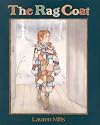
Minna is a child of poverty. Living in Appalachia, when her father dies as a result of working in the mines, life is even more difficult. Minna longs to attend school, but does not have a winter coat to protect her from the cold.
When her mother's friends from a quilting society, gather their unused scraps of material, a beautiful coat of many colors is sewn for Minna.
Happy to attend school, Minna discovers that her rag coat is an object for bullying. Trying to fit in, Minna turns the table show more and points to specific blocks of material which were sewn from her classmates objects.
This lovely illustrated book deals with difficult subjects of death, poverty and bullying. show less
When her mother's friends from a quilting society, gather their unused scraps of material, a beautiful coat of many colors is sewn for Minna.
Happy to attend school, Minna discovers that her rag coat is an object for bullying. Trying to fit in, Minna turns the table show more and points to specific blocks of material which were sewn from her classmates objects.
This lovely illustrated book deals with difficult subjects of death, poverty and bullying. show less
This traditional fairytale was a very cute, imaginative story about finding your own happiness. The descriptions were creative and thorough. I could see a little girl sleeping in a walnut shell with a rose petal for a blanket without the illustrations. One aspect I found lacking was the use of dialogue. The main character hardly spoke while the other characters in the story did most of the conversing. The author does tell what Thumbelina was thinking. I also thought the story had very old show more ideals, like being told who to marry. The characters in the story treated Thumbelina as an object and they all wanted to marry her at first sight. Thumbelina also was not independent and relied on everyone else to help her. This is unrealistic by today’s standards and is not a good message for young girls. Overall, I thought the story was cute but had no valuable lesson besides finding happiness. show less

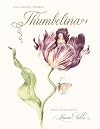
Thumbelina, illustrated by Lauren Mills.
Influenced by folktales such as Tom Thumb, as well as the fantasies of Jonathan Swift and E.T.A. Hoffman, Hans Christian Andersen's Thumbelina ("Tommelise" in the original Danish) follows the adventures of its diminutive heroine, from her birth in a tulip-like flower, through her almost-marriage to a string of unsuitable "suitors," to her eventual meeting with the perfect mate. An adventure-story with great appeal for readers who like tales of "little show more people," it has been retold many times.
This edition, adapted and illustrated by Lauren Mills - whose gorgeous artwork can also be seen in the Norwegian folktale, Tatterhood and the Hobgoblins, and Jane Yolen's Elfabet: An ABC of Elves - is probably my favorite, from a visual standpoint. Mills' beautiful watercolor illustrations emphasize Thumbelina's delicate, ethereal beauty, while also capturing the cozy appeal of the mouse's home, and the wonder of the sparrow in flight. I can't say that I was as fond of Mills' adaptation of the narrative - apparently intended to give Thumbelina more agency - as the changes made don't seem to add anything to the story. What is the point, for instance, of having Thumbelina's mother consult the old witch a second time, to discuss her fears of her tiny daughter "leaving the nest?" Still, what changers there were, were minor enough that they didn't detract from the overall appeal. All in all, a beautiful edition of this tale! show less
Influenced by folktales such as Tom Thumb, as well as the fantasies of Jonathan Swift and E.T.A. Hoffman, Hans Christian Andersen's Thumbelina ("Tommelise" in the original Danish) follows the adventures of its diminutive heroine, from her birth in a tulip-like flower, through her almost-marriage to a string of unsuitable "suitors," to her eventual meeting with the perfect mate. An adventure-story with great appeal for readers who like tales of "little show more people," it has been retold many times.
This edition, adapted and illustrated by Lauren Mills - whose gorgeous artwork can also be seen in the Norwegian folktale, Tatterhood and the Hobgoblins, and Jane Yolen's Elfabet: An ABC of Elves - is probably my favorite, from a visual standpoint. Mills' beautiful watercolor illustrations emphasize Thumbelina's delicate, ethereal beauty, while also capturing the cozy appeal of the mouse's home, and the wonder of the sparrow in flight. I can't say that I was as fond of Mills' adaptation of the narrative - apparently intended to give Thumbelina more agency - as the changes made don't seem to add anything to the story. What is the point, for instance, of having Thumbelina's mother consult the old witch a second time, to discuss her fears of her tiny daughter "leaving the nest?" Still, what changers there were, were minor enough that they didn't detract from the overall appeal. All in all, a beautiful edition of this tale! show less
Lists
Awards


You May Also Like


Associated Authors
Statistics
- Works
- 11
- Also by
- 7
- Members
- 1,561
- Popularity
- #16,516
- Rating
- 4.3
- Reviews
- 31
- ISBNs
- 25
- Languages
- 1
- Favorited
- 1