
Mary Rowlandson (–1711)
Author of A Narrative of the Captivity and Restoration of Mrs. Mary Rowlandson
About the Author
Works by Mary Rowlandson
The Account of Mary Rowlandson and Other Indian Captivity Narratives (Dover Books on Americana) (2005) 58 copies, 1 review
Captive, the 1 copy
Associated Works
The Heath Anthology of American Literature, Volume 1 (1990) — Contributor, some editions — 252 copies, 1 review
Colonial American Travel Narratives (Penguin Classics) (1994) — Author, some editions — 137 copies, 3 reviews
The Broadview Anthology of Seventeenth Century Verse & Prose (2000) — Contributor, some editions — 77 copies
The Heath Anthology of American Literature, Concise Edition (2003) — Contributor — 72 copies, 1 review
American Literature: The Makers and the Making (In Two Volumes) (1973) — Contributor, some editions — 24 copies
Captives among the Indians: first-hand narratives of Indian wars, customs, tortures, and habits of life in colonial times (1915) — some editions — 1 copy
Tagged
Common Knowledge
- Other names
- White, Mary
Rowlandson, Mary White - Birthdate
- c. 1635
- Date of death
- 1711-01-05
- Gender
- female
- Occupations
- memoirist
colonist - Relationships
- Rowlandson, Joseph (husband)
Talcott, Samuel (husband)
White, John (father) - Short biography
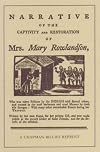
- Mary Rowlandson, née White, was born in Somerset, England and emigrated as a child with her family to the American colonies before 1650. They settled in the Massachusetts Bay Colony, first in Salem and then in 1653, moved to the frontier village of Lancaster. In 1656, she married Joseph Rowlandson, who became a Puritan minister; the couple had four children before 1669. On February 10, 1675, during King Philip's War, the settlement was attacked by native Americans, who killed 13 people and took at least 24 captive, including Mary Rowlandson and her three children, Joseph, Mary, and Sarah. Sarah, the youngest, age 6, died a week later. Mary and her surviving children were forced to accompany their captors on a grueling journey, suffering great hardships, through the wilderness for nearly three months. They were finally ransomed in May 1676. After her first husband died, Mary moved to Boston, where she is believed to have written her memoir, The Sovereignty and Goodness of God: The Narrative of the Captivity and Restoration of Mrs. Mary Rowlandson, published in 1682 in Cambridge, Massachusetts and in London. The book quickly became a bestseller -- perhaps the first in American history -- and selections from it have been included in countless anthologies of American literature. It also served as a source of information for 18th and 19th-century writers such as James Fenimore Cooper.
- Nationality
- England (birth)
USA - Birthplace
- Somersetshire, England
- Places of residence
- Salem, Massachusetts, USA
Lancaster, Massachusetts, USA
Wethersfield, Connecticut, USA
Boston, Massachusetts, USA - Place of death
- Massachusetts Bay Colony, USA
- Associated Place (for map)
- USA
Members
Reviews
Look, I appreciate no-one likes the puritans, and Mary would've been better off leaving these out if she was working to create an enduring work of literature. But she wasn't aiming to be Cervantes. This book is as much interesting for its historical context as for its narrative style. What Mrs. Rowlandson's narrative tells us is aided by her point of view, even if it is at times disagreeable, because we gain valuable insight into the views of the Puritans as well as telling insights into show more life amongst the natives. It makes the work more complex, as we view history through a certain tint, don't it? show less

Mary Rowlandson's account of her captivity among American Indians in New England in 1675 is both brutal and sympathetic. The Indians are portrayed as wild killers and slave owners, yet display moments of affection and kindness. One can see they are fighting for their lives, identity and way of life as they set out to kill the English in such numbers to drive them back into the sea. But it becomes clear the English are too many and despite victories in battle, there is an underlying show more desperation as the Indians stay on the run. Mary's memoir was among the first of the "captivity narrative" genre; and is an important historical document for her portraits of early American Indian life.
Listened to via LibriVox as read by Matthew Scott Surprenant. Clearly an amateur recording and difficult to follow at times as Matthew speeds too quickly through the words in places (pauses are good), but overall a strangely captivating reading style for the subject. show less
Listened to via LibriVox as read by Matthew Scott Surprenant. Clearly an amateur recording and difficult to follow at times as Matthew speeds too quickly through the words in places (pauses are good), but overall a strangely captivating reading style for the subject. show less
Mary’s story is one misery yet hope. Mary was captured by Native Americans in an attack on a small Massachusetts town during want we call King Philip’s War.” The more I read about this “unremembered” war the more interesting it becomes. I recommend first reading one of the many books on the history of this time period and then read Mary’s account. It will help you to better understand what some of her references refer to.
Yeah......this was not an exciting read. It is very detailed, and relatively dispassionate. She discusses food a LOT (I'm sure it was a very salient concern in her captivity). Lots of scripture, though I'm intrigued by Jason's idea of her carrying her culture with her through these various removes, and using the bible and Christianity as a light in the darkness she was experiencing at the time having been captured and held in a strange culture as a slave against her will.
And it is perfectly show more within the purview of my approach to "literature" to study this, which might more often be labeled as a "captivity narrative," or a primary historical source. But decisions get made when composing these kinds of texts that we tend to think about as non-fiction, or history. There are many choices in here about how to represent and present her experience and the people she discusses. Doesn't make it thrilling, though it might improve if I actually do work on it. show less
And it is perfectly show more within the purview of my approach to "literature" to study this, which might more often be labeled as a "captivity narrative," or a primary historical source. But decisions get made when composing these kinds of texts that we tend to think about as non-fiction, or history. There are many choices in here about how to represent and present her experience and the people she discusses. Doesn't make it thrilling, though it might improve if I actually do work on it. show less
Lists
You May Also Like


Associated Authors
Statistics
- Works
- 5
- Also by
- 10
- Members
- 596
- Popularity
- #42,150
- Rating
- 3.3
- Reviews
- 14
- ISBNs
- 69
- Languages
- 2
- Favorited
- 2