
Shirley McKay
Author of Hue and Cry
About the Author
Image credit: Shirley McKay, author of "Fate and Fortune" and "Hue and Cry"
Series
Works by Shirley McKay
Tagged
Common Knowledge
- Canonical name
- McKay, Shirley
- Gender
- female
- Education
- University of St Andrews
Durham University - Occupations
- novelist
proofreader - Nationality
- UK
- Birthplace
- Tynemouth, Tyne and Wear, England, UK
- Places of residence
- Fife, Scotland, UK
- Associated Place (for map)
- UK
Members
Reviews
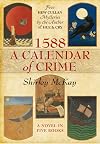
Shirley McKay - 1588 A Calendar of Crime.
Latest in the Hew Cullan series of mysteries.
This is a lighter read than the crime I normally go for and I thoroughly enjoyed the change of mood. This book is a perfect fit for the lengthening chilly evenings and an ideal Christmas present for fans of historical murder mysteries.
'1588', is set in the year of the Armada, which forms some of the background to the stories, it is one of the themes that links the five stories here contained. The calendar show more is significant because the people of the time lived by the seasons and the stories are linked in the form of an almanac. It is this that gives the stories a loose feel of a novel although each of the tales have been published as individual e-Stories and can be read as such. This edition, elegantly presented for a standard hardback comes with a glossary of words and historical notes that provides a light guide to the background to the stories for those who want to learn more.
The crimes/tales are well crafted and entertaining. The stories themselves cover the death of a candle maker, Spanish ghosts, love as a destructive and redemptive force, false crimes, and personal peril for Hew Cullan.
I thoroughly enjoyed '1588 A Calendar of Crime'. McKay is well versed in the history of the time; the superstition and beliefs, the emerging scientific knowledge, the cyclical nature of life. She is also comfortable with her characters and these two things have enabled her to concentrate on bringing a fresh edge and invention to the stories here told. There are also little twists on the familiar that work well. I liked the Scottish burr and McKay's light way with the old language just enough to place the novel properly in its setting. There are some darker moments, after all these were perilous times, but I was more struck by the playful and witty tone that deftly underpins the stories. Some of the encounters between characters, their banter, misunderstandings and situations that arise made me smile, (McKay created a light air of farce in one or two places).
I didn't feel that not having read any of the previous Hew Cullan novels was a hindrance to enjoying this book, and I would not be averse to picking one up in the future if I was in the right mood. As good as Ellis Peters, Candace Robb, Paul Doherty for me. show less
Latest in the Hew Cullan series of mysteries.
This is a lighter read than the crime I normally go for and I thoroughly enjoyed the change of mood. This book is a perfect fit for the lengthening chilly evenings and an ideal Christmas present for fans of historical murder mysteries.
'1588', is set in the year of the Armada, which forms some of the background to the stories, it is one of the themes that links the five stories here contained. The calendar show more is significant because the people of the time lived by the seasons and the stories are linked in the form of an almanac. It is this that gives the stories a loose feel of a novel although each of the tales have been published as individual e-Stories and can be read as such. This edition, elegantly presented for a standard hardback comes with a glossary of words and historical notes that provides a light guide to the background to the stories for those who want to learn more.
The crimes/tales are well crafted and entertaining. The stories themselves cover the death of a candle maker, Spanish ghosts, love as a destructive and redemptive force, false crimes, and personal peril for Hew Cullan.
I thoroughly enjoyed '1588 A Calendar of Crime'. McKay is well versed in the history of the time; the superstition and beliefs, the emerging scientific knowledge, the cyclical nature of life. She is also comfortable with her characters and these two things have enabled her to concentrate on bringing a fresh edge and invention to the stories here told. There are also little twists on the familiar that work well. I liked the Scottish burr and McKay's light way with the old language just enough to place the novel properly in its setting. There are some darker moments, after all these were perilous times, but I was more struck by the playful and witty tone that deftly underpins the stories. Some of the encounters between characters, their banter, misunderstandings and situations that arise made me smile, (McKay created a light air of farce in one or two places).
I didn't feel that not having read any of the previous Hew Cullan novels was a hindrance to enjoying this book, and I would not be averse to picking one up in the future if I was in the right mood. As good as Ellis Peters, Candace Robb, Paul Doherty for me. show less
Inescapably I thought of the Matthew Shardlake mystery I read last year – lured by what I’d heard of its dirty streets of 16th century England, C.J. Sansom’s sensory evocation of setting. Here I am in 16th century Scotland, in a novel written first to evoke time and place, with a gritty detailed realism, that stands your hair on end. I’ll go on with my Shardlakes but I found this one even more effective, and Hew Cullan has jumped the queue.
The writing is a joy. I notice in the show more author biography she did postgrad study in seventeenth-century prose; she knows how to write the sixteenth century into her sentences – without being difficult, but with an authenticity achieved. She does a shifting point-of-view that textures the novel, that makes people come alive – she enters their consciousness, and when they’re in an extreme experience, her impressionistic writing can get it across. It’s like a milder dose of what Robert Low did in The Lion Wakes (also very Scottish). In short I’ll read anything written like this, mystery or whatever.
I found the story strong. Who did what just isn’t what matters; I’m a bad guesser at mysteries and didn’t foresee much; it was a story about the university, and the kirk, and the society of St Andrews; and it was well-ended. Ends are hard to do. When I say it’s toe-curling – I had a real sense of horror, the more so because she can be understated – it’s not one of those ‘nasty, brutish and short’ books, but about a struggling humanity. Hew is too humane for his profession of the law. Can he and his friends save society’s victims? That is the question. show less
The writing is a joy. I notice in the show more author biography she did postgrad study in seventeenth-century prose; she knows how to write the sixteenth century into her sentences – without being difficult, but with an authenticity achieved. She does a shifting point-of-view that textures the novel, that makes people come alive – she enters their consciousness, and when they’re in an extreme experience, her impressionistic writing can get it across. It’s like a milder dose of what Robert Low did in The Lion Wakes (also very Scottish). In short I’ll read anything written like this, mystery or whatever.
I found the story strong. Who did what just isn’t what matters; I’m a bad guesser at mysteries and didn’t foresee much; it was a story about the university, and the kirk, and the society of St Andrews; and it was well-ended. Ends are hard to do. When I say it’s toe-curling – I had a real sense of horror, the more so because she can be understated – it’s not one of those ‘nasty, brutish and short’ books, but about a struggling humanity. Hew is too humane for his profession of the law. Can he and his friends save society’s victims? That is the question. show less
Thought I'd reviewed this! Excellent as ever - love the hero and his best friend and sister, and I find the setting subtly researched and convincing. The venture in to the Low Countries added a nice edge.
Having already purchased a mystery featuring 16th-century lawyer Hew Cullan based in St. Andrews, Scotland, I decided to meet him for the first time in this novella. This didn't turn out to be one of my better impulses because I walked right into the middle of a story in which everyone else was well-acquainted with Hew and I was not. This put me at somewhat of a disadvantage, but I still enjoyed the slice-of-life historical aspects of the story. I did feel as though I were walking the show more streets of St. Andrews in 1588, and I did enjoy trying to deduce what happened to the missing Elspet. The vernacular that McKay uses in her dialogue was a bit confusing from time to time, but the author does include a glossary in the back which helped a great deal.
Will I be meeting Hew Cullan again in the future? Yes, I do believe I will. show less
Will I be meeting Hew Cullan again in the future? Yes, I do believe I will. show less
You May Also Like


Statistics
- Works
- 12
- Members
- 268
- Popularity
- #86,165
- Rating
- 3.5
- Reviews
- 8
- ISBNs
- 32