
George Sarton (1884–1956)
Author of Ancient Science through the Golden Age of Greece
About the Author
George Sarton is generally considered the founder of the history of science as a scholarly discipline. He studied chemistry, celestial mechanics, and mathematics at the University of Ghent, where he earned a Ph.D. in mathematics (1911). In 1912, while still a resident of his native Belgium, he show more founded Isis, a "review dedicated to the history of science." Sarton immigrated to the United States in 1915, assuming a research position in the Widener Library at Harvard University in 1916. He remained at Harvard for the rest of his life, becoming a lecturer in 1920 and founding the History of Science Society in 1924. In 1940 Sarton was appointed professor of the history of science. Sarton also established the new discipline by example, writing more than 300 books, articles, and essays on ancient and medieval science; on early historians of the exact sciences, such as Jean Etienne Montucla (1725--99); and on the development of physics in the twentieth century. He nurtured his encyclopedic approach to the history of science, which he coupled to a broad vision of its potential contribution to what he called the "New Humanism," by editing Isis for almost four decades and compiling nearly 80 critical bibliographies. In published lectures and guides to the history of science, such as his Study of the History of Science (1936) and Guide to the History of Science (1952), as well as the editorial work for Isis, Sarton defined this emerging discipline while actively promoting teaching and research. (Bowker Author Biography) show less
Series
Works by George Sarton
Associated Works
Near Eastern Culture and Society: A Symposium on the Meeting of East and West (2017) — Contributor — 18 copies
Tagged
Common Knowledge
- Canonical name
- Sarton, George
- Legal name
- Sarton, George Alfred Leon
- Birthdate
- 1884-08-31
- Date of death
- 1956-03-22
- Gender
- male
- Education
- University of Ghent (Ph.D|1911)
- Occupations
- chemist
historian - Organizations
- Harvard University
History of Science Society - Awards and honors
- Prix Binoux (1915)
American Academy of Arts & Sciences (1927)
American Philosophical Society (1934)
George Sarton Medal (named in his honor) - Relationships
- Sarton, May (daughter)
- Nationality
- Belgium
USA - Birthplace
- Ghent, Belgium
- Places of residence
- Belgium
England, UK
USA - Place of death
- Cambridge, Massachusetts, USA
Members
Reviews
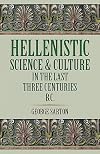
The author of this book discusses hellenistic science and literary culture with an incredibly broad scope. That includes science, history, medicine, literature, philosophy, mathematics, poetry etc., so it's presumably as complete as any book will ever be on that score. Another good thing about this book is that the author on many occasions traces the development of specific traditions from the hellenistic age to the european renaissance, a very useful exercise for students of european show more science. He also frequently offers useful reminders of how many hellenistic works have been lost and how fragmentary our knowledge of hellenistic learning consequently is. The bibliography is also valuable, but it is of course outdated since it's an old book.
But the problem with this book is that it's almost like an encyclopedia. The author has chosen to concentrate on the individuals who wrote science and literature. This means that he presents great amounts of biographical details and discusses selected works in depth. But he says almost nothing about the political and institutional context of hellenistic learning except for brief sections on the library in Alexandria and Roman libraries.
Perhaps this point of criticism is a bit anachronistic since social history and the study of "ideas in context" didn't really exist in 1955 when this book was written. It may also be difficult to make broad generalizations about hellenistic science and literature with any confidence. But even so I was a bit disappointed to find that this book lacks a general overview perspective. If that's what you are looking for, I would instead recommend Green's Alexander to Actium which contains good chapters on hellenistic science and philosophy. show less
But the problem with this book is that it's almost like an encyclopedia. The author has chosen to concentrate on the individuals who wrote science and literature. This means that he presents great amounts of biographical details and discusses selected works in depth. But he says almost nothing about the political and institutional context of hellenistic learning except for brief sections on the library in Alexandria and Roman libraries.
Perhaps this point of criticism is a bit anachronistic since social history and the study of "ideas in context" didn't really exist in 1955 when this book was written. It may also be difficult to make broad generalizations about hellenistic science and literature with any confidence. But even so I was a bit disappointed to find that this book lacks a general overview perspective. If that's what you are looking for, I would instead recommend Green's Alexander to Actium which contains good chapters on hellenistic science and philosophy. show less
A History of Science: Hellenistic Science and Culture in the Last Three Centuries b.c. by George Sarton
Sartons Buch ‚A History of Science‘ begibt sich auf eine weite Reise zurück in die Vergangenheit, aus der wir mit einem reichen Bestand an Wissenselementen zurückkehren. Es zeichnet sich nicht zuletzt durch den eloquenten Stil seines Autors aus. Dass man sich beim Lesen oft zu verlieren scheint in der Aufzählung von Namen, Werken, Daten oder Orten mag die große Meisterschaft, die der Autor hier mit der Wissenschaftsgeschichte ausficht, kaum schmälern. Jeder, der sich mit der show more Geschichte der Wissenschaften auch nur am Rande beschäftigen will, sollte dieses Buch gelesen haben. show less
You May Also Like


Associated Authors
Statistics
- Works
- 34
- Also by
- 1
- Members
- 548
- Popularity
- #45,523
- Rating
- 3.7
- Reviews
- 3
- ISBNs
- 31
- Languages
- 2