
American Heritage
Author of The American Heritage College Dictionary
About the Author
Series
Works by American Heritage
A Sense of History: The Best Writing from the Pages of American Heritage (1985) 492 copies, 4 reviews
The American Heritage Cookbook and Illustrated History of American Eating & Drinking (1964) 298 copies, 4 reviews
American Heritage 30 copies
The American Heritage Pictorial History of the Presidents of the United States, Volume 2 (1968) 28 copies
The American Heritage History of Flight 15 copies
AH New Pictorial Encyclopedic Guide to the US: 03 Connecticut, Delaware, Florida, Georgia (1965) 10 copies
The American Heritage Cookbook and Illustrated History of American Eating & Drinking Part 2 (1964) 9 copies, 1 review
The American Heritage Cookbook and Illustrated History of American Eating & Drinking Part 1 9 copies
Inventing America: Twenty-Six of the Best Articles from American Heritage of Invention and Technology (1995) 7 copies, 2 reviews
AH New Pictorial Encyclopedic Guide to the US: 07 Massachusetts, Michigan, Minnesota (1965) 7 copies
AH New Pictorial Encyclopedic Guide to the US: 08 Mississippi, Missouri, Montana, Nebraska (1965) 6 copies
The American Heritage Dictionary of the English Language, Third Edition (August 20, 1992) Hardcover (1602) 5 copies
AH New Pictorial Encyclopedic Guide to the US: 15 Washington, West Virginia, Wisconsin (1965) 5 copies
American Heritage 40-Year Cumulative Index/Volume 6, No 1-Volume 45, No 8 December 1954-December 1994 (1995) 5 copies
American heritage five year cumulative index : vol. XVI, no. 1 - vol. XX, no. 6; December 1964 - October 1969 (1969) 4 copies
The American Heritage: History of Flight, History of the Great West, Book of Natural Wonders (Set of 3 Books with Slipcases) (1965) 4 copies
American Heritage New Pictorial Encyclopedic Guide to the United States, Vol. 1: Alabama Through Nebraska (1965) 4 copies
American Heritage New Pictorial Encyclopedic Guide to the United States VOL. 2 Nevada Through Wyoming (1965) 4 copies
American heritage 5-year cumulative index : vol. VI, no. 1- vol. X, no. 6, December 1954-December 1959 (1959) 3 copies
Railroads in the Days of Steam 3 copies
AH New Pictorial Encyclopedic Guide to the US: 16 Wyoming, Washington, D.C., Puerto Rico, Territories (1965) 3 copies
AH New Pictorial Encyclopedic Guide to the US: 10 New York, North Carolina, North Dakota (1965) 3 copies
Civil War chronicles 3 copies
AH New Pictorial Encyclopedic Guide to the US: 09 Nevada, New Hampshire, New Jersey, New Mexico (1965) 3 copies
AH New Pictorial Encyclopedic Guide to the US: 12 Pennsylvania, Rhode Island, South Carolina (1965) 3 copies
Lexington, Concord and Bunker Hill 2 copies
The american héritage dictionary 2 copies
Picture history of the Civil War 2 copies
English As A Second Language Idioms Dictionary and English As A Second Language Dictionary Workbook (2001) 2 copies
The Essential American Heritage Dictionary (American Heritage Dictionary of the English Language) (2011) 2 copies
English As A Second Language Idiom Dictionary and Workbook and American Heritage Tlk CD-ROM (2001) 2 copies
AMERICAN HERITAGE COOKBOOK COOK BOOK 2 copies
The First Year of American Heritage. Volume 4, Numbers 1-6. December 1954-October 1955 (1958) 2 copies
The American Revolution 2 copies
American Heritage, Vol III 2 copies
Trappers and Mountain Men 1 copy
"The Mississippi Bubble," 1 copy
American Heritage: Vol. XII, No. 5, August 1961: Side Wheels and Walking Beams Bard Brothers article 1 copy
The Battle OF yORKTOWN 1 copy
"Frontier Photographer," 1 copy
Holiday Heritage 1 copy
THE AMERICAN HERITAGE HISTORY OF AMERICANANTIQUES, ANTIQUES, COLONIAL ANTIQUES (THREE VOLUME SET IN SLIPCASE) (1968) 1 copy
"Southwest Trail," 1 copy
The New Roget's Thesaurus (Student Edition) by American Heritage Editors (1990) Mass Market Paperback (1972) 1 copy
American Heritage New Pictorial Encyclopedic Guide to the United States Volume 2: Arkansas California Colorado (1965) 1 copy
AHG in the Catholic Church 1 copy
Light of the Past, The : A Treasury of Horizon — Author — 1 copy
The French and Indian Wars 1 copy
Clipper ships and captains 1 copy
American Heritage BOUND 1 copy
The Civil War 1 copy
RFK His Life and Death 1 copy
Horizon Bedside Reader 1 copy
Vietnam era 1 copy
Indians and the Old West 1 copy
American Antiques 1 copy
Book of Indians 1 copy
Colonial America 1 copy
History of Colonial America 1 copy
New World, The 1 copy
Revolution, The 1 copy
Roget’s Thesaurus 1 copy
Amrican Heritage: October 1957 (Vol. VIII, No. 6) / December 1957 (Vol. IX, No. 1) / April 1958 (Vol. IX, No. 3) / June 1958 (Vol. IX, No. 4) 1 copy, 1 review
Roget II 1 copy
Carrier War in the Pacific 1 copy
Tagged
Common Knowledge
Members
Reviews
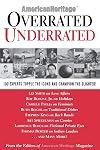
Overrated / Underrated by the editors of the American Heritage Magazine seems to me to be a monumental achievement. They took 100 topics/categories such as "Automobile", or "Generation", or "Sports Moment" and then teamed a writer with some expertise in the matter and had him, or her, come up with an "Overrated" and "Underrated" event, person, device or happening.
While I certainly did not agree with every dissertation, there were few subjects that were not interesting, and I did learn quite show more a bit. For instance who knew that Amelia Earhart was recruited (and later married) by publisher George Palmer Putnam in hopes of making her the female flipside of Charles Lindbergh? Odd how both aviators suffered such immense losses.
As a matter of fact this book could easily be made into a game. For instance when your relatives for Thanksgiving or Christmas over-stay their welcome, you might bring out this book and, spying your uncle (who is and has been the owner of several Chevrolet Corvettes) approach him with, "Hey, uncle Bob, it says here in my Overrated/Underrated book that the Corvette is the most overrated car ever." And then stand back, so he can take a look in the book at the most underrated car, for he will surely stroke-out and hit the floor (as I did) and then, hopefully, the paramedics will take him and his family away.
I'm certain countless editions of Overrated/Underrated were used as bathroom companions, as most comparisons cover only two opposing pages with large font that can easily be read in the time it takes to ... do it. Apparently it did not sell well, and this could be due to all the photos inside being grainy black and whites in this day of at least 256 colors available everywhere.
Yes this is an excellent book for the library with the ivory throne and for picking up on facts that you missed in high school because you were trying to look up Terri Seymour's skirt in geometry class once made curious about triangles. It's also good for many of us, who don't get out much, because it exposes us to ideas and opinions often time contrary to our own and our friends. show less
While I certainly did not agree with every dissertation, there were few subjects that were not interesting, and I did learn quite show more a bit. For instance who knew that Amelia Earhart was recruited (and later married) by publisher George Palmer Putnam in hopes of making her the female flipside of Charles Lindbergh? Odd how both aviators suffered such immense losses.
As a matter of fact this book could easily be made into a game. For instance when your relatives for Thanksgiving or Christmas over-stay their welcome, you might bring out this book and, spying your uncle (who is and has been the owner of several Chevrolet Corvettes) approach him with, "Hey, uncle Bob, it says here in my Overrated/Underrated book that the Corvette is the most overrated car ever." And then stand back, so he can take a look in the book at the most underrated car, for he will surely stroke-out and hit the floor (as I did) and then, hopefully, the paramedics will take him and his family away.
I'm certain countless editions of Overrated/Underrated were used as bathroom companions, as most comparisons cover only two opposing pages with large font that can easily be read in the time it takes to ... do it. Apparently it did not sell well, and this could be due to all the photos inside being grainy black and whites in this day of at least 256 colors available everywhere.
Yes this is an excellent book for the library with the ivory throne and for picking up on facts that you missed in high school because you were trying to look up Terri Seymour's skirt in geometry class once made curious about triangles. It's also good for many of us, who don't get out much, because it exposes us to ideas and opinions often time contrary to our own and our friends. show less
I admit to struggling between "effect" and "affect" ....so I bought the book (Or at least the kindle version) ,,,,,,and I'm not disappointed. I guess that I had few problems with about 80 percent of the entries but about five percent were quite troublesome and the authors have done a good job of clarifying the usage. On e of the things that I found especially interesting was their usage of panels to judge whether changing usage meant that some phrasing was now acceptable whereas it might not show more have been acceptable 20 years ago,
I've extracted a few of the gems that stood out for me. Hopefully, they will serve a memory joggers for me about correct usage. I was frankly expecting more differences between this American English and Australian English but I actually detected few differences. .......Maybe with something like the pronunciation of a word like "nuclear" but, as the editors point out....the pronunciation varies within America itself. Here's a few of the extracts:
According to a traditional rule, one persuades someone to act but convinces someone of the truth of a statement or proposition: By convincing me that no good could come of staying, he persuaded me to leave. If the distinction is accepted, then convince should not be used with an infinitive: He persuaded (not convinced) me to go. In a 1981 Usage Panel survey, 61 percent rejected the use of convince with an infinitive. But the tide of sentiment against the
construction appears to be turning. In a 1996 survey, 74 percent accepted it in the sentence I tried to convince him to chip in a few dollars, but he refused. Even in passive constructions, a majority of the Usage Panel accepted convince with an infinitive.
Because they are pronounced the same way, discreet and discrete are sometimes confused in print. Discreet means “prudent in speech and behavior”: He told me the news but asked me to be discreet about it. The related word discrete means “separate, distinct”: The summer science program consists of four discrete units.
The words affect and effect are often confused, in no small part because they often sound the same. What’s worse, two different words are spelled affect. One is solely a verb and means “to put on a false show of,” as in The actor affected a British accent. The other can be both a noun and a verb. The noun meaning “emotion” is a technical term from psychology that sometimes shows up in general writing, as in the quote “The soldiers seen on television had been carefully chosen for blandness of affect” written by Norman Mailer in a piece about the Gulf War. In its far more common role as a verb, affect usually means “to influence,” as in The Surgeon General’s report outlined how much smoking affects health. Effect can also serve as a noun or a verb. The noun means “a result.” Thus, if you affect something, you are likely to see an effect of some kind, and from this may arise further the confusion. As a verb, effect means “to bring about or execute.” Thus, using effect in the sentence These measures may effect savings implies that the measures will cause new savings to come about. But using affect in the very similar sentence These measures may affect savings could just as easily imply that the measures may reduce savings that have already been realized.
Flaunt as a transitive verb means “to exhibit ostentatiously”: She flaunted her wealth. To flout is “to show contempt for something by disregarding it”: Some people at the reception flouted convention by wearing sneakers. For some time now flaunt has been used in the sense “to show contempt for,” even by educated users of English. But this usage is still widely seen as erroneous. In our 2009 survey, 73 percent of the Usage Panel rejected it in the sentence This is just another example of an executive flaunting the rules for personal gain.
Assure, ensure, and insure all mean “to make secure or certain.” Only assure is used with reference to a person in the sense of “to set the mind at rest”: The ambassador assured the Prime Minister of his loyalty. Although ensure and insure are generally interchangeable, only insure is now widely used in American English in the commercial sense of “to guarantee persons or property against risk.”
The possessive form of it. Used as a modifier before a noun: The airline canceled its early flight to New York.
Its is the possessive form of the pronoun it and is correctly written without an apostrophe: The kitten licked its paws. It should not be confused with the contraction it’s (for it is or it has), which should always have an apostrophe: It’s snowing outside. It’s been years since I’ve visited Chicago.
Kudos is one of those words like congeries that look like plurals but are etymologically singular. Acknowledging the Greek history of the term requires Kudos is (not are) due her for her brilliant work on the score. The singular kudo remains far less common than the plural use; both are often viewed as incorrect in more formal contexts.
Etymology would require that the final consonant be pronounced as a voiceless (s), as we do in pathos, another word derived from Greek, rather than as a voiced (z).
The adjective precipitate and the adverb precipitately were once applied to physical steepness but are now used primarily of rash, headlong actions: Precipitous currently means “steep” in both literal and figurative senses: the precipitous rapids of the upper river; a precipitous drop in commodity prices. But precipitous and precipitously are also frequently used to mean “abrupt, hasty,” which takes them into territory that would ordinarily belong to precipitate and precipitately: their precipitous decision to
leave.
This usage is a natural extension of the use of precipitous to describe a rise or fall in a quantity over time: a precipitous increase in reports of measles is also an abrupt or sudden event. Although the extended use of precipitous is well attested in the work of reputable writers, it is still widely regarded as an error and was considered unacceptable to two-thirds of the Usage Panel in 2001.
The standard rule requires that that should be used only to introduce a restrictive (or defining) relative clause, which identifies the entity being talked about; in this use it should never be preceded by a comma. Thus, in the sentence The house that Jack built has been torn down, the clause that Jack built is a restrictive clause identifying the specific house that was torn down. Similarly, in I am looking for a book that is easy to read, the restrictive clause that is easy to read tells what kind of book is desired. A related rule stipulates that which should be used with nonrestrictive (or nondefining) clauses, which give additional
information about an entity that has already been identified in the context; in this use, which is always preceded by a comma. Thus, we say The students in Chemistry 101 have been complaining about the textbook, which (not that) is hard to follow. The clause which is hard to follow is nonrestrictive in that it does not indicate which text is being complained about; even if the clause were omitted, we would know that the phrase the textbook refers to the text in Chemistry 101.
The confusion between unexceptionable and unexceptional is understandable, since both derive from the noun exception. Unexceptionable takes its meaning from exception in the sense “objection,” as in the idiom take exception to (“ find fault with, object to”). Thus unexceptionable is commendatory, meaning “not open to any objection or criticism,” as in A judge’s ethical standards should be unexceptionable. Unexceptional, by contrast, is related to the adjective exceptional (“ outstanding, above average”), which takes its meaning from exception in the sense “an unusual case”; thus unexceptional generally has a somewhat negative meaning, “not superior, run-of-the-mill” as in Some judges’ ethical standards, sadly, have been unexceptional.
Traditionally, the first syllable of zoology has been pronounced as (zō), rhyming with toe. However, most likely due to the familiarity of the word zoo (which is merely a shortened form of zoological garden), the pronunciation of the first syllable as (zo̅o̅) is also commonly heard. In 1999, 88 percent of the Usage Panel found the (zō) pronunciation acceptable, and 60 percent found the (zo̅o̅) pronunciation acceptable. In their own speech, 68 percent of the Panelists use the (zō) pronunciation, and 32 percent use the (zo̅o̅) pronunciation. Thus, while both pronunciations can be considered acceptable, the (zō) pronunciation may be perceived as more scientific.
Overall, I liked the book and learned some new things. Five stars from me. show less
I've extracted a few of the gems that stood out for me. Hopefully, they will serve a memory joggers for me about correct usage. I was frankly expecting more differences between this American English and Australian English but I actually detected few differences. .......Maybe with something like the pronunciation of a word like "nuclear" but, as the editors point out....the pronunciation varies within America itself. Here's a few of the extracts:
According to a traditional rule, one persuades someone to act but convinces someone of the truth of a statement or proposition: By convincing me that no good could come of staying, he persuaded me to leave. If the distinction is accepted, then convince should not be used with an infinitive: He persuaded (not convinced) me to go. In a 1981 Usage Panel survey, 61 percent rejected the use of convince with an infinitive. But the tide of sentiment against the
construction appears to be turning. In a 1996 survey, 74 percent accepted it in the sentence I tried to convince him to chip in a few dollars, but he refused. Even in passive constructions, a majority of the Usage Panel accepted convince with an infinitive.
Because they are pronounced the same way, discreet and discrete are sometimes confused in print. Discreet means “prudent in speech and behavior”: He told me the news but asked me to be discreet about it. The related word discrete means “separate, distinct”: The summer science program consists of four discrete units.
The words affect and effect are often confused, in no small part because they often sound the same. What’s worse, two different words are spelled affect. One is solely a verb and means “to put on a false show of,” as in The actor affected a British accent. The other can be both a noun and a verb. The noun meaning “emotion” is a technical term from psychology that sometimes shows up in general writing, as in the quote “The soldiers seen on television had been carefully chosen for blandness of affect” written by Norman Mailer in a piece about the Gulf War. In its far more common role as a verb, affect usually means “to influence,” as in The Surgeon General’s report outlined how much smoking affects health. Effect can also serve as a noun or a verb. The noun means “a result.” Thus, if you affect something, you are likely to see an effect of some kind, and from this may arise further the confusion. As a verb, effect means “to bring about or execute.” Thus, using effect in the sentence These measures may effect savings implies that the measures will cause new savings to come about. But using affect in the very similar sentence These measures may affect savings could just as easily imply that the measures may reduce savings that have already been realized.
Flaunt as a transitive verb means “to exhibit ostentatiously”: She flaunted her wealth. To flout is “to show contempt for something by disregarding it”: Some people at the reception flouted convention by wearing sneakers. For some time now flaunt has been used in the sense “to show contempt for,” even by educated users of English. But this usage is still widely seen as erroneous. In our 2009 survey, 73 percent of the Usage Panel rejected it in the sentence This is just another example of an executive flaunting the rules for personal gain.
Assure, ensure, and insure all mean “to make secure or certain.” Only assure is used with reference to a person in the sense of “to set the mind at rest”: The ambassador assured the Prime Minister of his loyalty. Although ensure and insure are generally interchangeable, only insure is now widely used in American English in the commercial sense of “to guarantee persons or property against risk.”
The possessive form of it. Used as a modifier before a noun: The airline canceled its early flight to New York.
Its is the possessive form of the pronoun it and is correctly written without an apostrophe: The kitten licked its paws. It should not be confused with the contraction it’s (for it is or it has), which should always have an apostrophe: It’s snowing outside. It’s been years since I’ve visited Chicago.
Kudos is one of those words like congeries that look like plurals but are etymologically singular. Acknowledging the Greek history of the term requires Kudos is (not are) due her for her brilliant work on the score. The singular kudo remains far less common than the plural use; both are often viewed as incorrect in more formal contexts.
Etymology would require that the final consonant be pronounced as a voiceless (s), as we do in pathos, another word derived from Greek, rather than as a voiced (z).
The adjective precipitate and the adverb precipitately were once applied to physical steepness but are now used primarily of rash, headlong actions: Precipitous currently means “steep” in both literal and figurative senses: the precipitous rapids of the upper river; a precipitous drop in commodity prices. But precipitous and precipitously are also frequently used to mean “abrupt, hasty,” which takes them into territory that would ordinarily belong to precipitate and precipitately: their precipitous decision to
leave.
This usage is a natural extension of the use of precipitous to describe a rise or fall in a quantity over time: a precipitous increase in reports of measles is also an abrupt or sudden event. Although the extended use of precipitous is well attested in the work of reputable writers, it is still widely regarded as an error and was considered unacceptable to two-thirds of the Usage Panel in 2001.
The standard rule requires that that should be used only to introduce a restrictive (or defining) relative clause, which identifies the entity being talked about; in this use it should never be preceded by a comma. Thus, in the sentence The house that Jack built has been torn down, the clause that Jack built is a restrictive clause identifying the specific house that was torn down. Similarly, in I am looking for a book that is easy to read, the restrictive clause that is easy to read tells what kind of book is desired. A related rule stipulates that which should be used with nonrestrictive (or nondefining) clauses, which give additional
information about an entity that has already been identified in the context; in this use, which is always preceded by a comma. Thus, we say The students in Chemistry 101 have been complaining about the textbook, which (not that) is hard to follow. The clause which is hard to follow is nonrestrictive in that it does not indicate which text is being complained about; even if the clause were omitted, we would know that the phrase the textbook refers to the text in Chemistry 101.
The confusion between unexceptionable and unexceptional is understandable, since both derive from the noun exception. Unexceptionable takes its meaning from exception in the sense “objection,” as in the idiom take exception to (“ find fault with, object to”). Thus unexceptionable is commendatory, meaning “not open to any objection or criticism,” as in A judge’s ethical standards should be unexceptionable. Unexceptional, by contrast, is related to the adjective exceptional (“ outstanding, above average”), which takes its meaning from exception in the sense “an unusual case”; thus unexceptional generally has a somewhat negative meaning, “not superior, run-of-the-mill” as in Some judges’ ethical standards, sadly, have been unexceptional.
Traditionally, the first syllable of zoology has been pronounced as (zō), rhyming with toe. However, most likely due to the familiarity of the word zoo (which is merely a shortened form of zoological garden), the pronunciation of the first syllable as (zo̅o̅) is also commonly heard. In 1999, 88 percent of the Usage Panel found the (zō) pronunciation acceptable, and 60 percent found the (zo̅o̅) pronunciation acceptable. In their own speech, 68 percent of the Panelists use the (zō) pronunciation, and 32 percent use the (zo̅o̅) pronunciation. Thus, while both pronunciations can be considered acceptable, the (zō) pronunciation may be perceived as more scientific.
Overall, I liked the book and learned some new things. Five stars from me. show less
I thought this short book (it only covers a 100 words after all) might be educational but dry and not very enjoyable. I was pleasantly surprised!
Each word is defined and for each definition the word is used in a sentence - one of the cool things is that the example sentences are often from great works of literature we all know, like Shakespeare's plays, Dracula, Little Women, Jane Eyre, Middlemarch, The Age of Innocence, etc. Then there are usage notes explaining the problems with the word show more and also sometimes commentary on what percentage of the Usage Panel agrees on the usage of the word in this way, and how that percentage has changed over time.
I felt comfortable with the great majority of the words (i.e., right or wrong, I don't think I'm one of the 'almost everyone' in the title), but I still learned some things.
Enjoyable little book that I would recommend to those who like to read about etymology. show less
Each word is defined and for each definition the word is used in a sentence - one of the cool things is that the example sentences are often from great works of literature we all know, like Shakespeare's plays, Dracula, Little Women, Jane Eyre, Middlemarch, The Age of Innocence, etc. Then there are usage notes explaining the problems with the word show more and also sometimes commentary on what percentage of the Usage Panel agrees on the usage of the word in this way, and how that percentage has changed over time.
I felt comfortable with the great majority of the words (i.e., right or wrong, I don't think I'm one of the 'almost everyone' in the title), but I still learned some things.
Enjoyable little book that I would recommend to those who like to read about etymology. show less
Slim but information dense. Explanations are succinct and easy to understand (one per page), and there's plenty to learn here, even for the experienced writer and the widely read. The only drawback is that some sections could use further explanation.
Some misused words covered include
-"gender" vs. "sex"
-"aggravate" vs. "irritate"
-"all right" vs. "alright"
-"infer" vs. "imply"
-"which" vs. "that"
All serious writers and editors should prioritize reading this.
Some misused words covered include
-"gender" vs. "sex"
-"aggravate" vs. "irritate"
-"all right" vs. "alright"
-"infer" vs. "imply"
-"which" vs. "that"
All serious writers and editors should prioritize reading this.
Awards


You May Also Like


Associated Authors
Statistics
- Works
- 389
- Members
- 11,075
- Popularity
- #2,126
- Rating
- 3.9
- Reviews
- 65
- ISBNs
- 261
- Languages
- 3