
Harold Cruse (1916–2005)
Author of The Crisis of the Negro Intellectual
About the Author
Works by Harold Cruse
Associated Works
For a New America: Essays in History and Politics from Studies on the Left, 1959-1967 (1970) — Contributor — 21 copies
Tagged
Common Knowledge
- Legal name
- Cruse, Harold Wright
- Birthdate
- 1916-03-08
- Date of death
- 2005-03-26
- Gender
- male
- Occupations
- scholar of African-American studies
university professor - Organizations
- University of Michigan
- Nationality
- USA
- Birthplace
- Petersburg, Virginia, USA
- Place of death
- Ann Arbor, Michigan, USA
- Associated Place (for map)
- USA
Members
Reviews
The crisis of the Negro intellectual : a historical analysis of the failure of Black leadership by Harold Cruse
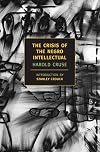
Published in 1967, as the early triumphs of the Civil Rights movement yielded to increasing frustration and violence, The Crisis of the Negro Intellectual electrified a generation of activists and intellectuals. The product of a lifetime of struggle and reflection, Cruse's book is a singular amalgam of cultural history, passionate disputation, and deeply considered analysis of the relationship between American blacks and American society. Reviewing black intellectual life from the Harlem show more Renaissance through the 1960s, Cruse discusses the legacy (and offers memorably acid-edged portraits) of figures such as Paul Robeson, Lorraine Hansberry, and James Baldwin, arguing that their work was marked by a failure to understand the specifically American character of racism in the United States. This supplies the background to Cruse's controversial critique of both integrationism and black nationalism and to his claim that black Americans will only assume a just place within American life when they develop their own distinctive centers of cultural and economic influence. For Cruse's most important accomplishment may well be his rejection of the clichés of the melting pot in favor of a vision of Americanness as an arena of necessary and vital contention, an open and ongoing struggle. show less
The Crisis of the Negro Intellectual: A Historical Analysis of the Failure of Black Leadership (New York Review Books Classics) by Harold Cruse
I'm very glad to have read this book, but good grief was it a chore to get through. Cruse has an interesting argument: that Black American intellectual life (c. 1968) remains hamstrung by its inability to move past allegiances to white communism, nationalism, and integrationism. So far so good.
Now imagine someone yelling that at you for 600 unbearably repetitive pages. Not a pleasant experience, nor a profitable one.
Add to this some extraneous, far less useful claims: for instance, his show more attempt to position Black Americans as nothing less than the subject of American revolutionary politics, while also insisting that no actually existing Black Americans, other than himself, have any frigging idea about anything; or his claim that Harlem, in particular, is the epicenter of that historical subject.
It's important to note that Cruse's work is, in some ways, ahead of its time, and is also worth reading for intellectual history purposes. In particular, his insistence on the importance of the media in American politics was a good one.
But he makes no positive claims other than "we have to do everything perfectly at once," which isn't so helpful. I don't mind when people don't make positive claims. But if you're going to shred every living soul to pieces, you'd better do *something* other than gesture at a vague utopia. show less
Now imagine someone yelling that at you for 600 unbearably repetitive pages. Not a pleasant experience, nor a profitable one.
Add to this some extraneous, far less useful claims: for instance, his show more attempt to position Black Americans as nothing less than the subject of American revolutionary politics, while also insisting that no actually existing Black Americans, other than himself, have any frigging idea about anything; or his claim that Harlem, in particular, is the epicenter of that historical subject.
It's important to note that Cruse's work is, in some ways, ahead of its time, and is also worth reading for intellectual history purposes. In particular, his insistence on the importance of the media in American politics was a good one.
But he makes no positive claims other than "we have to do everything perfectly at once," which isn't so helpful. I don't mind when people don't make positive claims. But if you're going to shred every living soul to pieces, you'd better do *something* other than gesture at a vague utopia. show less
It is said that Cruse collected and read volumes of magazines. This book is a review of Black culture in America from the 1920s to the '60s. Cruise discusses the works of such writers as Richard Wright, Lorraine Hansbury and others. He is also critical of racial integration (White/Black) and he provides a powerful critique of the relationships between groups of Black people (i.e. Black Americans and Black people from the Caribbean). A seethingly charged political-cultural book that is show more powerful and very intellectually stimulating. show less
Lists
Awards

You May Also Like


Associated Authors
Statistics
- Works
- 7
- Also by
- 3
- Members
- 424
- Popularity
- #57,553
- Rating
- 4.4
- Reviews
- 3
- ISBNs
- 12
- Favorited
- 3