

Gananath Obeyesekere
Author of The Apotheosis of Captain Cook: European Mythmaking in the Pacific
About the Author
Gananath Obeyesekere is Professor of Anthropology at Princeton University
Image credit: Prof. Gananath Obeyesekere. Photo byDenise Applewhite, 2000 (photo courtesy of Princeton University)
Works by Gananath Obeyesekere
Imagining Karma: Ethical Transformation in Amerindian, Buddhist, and Greek Rebirth (1999) 47 copies, 2 reviews
The Work of Culture: Symbolic Transformation in Psychoanalysis and Anthropology (Lewis Henry Morgan Lecture Series) (1990) 23 copies
නෙරපු රජ - NERAPU RAJA 1 copy
වන්නි රාජාවලිය 1 copy
Associated Works
Tagged
Common Knowledge
- Canonical name
- Obeyesekere, Gananath
- Birthdate
- 1930-02-02
- Gender
- male
- Education
- University of Ceylon, Peradeniya (BA|English|1956)
University of Washington (MA|Anthropology|1958)
University of Washington (PhD|Anthropology|1966) - Occupations
- sociologist
anthropologist
professor emeritus Princeton University - Organizations
- Princeton University
- Nationality
- Sri Lanka
- Birthplace
- Sri Lanka
- Places of residence
- Sri Lanka
Seattle, Washington, USA
Cambridge, Cambridgeshire, England, UK
San Diego, California, USA
Princeton, New Jersey, USA
New York, New York, USA - Associated Place (for map)
- USA
Members
Reviews

I was really enjoying this and admire the work of the author, however this new book feels rushed. Furthermore there are some really questionable contentions with issue. For example the representation of St. Francis Xavier, which is in glowing terms. Yet this man alone was responsible for the inauguration of the Portuguese Inquisition in Goa. He was the individual who wrote the request. The inquisition in India is arguably the worst expression of slaughter of Jews and Hindus. It’s very show more strange that the author does not mention this! show less
Imagining Karma: Ethical Transformation in Amerindian, Buddhist, and Greek Rebirth by Gananath Obeyesekere
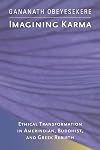
Obeyesekere works through a project of “comparative structural interpretation” (354), using simplified and idealized models of the processes described by rebirth doctrines within and among various cultures. One of his goals is to demonstrate that reincarnation “eschatologies” are not unique to Indic religions, as is sometimes supposed. The societies that furnish Obeyesekere with ethnological data are Vedanta and Upanishadic Hinduism, Theravada Buddhism, West Africa, Trobriand, show more Northwest Coast Amerindians, Inuit, Tlingit, Kwakiutl, Classical Hellenism (as Pythagoreanism and Platonism), “Heterodox Islam” (as Druzes and Ismailism), and Bali. He omits the kabbalistic metempsychosis of mystical Judaism, as well as some Australian and Asian cultures of reincarnation, noting that he is especially interested in those who hold beliefs permitting cross-species rebirth of humans. This latter idea he ties to the notion of “species sentience” (his term) and relates structurally to vegetarianism, by means of an endoanthropophagy (cannibalism) taboo.
Obeyesekere distinguishes a “karmic eschatology” from the basic “rebirth eschatology” according to the presence of two features, which he groups under the process of “ethicization” of the reincarnation process. The first feature is a differentiation of post-mortem otherworld experiences based on the ethical status of the deceased. The second is the ethicization of rebirth per se, so that the ethical value of one life has the determinative effect on the identity and quality of the next life. (He notes that this latter feature correlates to a devaluation of animals, when compared to rebirth schemas that lack it.) Tied to this ethicization is the establishment of a salvation that lies outside the cycle of rebirth altogether. Obeyesekere also asserts a parallel process of “axiologization,” by which preexisting local values are conceptualized and universalized. While outlining his model of the “karmic eschatology,” he counters Western descriptions (or “inventions”) of Buddhism as essentially and originally “rational” (151 ff.).
Having constructed the model of Buddhist rebirth ideas, with reference to those of “small-scale societies,” Obeyesekere compares it to other cultures under his consideration. He also discusses instances of deviance from the model within Buddhism (e.g. 132), and variability within the other cultures. None are presented as static or uniform, but the structure(s) described by Obeyesekere serve(s) as a strange attractor around which the instances group themselves, according to “expectability” and its circumstantial thwarting. He emphasizes (e.g. 139) that “popular” features durably contradicting “pure” doctrines are as likely to be survivals from the religion’s first codification as they are to be “contaminations” from a subsequent, alien source.
He explains that his methodological goal is to demonstrate that while cultures as wholes may be “incommensurable,” comparison of important aspects or dimensions of culture can be undertaken productively. Although I found plenty of his more specific arguments questionable (often provocatively so), I think he succeeds on this most general plane of his ambition. show less
Obeyesekere distinguishes a “karmic eschatology” from the basic “rebirth eschatology” according to the presence of two features, which he groups under the process of “ethicization” of the reincarnation process. The first feature is a differentiation of post-mortem otherworld experiences based on the ethical status of the deceased. The second is the ethicization of rebirth per se, so that the ethical value of one life has the determinative effect on the identity and quality of the next life. (He notes that this latter feature correlates to a devaluation of animals, when compared to rebirth schemas that lack it.) Tied to this ethicization is the establishment of a salvation that lies outside the cycle of rebirth altogether. Obeyesekere also asserts a parallel process of “axiologization,” by which preexisting local values are conceptualized and universalized. While outlining his model of the “karmic eschatology,” he counters Western descriptions (or “inventions”) of Buddhism as essentially and originally “rational” (151 ff.).
Having constructed the model of Buddhist rebirth ideas, with reference to those of “small-scale societies,” Obeyesekere compares it to other cultures under his consideration. He also discusses instances of deviance from the model within Buddhism (e.g. 132), and variability within the other cultures. None are presented as static or uniform, but the structure(s) described by Obeyesekere serve(s) as a strange attractor around which the instances group themselves, according to “expectability” and its circumstantial thwarting. He emphasizes (e.g. 139) that “popular” features durably contradicting “pure” doctrines are as likely to be survivals from the religion’s first codification as they are to be “contaminations” from a subsequent, alien source.
He explains that his methodological goal is to demonstrate that while cultures as wholes may be “incommensurable,” comparison of important aspects or dimensions of culture can be undertaken productively. Although I found plenty of his more specific arguments questionable (often provocatively so), I think he succeeds on this most general plane of his ambition. show less
Imagining karma : ethical transformation in Amerindian, Buddhist, and Greek rebirth by Gananath Obeyesekere
Major work of academic anthropology, comparing ideas of rebirth in different religions. In particular analyses how ideas of ethics - punishment and reward - became linked with the afterlife.

Some disbelief that cannibalism actually took place in some far-away areas. Funny that when a person thinks of cannibalism, often we think of exotic far-away places, when it is happening all the time (ok, not all the time) in good old North Amemrica.
Awards


You May Also Like


Associated Authors
Statistics
- Works
- 22
- Also by
- 1
- Members
- 415
- Popularity
- #58,724
- Rating
- 3.7
- Reviews
- 6
- ISBNs
- 49
- Languages
- 1