
al-Farabi (870–950)
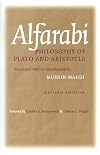
Author of Philosophy of Plato and Aristotle (Agora Editions)
About the Author
Image credit: Statue of al-Farabi in front of the Kazakh National University Photo: Ayana Sergebayeva.
Works by al-Farabi
The Political Writings: "Selected Aphorisms" and Other Texts (Agora Editions) (Volume 1) (2001) 62 copies
The Political Writings: "Political Regime" and "Summary of Plato's Laws" (Agora Editions) (Volume 2) (2015) 23 copies, 1 review
Al-Farabi's Commentary and Short Treatise on Aristotle's De Interpretatione (Classical and Medieval Logic Texts) (1981) 19 copies
Fusul al-Madani: Aphorisms of the statesman (University of Cambridge. Oriental publications;no.5) (1961) 2 copies
El-Medînetü'l-Fâzıla 1 copy
Kitāb al-mūsīqā al-kabīr 1 copy
El-Medînetü'l-Fâzıla 1 copy
Kitāb taḥṣīl al-saʻāda 1 copy
Kitāb al-burhān wa-Kitāb sharāʼiṭ al-yaqīn : maʻa taʻālīq Ibn Bājah ʻalá al-Burhān 1 copy
Państwo doskonałe ; Polityka 1 copy
Mulemma 1 copy
Felsefenin Temel Önermeleri & Mantık Ve Eski Felsefenin İlkeleri Konusunda Sorunların Kaynakları (2020) 1 copy
Iḥṣāʼ al-ʻulūm 1 copy
Alfārābī's philosophische Abhandlungen : aus Londoner, Leidener und Berliner Handschriften (1982) 1 copy
Falsafah al-'Arab 1 copy
De scientiis : secundum versionem Dominici Gundisalvi ; lateinisch - deutsch = Über die Wissenschaften (2006) 1 copy
PËRZGJEDHJE ANTOLOGJIKE 1 copy
Peradaban Luhur 1 copy
Логические трактаты 1 copy
Associated Works
Philosophy in the Middle Ages: The Christian, Islamic, and Jewish Traditions (1983) — Contributor — 495 copies, 2 reviews
Tagged
Common Knowledge
- Canonical name
- al-Farabi
- Other names
- Al-Farabi
Al Farabi, - Birthdate
- 870
- Date of death
- 950
- Gender
- male
- Occupations
- philosopher
- Places of residence
- Baghdad, Iraq
Damascus, Syria
Members
Reviews
Who was al-Farabi?
Alfarabi is one of the greatest philosophers to walk the earth since Plato and Aristotle left the sublunary world! This must seem an outrageous statement given how little Farabi is read, taught, or even translated here in the West. But what we today do not realize is: first, how Farabi defined the limits of medieval thought and, secondly, how those limits became part of the modern world. In this note I would like to start out by giving a brief indication of this.
Farabi is show more the first philosopher (that we know of) to notice that the world that philosophy inhabited was no longer the 'natural cave' that Plato spoke of in the Republic. Today, thanks to our reading of Nietzsche, it is almost a commonplace to refer to Christianity (and also, by extension, Islam, Liberalism and Socialism) as a 'Platonism for the people'. Farabi, by realizing that philosophy had in his time become lost (or forgotten), decisively leaves the ancient world (i.e., the natural cave) behind and enters, whether cheerfully, fearfully or cautiously we will never know, a world (specifically, the world of medieval monotheism) in which the shadows on the wall of the cave are no longer simply those thrown by 'natural', that is, pre-philosophical, customary religion and law (i.e., nomos); but rather these shadows are now (since the rise of the first 'Platonism for the people') -at least in part and in varying degrees- philosophical artifacts. So, how does philosophy behave once a (ahem) philosophical 'theory of everything' arises? That was the question that Farabi faced; and that was a question neither Plato nor Aristotle ever faced...
Now, philosophical esotericism in Antiquity was always concerned with the individual; it ultimately wanted to free the individual from his thralldom to nomos or sophistry and bring him to philosophy. But Farabi faces a situation in which everyone (i.e., the Christians and Moslems of his time) already knows the Truth and has God on their side. Farabi must establish and defend the continued necessary existence of philosophy in the face of an all-knowing, all-powerful God. After all, why would those who possess a Revelation search for Truth when it is here, in front of them, in the 'Religion of our People'? Farabi's "Philosophy of Plato and Aristotle" demonstrates the great skepticism genuine Philosophy has for Truth and the self-assured (but ultimately sophistical) holders of Truth by, in part, resorting to (or inventing) Platonic political esotericism.
In order to counteract the 'strong' illusions on the walls of this cave (i.e., monotheism) Farabi proposes, in the 'Attainment of Happiness', a fidelity to method that is (perhaps) unprecedented in the ancient world. This fidelity to method, of course, is intended, as Farabi indicates, to ensure a singularity of outcomes. (Fundamentally, Descartes will later use method for the same reason.) Now, the fact that the 'school' Farabi heads (the Islamic Philosophers, - that is, the Falasifa) disappears down the gullet of history is no reason to think that the story ended there. Averroes who, for the purposes of this brief note, can be identified as the last of the great 'Aristotelian' Falasifa, had an immense, but subterranean, impact on Western philosophy. Indeed, after Aquinas lost the good fight for a (moderate) 'Latin Aristotelianism', a 'radical Averroism' would eventually triumph in the West. (This 'Averroism', however, was in fact blind to the 'religious philosophy' of Averroes, that is, they had never seen his 'Decisive Treatise', and therefore went too far in the direction of secularism.) Before the rise of this 'Latin Averroism', however, a form of Kalam (Islamic Speculative Theology) would rule the Western world. But eventually this anti-rational, 'God's Will' theology of Scotus and Ockham is overthrown by the new secular philosophies best represented by Machiavelli, Descartes, Hobbes and Spinoza. These last are the genuine, but by no means merely direct, heirs of radical Latin Averroism. And this early-modern secularism eventually became the modern Enlightenment which continues its transformation of the world even today. But post-modernity is only the latest skirmish in the 'jihad of the falasifa' which may have ultimately begun, however much it has changed over time, in the thought of one man - Farabi.
Farabi changes Philosophy because the world that philosophy inhabited had irrevocably changed. The merely customary Nomos of classical antiquity was replaced by Revealed Law. But why was that a problem? Hadn't philosophy itself a hand in the rise of the monotheistic 'Platonisms for the People'? Yes, philosophy did have a hand in it. (Now, whether Plato intended to remake the world in this manner is another question, one which I will not address here.) But it is only too obvious that the various (at best) squabbling or (at worse) warring factions among the monotheists (Christianity/Islam, Catholic/Orthodox, Sunni/Shia, e.g.) were certainly not intended by the philosophers. This is, in part, the reason behind the great innovation of the 'Attainment of Happiness': Farabi teaches that one method, not one Truth, leads to one result. This single-minded pursuit of a single behavior is intended to moderate, and eventually end, the countless internecine conflicts of the various monotheistic sects.
Where the ancient philosophical schools had always practiced some form of 'soulcraft' on their students Farabi only wants to elicit a common, and therefore 'correct', behavior. The ancient study of philosophy generally culminated in some sort of truth. Of course, a given student might never reach the culminating truth. But the practice of philosophical soulcraft would, or so it was hoped, improve any student. Before Farabi philosophy always at least attempted to address the soul or psyche of individuals; after him, and to an ever increasing degree, philosophy addresses behavior by teaching one method, and philosophy thus purposefully addresses World-History; that is, philosophy is from this point on self-consciously making the future...
Now, this book is a tryptich, it begins with 'Attainment of Happiness', it has 'The Philosophy of Plato' in the middle, and it ends with 'The Philosophy of Aristotle'. We are to understand that the 'Attainment of Happiness' is Farabi's original contribution to Philosophy. This book was, in medieval times, referred to as 'The Two Philosophers'; in reality it could have been (and indeed should have been) referred to as the 'Three Philosophers'. - I mean by this that, according to our author, after Plato & Aristotle there is only Farabi. I recommend reading the book first in the traditional order: Farabi, Plato, Aristotle, and then reading it in chronological order, Plato, Aristotle, Farabi; and finally, reverse the chronological order, Farabi, Aristotle, Plato. This last, btw, has the virtue of allowing one to view the history of philosophy as Farabi himself saw it: that is, himself, Aristotle, Plato.
But reading this book chronologically, from Plato to Farabi, also has its merits. So we begin with Plato. Farabi, swimming in the wake of the results of Platonic esoteric caution, exaggerates the importance of Politics in his explication of Plato in order to counteract the even greater incaution of Revealed Religious Law. It is, unfortunately, often necessary to counter one exaggeration with another. In a storm (and History, may the gods help us, is a storm!) one always finds oneself steering in this, that and/or some other direction in order to simply stay on course. Farabi, towards the end of the ‘Philosophy of Plato’, alludes to the methods and ways of Timaeus, Socrates and Thrasymachus. These three are masks (or signs) of the three fundamental things the philosopher can speak about: Cosmos (or Theology), the individual Soul or Psyche, and the City (or Politics). Philosophy, in Itself, can perhaps be defined as the mixture of these three ways, in their proper measure at the proper time. I leave it to the discerning reader of the ‘Philosophy of Plato’ to determine which of these three ways Farabi elects to emphasize here. Keep in mind that in another work, for instance "On the Perfect State", Farabi may well choose to proceed in a (somewhat, if not entirely) different manner...
You should see the criticism of other philosophers inherent in the way Farabi here discusses Plato: Thus the ways of some other ancient philosophers (e.g., Parmenides or Pythagoras) would then be, from the viewpoint of Plato, or perhaps I should say the 'Plato' of Farabi, an immoderate privileging of the 'way of Timaeus'. Another point to note is that of these three (i.e., Cosmos, City, Soul) the only one that the philosopher can fundamentally effect is the City. This is simultaneously a great danger and (perhaps) an even greater opportunity. In either case, it should really surprise no one that philosophy winds up here, in our post-modernity, thinking it has made (or will make) everything in the City... I want to add that for those who continue to insist upon the alleged 'Neoplatonism' of Farabi this essay, 'The Philosophy of Plato', must always remain a great scandal to them. We should never stop being amazed by the fact that in this essay Farabi can't even bring himself to mention the Platonic Ideas! As an aside I will point out that this can also be said of the 'Platonist' (really, the Farabian) Leo Strauss. In fact it has been said, by one of the greatest students of Strauss - Stanley Rosen. Now, Rosen isn't at all happy about this but this unhappiness is the result of his expecting Strauss to behave like a Platonist when Strauss is in fact a Farabian. Well, enough of this digression...
Regarding Aristotle I can only mention, in these brief remarks, that just as Farabi's Plato barely discusses 'Metaphysics' so too Farabi's Aristotle barely discusses politics. Farabi says Plato's discussion terminates (i.e., finishes) but near the very end of the Aristotle essay Farabi says "we do not possess metaphysical science." One can perhaps understand this to mean that, properly speaking, 'metaphysical" investigation is endless while Plato, in fact, exhausted the study of philosophical anthropology and politics. In closing I should say that in order to properly understand the philosophy of Farabi (i.e.,"The Attainment of Happiness") we need to see how he intends to utilize the results of Plato's investigations in order to secure foundations that support unending metaphysical research. The 'Attainment of Happiness' ends with Farabi assuring us that Plato and Aristotle "intended to offer one and the same philosophy." We should add that this was Farabi's intention too.
Farabi is the least read of the great philosophers. Begin your study here. show less
Alfarabi is one of the greatest philosophers to walk the earth since Plato and Aristotle left the sublunary world! This must seem an outrageous statement given how little Farabi is read, taught, or even translated here in the West. But what we today do not realize is: first, how Farabi defined the limits of medieval thought and, secondly, how those limits became part of the modern world. In this note I would like to start out by giving a brief indication of this.
Farabi is show more the first philosopher (that we know of) to notice that the world that philosophy inhabited was no longer the 'natural cave' that Plato spoke of in the Republic. Today, thanks to our reading of Nietzsche, it is almost a commonplace to refer to Christianity (and also, by extension, Islam, Liberalism and Socialism) as a 'Platonism for the people'. Farabi, by realizing that philosophy had in his time become lost (or forgotten), decisively leaves the ancient world (i.e., the natural cave) behind and enters, whether cheerfully, fearfully or cautiously we will never know, a world (specifically, the world of medieval monotheism) in which the shadows on the wall of the cave are no longer simply those thrown by 'natural', that is, pre-philosophical, customary religion and law (i.e., nomos); but rather these shadows are now (since the rise of the first 'Platonism for the people') -at least in part and in varying degrees- philosophical artifacts. So, how does philosophy behave once a (ahem) philosophical 'theory of everything' arises? That was the question that Farabi faced; and that was a question neither Plato nor Aristotle ever faced...
Now, philosophical esotericism in Antiquity was always concerned with the individual; it ultimately wanted to free the individual from his thralldom to nomos or sophistry and bring him to philosophy. But Farabi faces a situation in which everyone (i.e., the Christians and Moslems of his time) already knows the Truth and has God on their side. Farabi must establish and defend the continued necessary existence of philosophy in the face of an all-knowing, all-powerful God. After all, why would those who possess a Revelation search for Truth when it is here, in front of them, in the 'Religion of our People'? Farabi's "Philosophy of Plato and Aristotle" demonstrates the great skepticism genuine Philosophy has for Truth and the self-assured (but ultimately sophistical) holders of Truth by, in part, resorting to (or inventing) Platonic political esotericism.
In order to counteract the 'strong' illusions on the walls of this cave (i.e., monotheism) Farabi proposes, in the 'Attainment of Happiness', a fidelity to method that is (perhaps) unprecedented in the ancient world. This fidelity to method, of course, is intended, as Farabi indicates, to ensure a singularity of outcomes. (Fundamentally, Descartes will later use method for the same reason.) Now, the fact that the 'school' Farabi heads (the Islamic Philosophers, - that is, the Falasifa) disappears down the gullet of history is no reason to think that the story ended there. Averroes who, for the purposes of this brief note, can be identified as the last of the great 'Aristotelian' Falasifa, had an immense, but subterranean, impact on Western philosophy. Indeed, after Aquinas lost the good fight for a (moderate) 'Latin Aristotelianism', a 'radical Averroism' would eventually triumph in the West. (This 'Averroism', however, was in fact blind to the 'religious philosophy' of Averroes, that is, they had never seen his 'Decisive Treatise', and therefore went too far in the direction of secularism.) Before the rise of this 'Latin Averroism', however, a form of Kalam (Islamic Speculative Theology) would rule the Western world. But eventually this anti-rational, 'God's Will' theology of Scotus and Ockham is overthrown by the new secular philosophies best represented by Machiavelli, Descartes, Hobbes and Spinoza. These last are the genuine, but by no means merely direct, heirs of radical Latin Averroism. And this early-modern secularism eventually became the modern Enlightenment which continues its transformation of the world even today. But post-modernity is only the latest skirmish in the 'jihad of the falasifa' which may have ultimately begun, however much it has changed over time, in the thought of one man - Farabi.
Farabi changes Philosophy because the world that philosophy inhabited had irrevocably changed. The merely customary Nomos of classical antiquity was replaced by Revealed Law. But why was that a problem? Hadn't philosophy itself a hand in the rise of the monotheistic 'Platonisms for the People'? Yes, philosophy did have a hand in it. (Now, whether Plato intended to remake the world in this manner is another question, one which I will not address here.) But it is only too obvious that the various (at best) squabbling or (at worse) warring factions among the monotheists (Christianity/Islam, Catholic/Orthodox, Sunni/Shia, e.g.) were certainly not intended by the philosophers. This is, in part, the reason behind the great innovation of the 'Attainment of Happiness': Farabi teaches that one method, not one Truth, leads to one result. This single-minded pursuit of a single behavior is intended to moderate, and eventually end, the countless internecine conflicts of the various monotheistic sects.
Where the ancient philosophical schools had always practiced some form of 'soulcraft' on their students Farabi only wants to elicit a common, and therefore 'correct', behavior. The ancient study of philosophy generally culminated in some sort of truth. Of course, a given student might never reach the culminating truth. But the practice of philosophical soulcraft would, or so it was hoped, improve any student. Before Farabi philosophy always at least attempted to address the soul or psyche of individuals; after him, and to an ever increasing degree, philosophy addresses behavior by teaching one method, and philosophy thus purposefully addresses World-History; that is, philosophy is from this point on self-consciously making the future...
Now, this book is a tryptich, it begins with 'Attainment of Happiness', it has 'The Philosophy of Plato' in the middle, and it ends with 'The Philosophy of Aristotle'. We are to understand that the 'Attainment of Happiness' is Farabi's original contribution to Philosophy. This book was, in medieval times, referred to as 'The Two Philosophers'; in reality it could have been (and indeed should have been) referred to as the 'Three Philosophers'. - I mean by this that, according to our author, after Plato & Aristotle there is only Farabi. I recommend reading the book first in the traditional order: Farabi, Plato, Aristotle, and then reading it in chronological order, Plato, Aristotle, Farabi; and finally, reverse the chronological order, Farabi, Aristotle, Plato. This last, btw, has the virtue of allowing one to view the history of philosophy as Farabi himself saw it: that is, himself, Aristotle, Plato.
But reading this book chronologically, from Plato to Farabi, also has its merits. So we begin with Plato. Farabi, swimming in the wake of the results of Platonic esoteric caution, exaggerates the importance of Politics in his explication of Plato in order to counteract the even greater incaution of Revealed Religious Law. It is, unfortunately, often necessary to counter one exaggeration with another. In a storm (and History, may the gods help us, is a storm!) one always finds oneself steering in this, that and/or some other direction in order to simply stay on course. Farabi, towards the end of the ‘Philosophy of Plato’, alludes to the methods and ways of Timaeus, Socrates and Thrasymachus. These three are masks (or signs) of the three fundamental things the philosopher can speak about: Cosmos (or Theology), the individual Soul or Psyche, and the City (or Politics). Philosophy, in Itself, can perhaps be defined as the mixture of these three ways, in their proper measure at the proper time. I leave it to the discerning reader of the ‘Philosophy of Plato’ to determine which of these three ways Farabi elects to emphasize here. Keep in mind that in another work, for instance "On the Perfect State", Farabi may well choose to proceed in a (somewhat, if not entirely) different manner...
You should see the criticism of other philosophers inherent in the way Farabi here discusses Plato: Thus the ways of some other ancient philosophers (e.g., Parmenides or Pythagoras) would then be, from the viewpoint of Plato, or perhaps I should say the 'Plato' of Farabi, an immoderate privileging of the 'way of Timaeus'. Another point to note is that of these three (i.e., Cosmos, City, Soul) the only one that the philosopher can fundamentally effect is the City. This is simultaneously a great danger and (perhaps) an even greater opportunity. In either case, it should really surprise no one that philosophy winds up here, in our post-modernity, thinking it has made (or will make) everything in the City... I want to add that for those who continue to insist upon the alleged 'Neoplatonism' of Farabi this essay, 'The Philosophy of Plato', must always remain a great scandal to them. We should never stop being amazed by the fact that in this essay Farabi can't even bring himself to mention the Platonic Ideas! As an aside I will point out that this can also be said of the 'Platonist' (really, the Farabian) Leo Strauss. In fact it has been said, by one of the greatest students of Strauss - Stanley Rosen. Now, Rosen isn't at all happy about this but this unhappiness is the result of his expecting Strauss to behave like a Platonist when Strauss is in fact a Farabian. Well, enough of this digression...
Regarding Aristotle I can only mention, in these brief remarks, that just as Farabi's Plato barely discusses 'Metaphysics' so too Farabi's Aristotle barely discusses politics. Farabi says Plato's discussion terminates (i.e., finishes) but near the very end of the Aristotle essay Farabi says "we do not possess metaphysical science." One can perhaps understand this to mean that, properly speaking, 'metaphysical" investigation is endless while Plato, in fact, exhausted the study of philosophical anthropology and politics. In closing I should say that in order to properly understand the philosophy of Farabi (i.e.,"The Attainment of Happiness") we need to see how he intends to utilize the results of Plato's investigations in order to secure foundations that support unending metaphysical research. The 'Attainment of Happiness' ends with Farabi assuring us that Plato and Aristotle "intended to offer one and the same philosophy." We should add that this was Farabi's intention too.
Farabi is the least read of the great philosophers. Begin your study here. show less

Farabi and some modern scholars
This is the only English translation of 'Mabadi ara ahl al-madina al-fadila' (henceforth referred to as the Ara) of which I am aware. Richard Walzer provides a very suggestive annotated commentary that is about 170 pages long. The text itself is almost 300 pages and it appears in both Arabic and English on facing pages. Walzer "left the manuscript of the present work ready for publication" upon his death but did not live to see it through the publishing show more process. He made use of 10 manuscripts in preparing this critical edition. One of the main problems he faced in establishing the text for this edition was that it was "written in an ordinary naskhi, eighteen lines to the page, with no vowels and very few diacritical consonantal signs, so that quite a few words can be understood in different ways. [...] Numerous variant readings in later MSS. of the Ara are best explained in this way." Following the introduction Walzer indicates which manuscripts he found most useful in preparing this edition and why he thought they were useful.
Walzer argues that Farabi is something of a Shia who clearly preferred the Imamiyya to the Ismaili's. I do not have enough knowledge of the times Farabi wrote to have a judgement one way or the other about this. However, I did find Walzer's continual assurance in his commentary that Farabi must have had a Greek predecessor every time he is original really quite annoying. For instance, on page 424, Walzer, while speaking of the difference between Farabi's way of handling political Platonism and his neo-Platonic and Aristotelian predecessors, muses about who his 'Greek predecessor' must have been: "One obviously wonders who the author of this unusual synthesis of Aristotle and Plato may have been or, if this question cannot be answered, whether at least his place in the history of later Greek philosophy can somehow be circumscribed." In other words, even if a putative predecessor is never found we must assume he did exist! I will, btw, concede that if there is a predecessor Walzer is surely correct to say that it would be among the Middle Platonists, and not the Neoplaonists, that we would find him.
But why are we even looking for him? Walzer says, "the best evidence of a continuous appreciation of Plato's political thought in later Antiquity is provided by its impact on Arabic philosophical literature." Isn't this a bit like arguing that the best proof early moderns had something like refrigeration is that late moderns have it? I think the reason that Islam (and also Judaism in the Medieval period) had philosophers that made a great deal of Plato's Political Philosophy is that the Prophet Mohammed was above all a bringer of Law (as was Moses) but Jesus in the Gospels brings no Law (except to love others as you love yourself) at all. The fact of the Prophet/Legislator in Islam and Judaism thus dovetails rather nicely with Plato's political discussions in his Republic and Laws. This provided the opportunity for Farabi to speak of the Prophet as if he were Plato's Philosopher-King. Thus we should find that the originality of Farabi's Platonic Politics is explained by the fact that he was immersed in a revealed Religion that also contained a detailed revealed Law. This 'political interpretation' of the Platonic texts first becomes possible in Islam.
In Walzer's defense I want to add that it was not very long ago that it was thought that Islamic philosophers (falasifa) weren't really philosophers but merely transmitters of original Greek thought and texts. Thus it was typical that whenever one of the falasifa said something that wasn't in precise agreement with some Greek predecessor it was assumed that the Islamic philosopher had made a mistake. In other words, according to the accepted scholarship, originality was always taken to be an error. Charitably one could say that perhaps Walzer bent over backwards to show that Farabi was a genuine philosopher by insisting he belongs in the line of Middle Platonism. And I do not doubt for a moment that this was indeed part of his motivation. After all, Walzer does say that, "none of the 'political' works of al-Farabi - such as the Ara - which were well known and popular all over the Muslim world, from Spain to India, was ever translated into medieval Latin, although this important section of the Greek legacy had been seen in a new and very original light by al-Farabi." So we see that Walzer is somewhat aware of Farabi's originality. Now, further down this page (32) Walzer remarks that the reason these texts weren't translated into Latin by the Christians was that "Platonic 'political' thought as applied to Islamic situations of the tenth century A.D. was useless for them, and thus they did not embark on latinizing any such texts." Well, all I would add (as stated earlier) is that if we can explain the absence of Farabi's political Platonism in the West by the situation of Christianity then why can't we go ahead and explain the appearance of an original political Platonism in Farabi by the situation of Islam?
So, why does Walzer insist upon looking for a supposed 'Greek predecessor'? The problem is that all scholars worry about, can worry about, is the source of a given philosophical position and the accuracy of its transmission; but all that genuine philosophers can worry about is the appropriateness of a philosophical position in given circumstances. If the works of Plato were only discovered yesterday a scholar would have no trouble 'showing' that all the elements (positions) in Plato had come from Pythagoras, Parmenides, Heraclitus and Socrates. This would be exactly how one would expect a scholar to 'reason'! But Plato, by putting each of these elements together in the proper measure, as the circumstances of Athens and Greece required, creates Western Philosophy. So too Farabi, by weaving together prior elements into a properly measured whole, virtually creates Islamic philosophy. The Falasifa that follow him continually refer back to Farabi (known as the 'Second Philosopher' or 'Second Master', i.e., second after Aristotle, throughout much of the medieval period) in their works. Indeed, one can say (through Farabi's distant heirs, the 'Latin Averroists') that Farabi's decisive turn to (and distinctive interpretation of) Platonic political philosophy has even influenced Western philosophy itself.
As far as the text goes I can say that of the translations of Farabi that I have seen the Ara goes further in what might be called a neo-Platonic direction than any of the others. In fact, if one wanted to keep Farabi in the neo-Platonic canon this would certainly be the translated text one would choose to argue the point. As such, it is a very good antidote to those that see Farabi as only, I do not say merely, a political Platonic esotericist. He really does have metaphysical interests too! Now, the question how the political and the metaphysical hang together is a vexed one and it certainly can't be clarified in a few sentences and I won't even try here. I will just note that for Farabi the metaphysical is best approached through philosophy; everything else is a step down from philosophy. This is a recurring motif among the falasifa, as Ghazali well knew. Averroes will later make the same point, in somewhat altered circumstances, in his tremendous 'Decisive Treatise'.
Lastly, I want to mention how unconcerned Farabi seems, compared even to Averroes, about how the orthodox view him. Look at what Farabi says about prophecy in chapter 14, 'Representation and Divination'. He speaks of prophecy in a manner that separates it from the rational faculty and places prophecy in the realm of the representative faculty. Thus Farabi seems to indicate that the Koran itself is beneath philosophy and its ability to reason. Walzer correctly says that Farabi, "accepted the inherited fabric of beliefs but gave it -and theological speculation with it- an inferior place in his philosophical interpretation of the universe and man. He can, in this respect, be compared with Plato himself..." Thus one wonders if this acceptance of "the inherited fabric of beliefs" is to be understood as acceptance of the beliefs themselves or 'acceptance' of the utility of said beliefs. If Plato 'accepted' paganism and Farabi 'accepted' monotheism due to their utility at the time one finds oneself wondering about modern philosophers and their 'acceptance' of modernity. But that is another story...
I haven't even touched on the complex argument that Farabi here weaves. Suffice to say that a discussion of the subtle argument requires far more words than an Amazon review is allowed. But there are several questions that kept occurring to me as I worked my way through the text. Most importantly, how does Farabi keep the various (middle) Platonic, neo-Platonic, and Aristotelian elements from contradicting each other? That is, how does Farabi 'harmonize' (a term of art in philosophic circles in the later Roman Empire) these various elements? Next, does Farabi intend the final 'political' chapters (15 - 19, but also 13 and 14) to overpower our reading of the text as a whole as they do for so many of us today? Finally, one wonders about the extent of Farabi's influence, not only among the falasifa or within Islam but also his influence on Maimonides, Jewish philosophy, and the Latin West too. I give 5 stars for Farabi but only 4 stars for Walzers commentary and his inane insistence that there is a 'Greek predecessor' to virtually every position Farabi takes. ...It really does wear one down. But, that said, I did find many gems of information in his commentary; it would be foolish to simply ignore it. show less
This is the only English translation of 'Mabadi ara ahl al-madina al-fadila' (henceforth referred to as the Ara) of which I am aware. Richard Walzer provides a very suggestive annotated commentary that is about 170 pages long. The text itself is almost 300 pages and it appears in both Arabic and English on facing pages. Walzer "left the manuscript of the present work ready for publication" upon his death but did not live to see it through the publishing show more process. He made use of 10 manuscripts in preparing this critical edition. One of the main problems he faced in establishing the text for this edition was that it was "written in an ordinary naskhi, eighteen lines to the page, with no vowels and very few diacritical consonantal signs, so that quite a few words can be understood in different ways. [...] Numerous variant readings in later MSS. of the Ara are best explained in this way." Following the introduction Walzer indicates which manuscripts he found most useful in preparing this edition and why he thought they were useful.
Walzer argues that Farabi is something of a Shia who clearly preferred the Imamiyya to the Ismaili's. I do not have enough knowledge of the times Farabi wrote to have a judgement one way or the other about this. However, I did find Walzer's continual assurance in his commentary that Farabi must have had a Greek predecessor every time he is original really quite annoying. For instance, on page 424, Walzer, while speaking of the difference between Farabi's way of handling political Platonism and his neo-Platonic and Aristotelian predecessors, muses about who his 'Greek predecessor' must have been: "One obviously wonders who the author of this unusual synthesis of Aristotle and Plato may have been or, if this question cannot be answered, whether at least his place in the history of later Greek philosophy can somehow be circumscribed." In other words, even if a putative predecessor is never found we must assume he did exist! I will, btw, concede that if there is a predecessor Walzer is surely correct to say that it would be among the Middle Platonists, and not the Neoplaonists, that we would find him.
But why are we even looking for him? Walzer says, "the best evidence of a continuous appreciation of Plato's political thought in later Antiquity is provided by its impact on Arabic philosophical literature." Isn't this a bit like arguing that the best proof early moderns had something like refrigeration is that late moderns have it? I think the reason that Islam (and also Judaism in the Medieval period) had philosophers that made a great deal of Plato's Political Philosophy is that the Prophet Mohammed was above all a bringer of Law (as was Moses) but Jesus in the Gospels brings no Law (except to love others as you love yourself) at all. The fact of the Prophet/Legislator in Islam and Judaism thus dovetails rather nicely with Plato's political discussions in his Republic and Laws. This provided the opportunity for Farabi to speak of the Prophet as if he were Plato's Philosopher-King. Thus we should find that the originality of Farabi's Platonic Politics is explained by the fact that he was immersed in a revealed Religion that also contained a detailed revealed Law. This 'political interpretation' of the Platonic texts first becomes possible in Islam.
In Walzer's defense I want to add that it was not very long ago that it was thought that Islamic philosophers (falasifa) weren't really philosophers but merely transmitters of original Greek thought and texts. Thus it was typical that whenever one of the falasifa said something that wasn't in precise agreement with some Greek predecessor it was assumed that the Islamic philosopher had made a mistake. In other words, according to the accepted scholarship, originality was always taken to be an error. Charitably one could say that perhaps Walzer bent over backwards to show that Farabi was a genuine philosopher by insisting he belongs in the line of Middle Platonism. And I do not doubt for a moment that this was indeed part of his motivation. After all, Walzer does say that, "none of the 'political' works of al-Farabi - such as the Ara - which were well known and popular all over the Muslim world, from Spain to India, was ever translated into medieval Latin, although this important section of the Greek legacy had been seen in a new and very original light by al-Farabi." So we see that Walzer is somewhat aware of Farabi's originality. Now, further down this page (32) Walzer remarks that the reason these texts weren't translated into Latin by the Christians was that "Platonic 'political' thought as applied to Islamic situations of the tenth century A.D. was useless for them, and thus they did not embark on latinizing any such texts." Well, all I would add (as stated earlier) is that if we can explain the absence of Farabi's political Platonism in the West by the situation of Christianity then why can't we go ahead and explain the appearance of an original political Platonism in Farabi by the situation of Islam?
So, why does Walzer insist upon looking for a supposed 'Greek predecessor'? The problem is that all scholars worry about, can worry about, is the source of a given philosophical position and the accuracy of its transmission; but all that genuine philosophers can worry about is the appropriateness of a philosophical position in given circumstances. If the works of Plato were only discovered yesterday a scholar would have no trouble 'showing' that all the elements (positions) in Plato had come from Pythagoras, Parmenides, Heraclitus and Socrates. This would be exactly how one would expect a scholar to 'reason'! But Plato, by putting each of these elements together in the proper measure, as the circumstances of Athens and Greece required, creates Western Philosophy. So too Farabi, by weaving together prior elements into a properly measured whole, virtually creates Islamic philosophy. The Falasifa that follow him continually refer back to Farabi (known as the 'Second Philosopher' or 'Second Master', i.e., second after Aristotle, throughout much of the medieval period) in their works. Indeed, one can say (through Farabi's distant heirs, the 'Latin Averroists') that Farabi's decisive turn to (and distinctive interpretation of) Platonic political philosophy has even influenced Western philosophy itself.
As far as the text goes I can say that of the translations of Farabi that I have seen the Ara goes further in what might be called a neo-Platonic direction than any of the others. In fact, if one wanted to keep Farabi in the neo-Platonic canon this would certainly be the translated text one would choose to argue the point. As such, it is a very good antidote to those that see Farabi as only, I do not say merely, a political Platonic esotericist. He really does have metaphysical interests too! Now, the question how the political and the metaphysical hang together is a vexed one and it certainly can't be clarified in a few sentences and I won't even try here. I will just note that for Farabi the metaphysical is best approached through philosophy; everything else is a step down from philosophy. This is a recurring motif among the falasifa, as Ghazali well knew. Averroes will later make the same point, in somewhat altered circumstances, in his tremendous 'Decisive Treatise'.
Lastly, I want to mention how unconcerned Farabi seems, compared even to Averroes, about how the orthodox view him. Look at what Farabi says about prophecy in chapter 14, 'Representation and Divination'. He speaks of prophecy in a manner that separates it from the rational faculty and places prophecy in the realm of the representative faculty. Thus Farabi seems to indicate that the Koran itself is beneath philosophy and its ability to reason. Walzer correctly says that Farabi, "accepted the inherited fabric of beliefs but gave it -and theological speculation with it- an inferior place in his philosophical interpretation of the universe and man. He can, in this respect, be compared with Plato himself..." Thus one wonders if this acceptance of "the inherited fabric of beliefs" is to be understood as acceptance of the beliefs themselves or 'acceptance' of the utility of said beliefs. If Plato 'accepted' paganism and Farabi 'accepted' monotheism due to their utility at the time one finds oneself wondering about modern philosophers and their 'acceptance' of modernity. But that is another story...
I haven't even touched on the complex argument that Farabi here weaves. Suffice to say that a discussion of the subtle argument requires far more words than an Amazon review is allowed. But there are several questions that kept occurring to me as I worked my way through the text. Most importantly, how does Farabi keep the various (middle) Platonic, neo-Platonic, and Aristotelian elements from contradicting each other? That is, how does Farabi 'harmonize' (a term of art in philosophic circles in the later Roman Empire) these various elements? Next, does Farabi intend the final 'political' chapters (15 - 19, but also 13 and 14) to overpower our reading of the text as a whole as they do for so many of us today? Finally, one wonders about the extent of Farabi's influence, not only among the falasifa or within Islam but also his influence on Maimonides, Jewish philosophy, and the Latin West too. I give 5 stars for Farabi but only 4 stars for Walzers commentary and his inane insistence that there is a 'Greek predecessor' to virtually every position Farabi takes. ...It really does wear one down. But, that said, I did find many gems of information in his commentary; it would be foolish to simply ignore it. show less

LA CIUDAD IDEAL
La ciudad ideal o virtuosa es una de las tres
grandes obras del pensamiento islámico
en el campo de la teoría política; las otras dos
son El régimen del solitario, de Avempace
y el Comentario a la «República» de Platón,
de Averroes. Pero la extraordinaria
importancia del presente texto de al-Farabr
nace de ser la primera en orden cronológico
y de la influencia que después ejerció
en la especulación de los pensadores islámicos
que en árabe son llamados fatasifa, o sea,
los show more filósofos
Frente a las imperfectas y perjudiciales
ciudades del mal se levanta la ciudad ideal,
la sociedad modelo, la única capaz de realizar
plenamente la perfección y el destino
inherentes a la condición humana. Esta
ciudad ideal debe estar basada, construida
y regida por la ciencia política; no arranca
de las situaciones sociales fácticas, sino
de la inteligencia práctica del hombre,
formando una unidad tan natural como
la del cuerpo vivo, sin que exista alegría, bien
y felicidad individuales si no son al mismo
tiempo comunes. show less
La ciudad ideal o virtuosa es una de las tres
grandes obras del pensamiento islámico
en el campo de la teoría política; las otras dos
son El régimen del solitario, de Avempace
y el Comentario a la «República» de Platón,
de Averroes. Pero la extraordinaria
importancia del presente texto de al-Farabr
nace de ser la primera en orden cronológico
y de la influencia que después ejerció
en la especulación de los pensadores islámicos
que en árabe son llamados fatasifa, o sea,
los show more filósofos
Frente a las imperfectas y perjudiciales
ciudades del mal se levanta la ciudad ideal,
la sociedad modelo, la única capaz de realizar
plenamente la perfección y el destino
inherentes a la condición humana. Esta
ciudad ideal debe estar basada, construida
y regida por la ciencia política; no arranca
de las situaciones sociales fácticas, sino
de la inteligencia práctica del hombre,
formando una unidad tan natural como
la del cuerpo vivo, sin que exista alegría, bien
y felicidad individuales si no son al mismo
tiempo comunes. show less
Lists
You May Also Like


Associated Authors
Statistics
- Works
- 63
- Also by
- 1
- Members
- 468
- Popularity
- #52,558
- Rating
- 3.9
- Reviews
- 6
- ISBNs
- 59
- Languages
- 7
- Favorited
- 5
