
P. W. Singer
Author of Wired for War: The Robotics Revolution and Conflict in the 21st Century
About the Author
Peter Warren Singer graduated with a BA from Princeton University's Woodrow Wilson School of Public and International Affairs and earned his Ph.D. in Government at Harvard University. Previous career experiences include working for the Belfer Center for Science and International Affairs at Harvard show more University, the Balkans Task Force in the U.S. Department of Defense, and the International Peace Academy. He also served as the Defense Policy Task Force coordinator for Barack Obama's 2008 presidential campaign. Singer is the Director of the 21st Century Defense Initiative at the Brookings Institution and was the youngest scholar named a Senior Fellow by the Institution. He has written the following books about contemporary warfare: Corporate Warriors, Children at War, and Wired for War. Corporate Warriors, about private companies providing services to the military, was named best book of the year by the American Political Science Association. Children at War, which examines the role of child soldiers, was recognized as the 2006 Robert F. Kennedy Memorial Book of the Year Award. Wired for War became a New York Times bestseller in the first week of its release and focuses on current technologies being used in warfare, including robotics. Singer is a frequent consultant and commentator and has written numerous articles for major publications including the Washington Post, Foreign Affairs, and World Policy Journal, as well as spoken on the radio and appeared on television. (Bowker Author Biography) show less
Works by P. W. Singer
Wired for War: The Robotics Revolution and Conflict in the 21st Century (2009) 610 copies, 13 reviews
Associated Works
MHQ: The Quarterly Journal of Military History — Spring 2003 (2003) — Author "The Ultimate Military Entrepreneur" — 9 copies
Tagged
Common Knowledge
- Legal name
- Singer, Peter Warren
- Birthdate
- 1974
- Gender
- male
- Education
- Princeton University (AB|1997)
Harvard University (PhD|2001) - Occupations
- political scientist
international relations scholar - Organizations
- Brookings Institution
United States Department of Defense
International Peace Institute
New America
Arizona State University - Agent
- Dan Mandel (Sanford J. Greenburger Assoc.)
- Nationality
- USA
- Associated Place (for map)
- USA
Members
Reviews
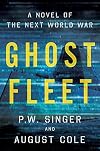
This gripping thriller about what the next world war might look like has captured the attention of Washington policymakers and defense industry insiders alike. Singer is a senior fellow at the New America Foundation, a nonprofit, nonpartisan Washington, D.C., think tank, and Cole is a former defense industry reporter for the Wall Street Journal.
Unlike so many other speculative fiction outings, this one is based on technologies already plausibly “in the works,” and the authors provide 374 show more endnotes to backstop the action and interfere with readers’ ability to sleep peacefully at night. Ghost Fleet is a novel of the post-Snowden world, in which the techniques the U.S. National Security Agency used on others are turned back against the Americans.
The story begins at the International Space Station. Russia and China have declared war against the United States, and a U.S. Air Force Colonel, on a disastrously timed space-walk, becomes the unwitting point of the spear. Oblivious to the political developments taking place on the blue globe spinning below, he finds the ISS reentry hatches sealed against him. “Goodbye, my friend. I am truly sorry. It is orders,” says his Russian cosmonaut colleague.
It’s the initial action in a war fought not solely, but significantly, in cyberspace. Takeover of the ISS enables the analogous Chinese space station, Tiangong-3, to systematically knock out every communications satellite that U.S. armed forces depend on. It soon becomes apparent that not only the satellites are down, all local-area communications networks are compromised, because military suppliers have been using low-cost Chinese-made computer chips in their planes, ships, and communications equipment by the unidentifiable thousands, and these chips are insecure, tiny moles. Only the mothballed planes and ships destined for the scrapyard are now safe: “The 707 passenger-jet derivatives did not have a modern chip anywhere, unlike the new KC-46s, which had turned out to be missile magnets like all the other Chinese-chipped gear.” This new top-to-bottom vulnerability of the military, which has become overly confident in the security of its communications systems, shows in brilliant and devastating relief.
This is a multiple point-of-view novel, with short scenes from many locations involving numerous protagonists, though most of the action takes place in the Pacific, San Francisco, and Hawaii, where “The Directorate”—comprising Chinese military, along with Russian elements under their command—has established an important outpost. At the story’s heart are the trials of the USS Zumwalt, an oddly designed, mothballed ship recalled into action after much of the modern U.S. fleet is destroyed—again at Pearl Harbor. The Zumwalt’s newly appointed captain, Jamie Simmons, is challenged militarily and by relations with his estranged father, retired chief petty officer Mike Simmons. Like the vintage tin cans—seagoing and aerial—rescued for the U.S. counterattack, retired military personnel are called back into service, and by some inevitable cosmic sense of humor or irony, Mike is assigned to the Zumwalt.
Other principal characters include: a Hawaiian woman working as a freelance assassin who is tracked by the omnipresent surveillance drones and a live Russian operative; a small team of surviving Marine insurgents harassing the Chinese forces on Oahu; a Russian who attempts to aid the Americans and ends up in a neuroscience laboratory nightmare; Sun-Tzu-spouting Admiral Wang, captain of the Chinese battleship Admiral Zheng He; and a wealthy Brit-turned-space-privateer. Other non-state players also emerge, providing a level of DIY unpredictability.
The epigrams for the several parts of the book come from Sun-Tzu’s advice to warriors, and the one for Part 3 is “All warfare is based on deception.” The levels of deception between the Chinese and Russian “allies,” between the antagonists, and arising from the inability to rely on secure communications is paranoia-inducing. Meanwhile, the roles of drones and robots escalate, which is great when they’re yours.
If you are a fan of techno-thrillers, like I am, this novel is the ultimate: fast-paced, high stakes, well-grounded, and, one may hope, consequential. International readers may be disappointed that the book is so US-centric—a casualty of “write what you know”? The book doesn’t come to a too-tidy conclusion, either, and that, is also sadly realistic. show less
Unlike so many other speculative fiction outings, this one is based on technologies already plausibly “in the works,” and the authors provide 374 show more endnotes to backstop the action and interfere with readers’ ability to sleep peacefully at night. Ghost Fleet is a novel of the post-Snowden world, in which the techniques the U.S. National Security Agency used on others are turned back against the Americans.
The story begins at the International Space Station. Russia and China have declared war against the United States, and a U.S. Air Force Colonel, on a disastrously timed space-walk, becomes the unwitting point of the spear. Oblivious to the political developments taking place on the blue globe spinning below, he finds the ISS reentry hatches sealed against him. “Goodbye, my friend. I am truly sorry. It is orders,” says his Russian cosmonaut colleague.
It’s the initial action in a war fought not solely, but significantly, in cyberspace. Takeover of the ISS enables the analogous Chinese space station, Tiangong-3, to systematically knock out every communications satellite that U.S. armed forces depend on. It soon becomes apparent that not only the satellites are down, all local-area communications networks are compromised, because military suppliers have been using low-cost Chinese-made computer chips in their planes, ships, and communications equipment by the unidentifiable thousands, and these chips are insecure, tiny moles. Only the mothballed planes and ships destined for the scrapyard are now safe: “The 707 passenger-jet derivatives did not have a modern chip anywhere, unlike the new KC-46s, which had turned out to be missile magnets like all the other Chinese-chipped gear.” This new top-to-bottom vulnerability of the military, which has become overly confident in the security of its communications systems, shows in brilliant and devastating relief.
This is a multiple point-of-view novel, with short scenes from many locations involving numerous protagonists, though most of the action takes place in the Pacific, San Francisco, and Hawaii, where “The Directorate”—comprising Chinese military, along with Russian elements under their command—has established an important outpost. At the story’s heart are the trials of the USS Zumwalt, an oddly designed, mothballed ship recalled into action after much of the modern U.S. fleet is destroyed—again at Pearl Harbor. The Zumwalt’s newly appointed captain, Jamie Simmons, is challenged militarily and by relations with his estranged father, retired chief petty officer Mike Simmons. Like the vintage tin cans—seagoing and aerial—rescued for the U.S. counterattack, retired military personnel are called back into service, and by some inevitable cosmic sense of humor or irony, Mike is assigned to the Zumwalt.
Other principal characters include: a Hawaiian woman working as a freelance assassin who is tracked by the omnipresent surveillance drones and a live Russian operative; a small team of surviving Marine insurgents harassing the Chinese forces on Oahu; a Russian who attempts to aid the Americans and ends up in a neuroscience laboratory nightmare; Sun-Tzu-spouting Admiral Wang, captain of the Chinese battleship Admiral Zheng He; and a wealthy Brit-turned-space-privateer. Other non-state players also emerge, providing a level of DIY unpredictability.
The epigrams for the several parts of the book come from Sun-Tzu’s advice to warriors, and the one for Part 3 is “All warfare is based on deception.” The levels of deception between the Chinese and Russian “allies,” between the antagonists, and arising from the inability to rely on secure communications is paranoia-inducing. Meanwhile, the roles of drones and robots escalate, which is great when they’re yours.
If you are a fan of techno-thrillers, like I am, this novel is the ultimate: fast-paced, high stakes, well-grounded, and, one may hope, consequential. International readers may be disappointed that the book is so US-centric—a casualty of “write what you know”? The book doesn’t come to a too-tidy conclusion, either, and that, is also sadly realistic. show less
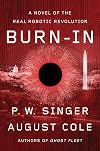
Singer, P. W., and August Cole. Burn-In: A Novel of the Real Robotic Revolution. Houghton Mifflin Harcourt, 2020.
A near-future tech thriller always requires finding a balance between action and exposition. You can imagine a scale with Tom Clancy on the action end and Kim Stanley Robinson on the exposition end. Burn-In, as you might guess from its subtitle and long list of references, leans more toward Robinson than Clancy. One snarky review on Goodreads said that if you like slow thrillers, show more this the book for you. The complaint is valid if a bit harsh. Singer and Cole do create quite a few riveting action scenes, but you can tell they are more interested in speculating about near-future advances in AI, robotics, and human-machine interactions. Their heroine, an FBI agent assigned to field-test an advanced police robot, struggles to remember not to anthropomorphize the machine. She refuses to give it a name, and frequently reminds herself never to test a machine you can’t disable in the crunch. For the most part, Singer and Cole succeed in not turning their robot into Johnny-Five or K-9. Four stars. show less
A near-future tech thriller always requires finding a balance between action and exposition. You can imagine a scale with Tom Clancy on the action end and Kim Stanley Robinson on the exposition end. Burn-In, as you might guess from its subtitle and long list of references, leans more toward Robinson than Clancy. One snarky review on Goodreads said that if you like slow thrillers, show more this the book for you. The complaint is valid if a bit harsh. Singer and Cole do create quite a few riveting action scenes, but you can tell they are more interested in speculating about near-future advances in AI, robotics, and human-machine interactions. Their heroine, an FBI agent assigned to field-test an advanced police robot, struggles to remember not to anthropomorphize the machine. She refuses to give it a name, and frequently reminds herself never to test a machine you can’t disable in the crunch. For the most part, Singer and Cole succeed in not turning their robot into Johnny-Five or K-9. Four stars. show less
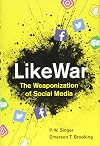
"There is a war... for your Mind!"
That's the slogan of InfoWars, the incendiary conspiracy news network and nutritional supplement marketing firm. And while Alex Jones is wrong about almost everything, he's right about that. In LikeWar Singer and Brooking ably synthesize a sophisticated picture of information warfare in 2018, drawing from sources as diverse as Taylor Swift, Donald Trump, and ISIS, to argue that the internet has lead to a blurring of lines between consumer, citizen, show more journalist, activist, and warrior which threatens the foundations of liberal democracy. The tech companies which built these platforms and profited from them must grapple with the politics of their technologies, before we all reap the whirlwind.
Computer networks and smart phones connect billions of people, allowing ideas to flow faster than ever before in history. Sometimes, the results can be impressive. The Chiapas Zapatista movement in 1994 was a dial-up and fax version of a network insurgency that managed to bring enough international opprobrium on Mexico that the government blinked, and reached some kind of political accord (Chiapas is complicated). More recently, Eliot Higgins and a team of open source analysts at Bellingcat managed to track down the exact BUK missile system and Russian soldiers responsible for shooting down MH 17 in 2014.
But there are a lot of dark sides. When people connect, the emotion that spreads most rapidly is anger. Lies spread five times faster than truth. Musicians can use social networks to directly connect with their fans, and ISIS uses it to connect with alienated Muslim youths worldwide. Social networks sort diverse citizens into filter bubbles of people who think alike. Eliot Higgin's careful open source intelligence has a paranoid fun-house mirror version in the QAnon conspiracy, where Qultist decoders find hidden messages from an alleged 'senior white house source'.
And then there is the matter of information war, an area that even now, after years of offensive cyber operations, liberal democracies still don't understand. Hostile propaganda slips into Western news networks and major platforms like Twitter, Facebook, and Instagram are infested with bots. LikeWar can even take a personal toll. Over the course of writing this book, General Michael Flynn went from forward looking full-spectrum commander to head Trumpist conspiracy cheerleader to indicted and plead out felon. Flynn's fall is complex, but it can't be separated from the internet. If the trolls got him, what chance does your idiot cousin stand? The counters, 'citizen truth teams' and senior emissaries to groups vulnerable to recruitment, seem like thin reeds against the coming maelstrom of noise.
LikeWar starts with Clausewitz's dictum that war is a continuation of politics by other means, and there are clear links between cyberspace and physical space. Intensity of hashtags impacted the subsequent intensity of Israeli airstrikes during attacks on the Gaza strip. ISIS used propaganda to create an aura of invincibility that outflanked the defenders of Mosul, while Russia denied that its 'little green men' were even in Ukraine. But the difference is that cyberspace is constructed space rather than natural space. The networks are built, maintained, and owned by real corporations and real people. The internet grew from an anarchic specialized scientific network to a major engine of commerce and communicate with little deliberate government oversight. Section 230 absolved American companies of responsibility for policing content, with major carve outs for copyrighted IP and pornography. Yet as concerns over cyberbullying and counter-terrorism rose, major networks adopted digital constitutions that were permissive towards speech and censorious towards erotica. Policing content is and was possible, but always took a back seat to growth and engagement, the guide stars of Silicon Valley.
The future is if anything, darker. Advances in machine learning and AI allow ever more realistic bots, computer generated DeepFakes where a politician can be programmed to say anything, and personalized targeting of people with exactly the propaganda they'll believe. There are defensive counters, but if I might draw military analogies, what we saw in 2016 was armored warfare circa 1918: clearly the future, but not yet a mature system. Given the pace of technology, we only have a few years before digital blitzkrieg.
I'm extremely online, and I've been following this space for years. I've presented at multiple conferences on this topic, including Governance of Emerging Technologies and Association of Internet Researchers. LikeWar is the book I wish I'd written. Cognizant, forward looking, and deeply researched, it is vital reading for anyone interested in technology or politics.
My only reservation is that I wish the sources were better linked in the text, instead of being buried in static endnotes. Maybe the next edition will push an update. show less
That's the slogan of InfoWars, the incendiary conspiracy news network and nutritional supplement marketing firm. And while Alex Jones is wrong about almost everything, he's right about that. In LikeWar Singer and Brooking ably synthesize a sophisticated picture of information warfare in 2018, drawing from sources as diverse as Taylor Swift, Donald Trump, and ISIS, to argue that the internet has lead to a blurring of lines between consumer, citizen, show more journalist, activist, and warrior which threatens the foundations of liberal democracy. The tech companies which built these platforms and profited from them must grapple with the politics of their technologies, before we all reap the whirlwind.
Computer networks and smart phones connect billions of people, allowing ideas to flow faster than ever before in history. Sometimes, the results can be impressive. The Chiapas Zapatista movement in 1994 was a dial-up and fax version of a network insurgency that managed to bring enough international opprobrium on Mexico that the government blinked, and reached some kind of political accord (Chiapas is complicated). More recently, Eliot Higgins and a team of open source analysts at Bellingcat managed to track down the exact BUK missile system and Russian soldiers responsible for shooting down MH 17 in 2014.
But there are a lot of dark sides. When people connect, the emotion that spreads most rapidly is anger. Lies spread five times faster than truth. Musicians can use social networks to directly connect with their fans, and ISIS uses it to connect with alienated Muslim youths worldwide. Social networks sort diverse citizens into filter bubbles of people who think alike. Eliot Higgin's careful open source intelligence has a paranoid fun-house mirror version in the QAnon conspiracy, where Qultist decoders find hidden messages from an alleged 'senior white house source'.
And then there is the matter of information war, an area that even now, after years of offensive cyber operations, liberal democracies still don't understand. Hostile propaganda slips into Western news networks and major platforms like Twitter, Facebook, and Instagram are infested with bots. LikeWar can even take a personal toll. Over the course of writing this book, General Michael Flynn went from forward looking full-spectrum commander to head Trumpist conspiracy cheerleader to indicted and plead out felon. Flynn's fall is complex, but it can't be separated from the internet. If the trolls got him, what chance does your idiot cousin stand? The counters, 'citizen truth teams' and senior emissaries to groups vulnerable to recruitment, seem like thin reeds against the coming maelstrom of noise.
LikeWar starts with Clausewitz's dictum that war is a continuation of politics by other means, and there are clear links between cyberspace and physical space. Intensity of hashtags impacted the subsequent intensity of Israeli airstrikes during attacks on the Gaza strip. ISIS used propaganda to create an aura of invincibility that outflanked the defenders of Mosul, while Russia denied that its 'little green men' were even in Ukraine. But the difference is that cyberspace is constructed space rather than natural space. The networks are built, maintained, and owned by real corporations and real people. The internet grew from an anarchic specialized scientific network to a major engine of commerce and communicate with little deliberate government oversight. Section 230 absolved American companies of responsibility for policing content, with major carve outs for copyrighted IP and pornography. Yet as concerns over cyberbullying and counter-terrorism rose, major networks adopted digital constitutions that were permissive towards speech and censorious towards erotica. Policing content is and was possible, but always took a back seat to growth and engagement, the guide stars of Silicon Valley.
The future is if anything, darker. Advances in machine learning and AI allow ever more realistic bots, computer generated DeepFakes where a politician can be programmed to say anything, and personalized targeting of people with exactly the propaganda they'll believe. There are defensive counters, but if I might draw military analogies, what we saw in 2016 was armored warfare circa 1918: clearly the future, but not yet a mature system. Given the pace of technology, we only have a few years before digital blitzkrieg.
I'm extremely online, and I've been following this space for years. I've presented at multiple conferences on this topic, including Governance of Emerging Technologies and Association of Internet Researchers. LikeWar is the book I wish I'd written. Cognizant, forward looking, and deeply researched, it is vital reading for anyone interested in technology or politics.
My only reservation is that I wish the sources were better linked in the text, instead of being buried in static endnotes. Maybe the next edition will push an update. show less
I was a bit late in getting to it, but I was pleasantly surprised by P.W. Singer and August Cole's Ghost Fleet. It took a bit of effort to get into it, but the temporal leap the novel takes into years after a second Pearl Harbor attack allows for some very interesting worldbuilding. The United States has been taken down a peg and enjoys little to none of its previous dominance. What does the post-hegemonic era look like for America? How, in the fabled era of "degraded ISR," can American show more armed forces operate and conduct operations? While we're living through that transition now, Singer and Cole explore what that future might actually resemble.
Riddled throughout with trenchant criticisms of the current political-military-industrial complex (such as a "Big Two" defense contractors, numerous references to the failings of the F-35, and the Air Force's institutional resistance to unmanned air-to-air platforms), the vision fleshed out in Ghost Fleet is not a flattering one to our current state of affairs. At times the references are a bit on the nose, but the degree of underlying wit makes up for it.
If nothing else, the opening sequence helps explain even to the layman the importance of sensor platforms and space-based assets, the US military's dependence on them, and their exquisite vulnerability. Finite quantities of ship-launched missiles and other material become apparent in a way that can be challenging to discern in real-life operations. Our reliance on Chinese-produced microchips and other advanced technology becomes a easily-exploitable Achilles' Heel, in a manner all too reminiscent of the Battlestar Galactica pilot miniseries.
A new techno-thriller is, of course, cause for comparison to Tom Clancy, and where this far outshines him is in its willingness to critique technology and current trends in military procurement rather than lauding it unreservedly, while crafting somewhat multi-dimensional characters (some of whom are even not white!). And as I've written before, even if wrong in the details, fiction like this helps broaden the aperture a bit and convey the potentialities of future conflict. If not China, then Russia; if not the F-35, then perhaps the long-range strike bomber: things will go wrong, technologies will fail, and the United States may well be caught unawares. Hopefully, with novels such as Ghost Fleet illustrating the cost of unpreparedness, it will be possible to forestall the future it envisions. show less
Riddled throughout with trenchant criticisms of the current political-military-industrial complex (such as a "Big Two" defense contractors, numerous references to the failings of the F-35, and the Air Force's institutional resistance to unmanned air-to-air platforms), the vision fleshed out in Ghost Fleet is not a flattering one to our current state of affairs. At times the references are a bit on the nose, but the degree of underlying wit makes up for it.
If nothing else, the opening sequence helps explain even to the layman the importance of sensor platforms and space-based assets, the US military's dependence on them, and their exquisite vulnerability. Finite quantities of ship-launched missiles and other material become apparent in a way that can be challenging to discern in real-life operations. Our reliance on Chinese-produced microchips and other advanced technology becomes a easily-exploitable Achilles' Heel, in a manner all too reminiscent of the Battlestar Galactica pilot miniseries.
A new techno-thriller is, of course, cause for comparison to Tom Clancy, and where this far outshines him is in its willingness to critique technology and current trends in military procurement rather than lauding it unreservedly, while crafting somewhat multi-dimensional characters (some of whom are even not white!). And as I've written before, even if wrong in the details, fiction like this helps broaden the aperture a bit and convey the potentialities of future conflict. If not China, then Russia; if not the F-35, then perhaps the long-range strike bomber: things will go wrong, technologies will fail, and the United States may well be caught unawares. Hopefully, with novels such as Ghost Fleet illustrating the cost of unpreparedness, it will be possible to forestall the future it envisions. show less
Lists
Awards


You May Also Like


Associated Authors
Statistics
- Works
- 10
- Also by
- 1
- Members
- 2,407
- Popularity
- #10,656
- Rating
- 3.5
- Reviews
- 57
- ISBNs
- 78
- Languages
- 10
- Favorited
- 1